Did you catch this man?” asked the colonel, frowning. Father Brown looked him full in the face, “Yes,” he said, “I caught him, with an unseeing hook and an invisible line which is long enough to let him wander to the ends of the world, and still to bring him back with a twitch upon the thread.” This dialogue is in one of Father Brown’s stories, in the first collection published by Chesterton in 1911, more than a decade before his conversion to the Catholic Church in 1922. Father Brown is an imaginary priest-detective and he was inspired to Chesterton by the figure of a simple country priest, Fr. John O’ Connor, who, later on, received the writer into the Church. Father Brown’s sentence already prophetically describes the author’s journey of conversion.
“The moment men cease to pull against the Catholic Church, they feel a tug towards it. The moment they cease to shut it down, they begin to listen to it in pleasure. The moment they try to be fair to it, they begin to be fond of it. But, when the affection has passed a certain point, it begins to take on the tragic and menacing grandeur of a great love affair.” Here, in barely a paragraph, Chesterton has presented his life’s journey in a nutshell: the initial pull against the Church, the subsequent tug he felt towards it, his desire to be fair leading to a fondness and thence, in time, to a great love affair with it.
Joseph Pearce, the writer of Chesterton’s last biography and himself converted to Catholicism by Chesterton’s influence, writes: “Certainly, there were other love affairs in his life, most notably and obviously, with his wife, Frances, but also with his brother, Cecil, and his great friends Belloc and Shaw. Yet these were only subplots, subsisting with the great love affair with Christ.
Chesterton put the matter poetically: “If seeds in the black earth can turn into such beautiful roses, what might not the heart of man become in its long journey towards the stars?”
Few years later, Chesterton published the book by the title “The Catholic Church and Conversion” (1926). With his usual ironic and brilliant originality, the great English writer gives an account of the anxiety of his soul constantly uncertain during the three phases preceding his entering the Church of Rome: the assumption of an honest attitude towards it, then the progressive and irresistible discovery and lastly the impossibility of abandoning it once he entered it.
At the end of his pilgrimage, Chesterton reaches the same conclusions as Pope Benedict XVI, discovering that the foundation of the authentic universality of the Catholic Church consists in its rationality and freedom. When Chesterton speaks of religion, he starts always from reason and the experience of life. His discourse is never churchly or clerical. He can start from a sunset or a lion’s tooth, or anything and his point of arrival is each one’s relationship with the mystery of God. That was what happened to him: The mystery revealed itself to him through the humble but powerful signs of family happiness, the taste for beauty seen in everyday reality.
THE KING OF FLEET STREET
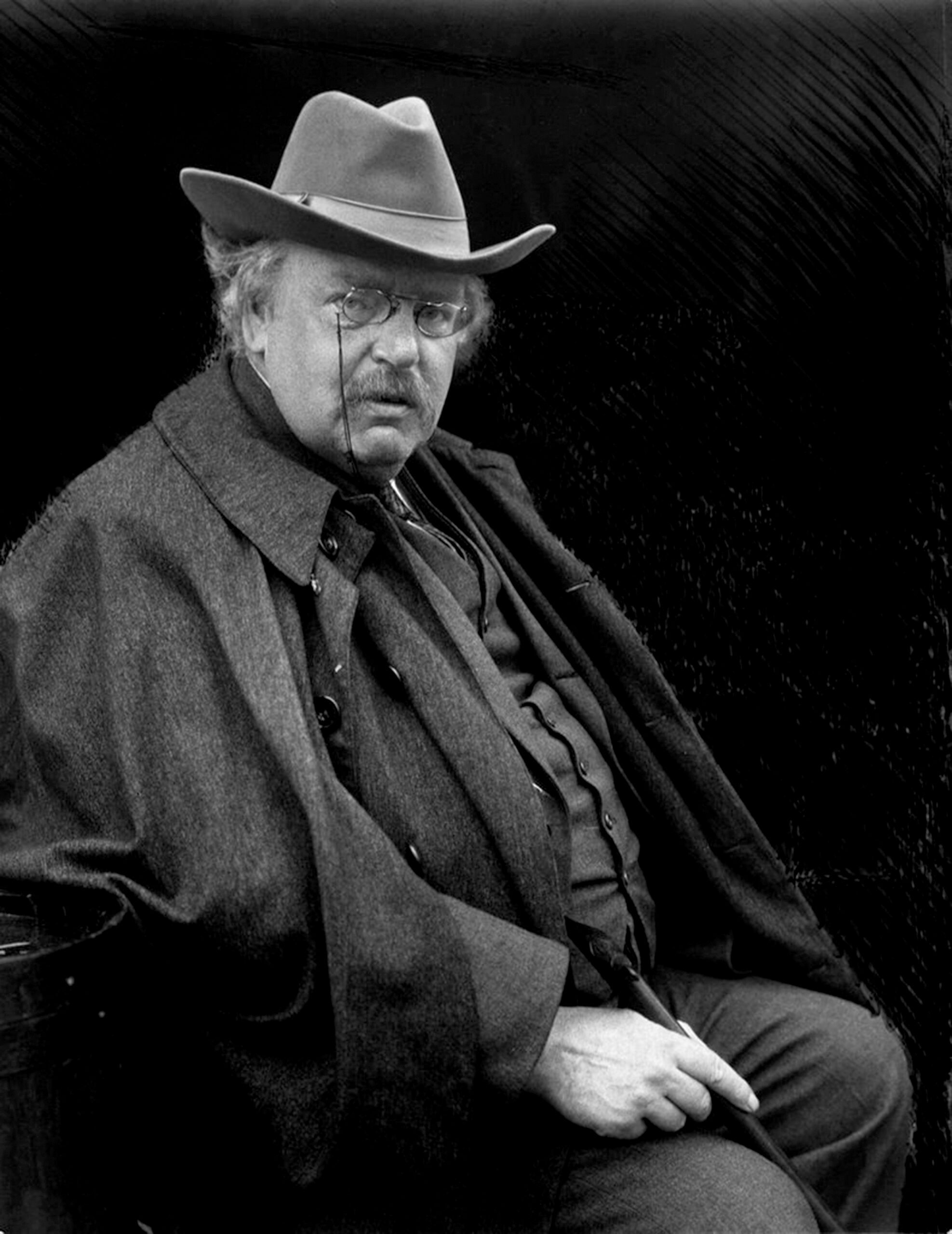
Gilbert Keith Chesterton was born at Campden Hill in Kensington, London, on May 29, 1874. He was educated at St. Paul’s School and attended the Slade School of Art in order to become an illustrator and also took literature classes at University College London (UCL) but did not complete a degree at either. In 1896, Chesterton began working for a London publisher. During this period, he also undertook his first journalistic work as a freelance art and literary critic. In 1901, he married Frances Blogg, to whom he remained married for the rest of his life.
In 1902, he was given a weekly opinion column in the Daily News, followed in 1905 by a weekly column in The Illustrated London News, for which he would continue to write for the next thirty years. Chesterton took Fleet Street by storm, writing a huge number of essays, biographies, poems, novels, plays and debating with all the great names of the day. He became and remained a public figure known as G.K.C. Chesterton already exhibited something of the personality that later on would become famous – absent minded, good-natured but tenacious in maintaining his ideas, and deeply concerned with grave problems in many human areas. In appearance, he was then, as after, a tall, clumsy, untidy scarecrow.
Chesterton was a large man, standing 6 feet 4 inches (1.93 m) and weighing around 21 stone (130 kg; 290 lb). His girth gave rise to a famous anecdote. During World War I, a lady in London asked why he wasn’t “out at the front.” He replied, “If you go round to the side, you will see that I am.” Chesterton usually wore a cape and a crumpled hat, with a swordstick in hand, and had a cigar hanging out of his mouth. Chesterton often forgot where he was supposed to be going and would miss the train that was supposed to take him there. At heart, he was someone who loved the friendship of children, idolized his wife and was sustained by his great friendships with Hilaire Belloc, Bernard Shaw and H. G. Wells.
Throughout Chesterton’s writings, there prevailed a sense of youthfulness and high-spirited foolery that caused his detractors to call him childish, but behind which his defenders found a seriousness and keen insight. Chesterton has been called the “prince of paradox.” For example, he wrote: “Thieves respect property. They merely wish the property to become their property that they may more perfectly respect it.” Chesterton is well known for his reasoned apologetics and even some of those who disagree with him have recognized the universal appeal of such works as “Orthodoxy” and “The Everlasting Man.”
As a political thinker, he rejects both liberalism and conservatism, saying, “The whole modern world has divided itself into Conservatives and Progressives. The business of Progressives is to go on making mistakes. The business of the Conservatives is to prevent the mistakes from being corrected.” Chesterton routinely referred to himself as an “orthodox” Christian, and came to identify such a position with Catholicism more and more, eventually converting to Roman Catholicism from Anglicanism. George Bernard Shaw, Chesterton’s “friendly enemy,” said of him: “He was a man of colossal genius.”
His writings consistently displayed wit and a sense of humor. He employed paradox, while making serious comments on the world, government, politics, economics, philosophy, theology and many other topics. When The Times invited several eminent authors to write essays on the theme “What’s Wrong with the World?” Chesterton’s contribution took the form of a letter: Dear Sirs, I am. Sincerely yours, G. K. Chesterton. Chesterton here combined wit with a serious point – that of fallen human nature and humility.
He wrote: “Reason is itself a matter of faith. It is an act of faith to assert that our thoughts have any relation to reality at all.” Again, about his approach to Nature, “The only words that ever satisfied me as describing Nature are the terms used in the fairy books, ‘charm,’ ‘spell,’ ‘enchantment.’ They express the arbitrariness of the fact and its mystery. A tree grows fruit because it is a magic tree. Water runs downhill because it is bewitched. The sun shines because it is bewitched. I deny altogether that this is fantastic or even mystical. We may have some mysticism later on; but this fairy-tale language about things is simply rational and agnostic.”
“A DEFENSE OF NONSENSE”
Chesterton entered his final period when he was received into the Catholic Church. His conversion at 48 had been gradual, carefully reasoned, and deeply felt. His works became more serious and committed especially to explain and defend his Christian and Catholic faith. Chesterton was neither conventional nor reactionary. He was a rebel towards the prevailing ideologies of the time. His very reliance on tradition was original and creative. Almost alone in the midst of the pessimists, agnostics, materialists of the beginning of the 20th century, Chesterton “came home”: he rediscovered England, Rome and the West.
The essence of Chesterton and his thought is balance, a balance seen in his dynamic synthesis of reason and faith, the real and the ideal, the prose and the poetry of life. Because he related the ephemeral to the eternal, issues to principles, few of his writing will date. Not a few authors, among them C. S. Lewis and Ronald Knox, have acknowledged their intellectual and spiritual debt to this man whom Etienne Gilson called “one of the deepest thinkers who ever existed.” “Orthodoxy” (1908) was an attempt to state “his ultimate attitude towards life,” posing Christianity as the answer to universal questioning. Some of his most profound works like “St. Francis of Assisi” (1923) and “The Everlasting Man” (1925) did much to convince many of his audience that Christianity is alive and important.
During the last 11 years of his life, Chesterton’s amazing literary productivity continued, he travelled to the Unites States and Canada, and also did a series of broadcasts for the B.B.C. Chesterton died on June 14, 1936, at his home in Beaconsfield, Buckinghamshire. The homily at Chesterton’s Requiem Mass in Westminster Cathedral, London, was delivered by Fr. Ronald Knox. He is buried in the Catholic cemetery in Beaconsfield. At the time of his death, Pius XI bestowed on him the title, “Defender of the Catholic Faith.”
Chesterton wrote around 80 books, several hundred poems, some 200 short stories, 4,000 essays, and several plays. He was a literary and social critic, historian, playwright, novelist, Catholic theologian and apologist, debater, and mystery writer. His best-known character is the priest-detective Father Brown, who appeared only in short stories, while “The Man Who Was Thursday” is arguably his best-known novel. He was extraordinarily able and versatile and is estimated now as highly as during his lifetime. Much of Chesterton’s work remains in print. Ignatius Press is currently in the process of publishing his “Complete Works.”
His essays developed his shrewd, paradoxical irreverence to its ultimate point of real seriousness. He is seen at his happiest in such essays as “A Defense of Nonsense” (1901), in which he says that nonsense and faith are the “two supreme assertions of truth” and “to draw out the soul of things with a syllogism is as impossible as to draw out Leviathan with a hook.” Many readers value Chesterton’s fiction most highly. But the most successful association of fiction with religious and social judgment is in Chesterton’s series on the priest-sleuth Father Brown.
THE ROAD TO HOLINESS
G. K. Chesterton is well known for his clever and humorous writing, and his thought-provoking paradoxes. But he might also be known as a saint, if the proposal to launch his cause of beatification goes forward. It is the initiative of the cultural association dedicated to him, the Chesterton Society, founded in England in 1974 on the occasion of the 100th anniversary of the great author’s birth, with the idea of spreading awareness of the work, thought and figure of this extraordinary personality. For years, there had been talk of a possible cause of beatification and in 2009, during an international conference organized in Oxford on “The Holiness of G. K. Chesterton,” it was decided to go ahead with this proposal.
Many people feel that there is clear evidence of Chesterton’s sanctity. Testimonies about him speak of a person of great goodness and humility, a man without enemies, who proposed the faith without compromises but also without confrontation, a defender of Truth and Charity. His greatness is also in the fact that he knew how to present Christianity to a wide public. According to the ancient categories of the Church, we could define Chesterton as a “confessor of the faith.” He was not just an apologist, but also a type of prophet who glimpsed far ahead of time the dramatic character of modern issues. The English Dominican Aidan Nichols sustains that Chesterton should be seen as nothing less than a possible “Father of the Church” of the 20th century.
One rarely reads pages that speak of faith, conversion and doctrine that are so clear and incisive, while being free of every sentimental or moralistic excess. This comes from Chesterton’s attentive reading of reality, given the fact that the modern world has suffered a mental fall possibly greater than the moral one. Faced with this reality, Chesterton chose Catholicism, and affirms that there are at least 10,000 reasons to justify this choice, everyone of them valid and well-founded, but able to be boiled down to one reason: that Catholicism is true. The holiness of Gilbert Keith Chesterton that the Church will certainly recognize, already shines before the world.