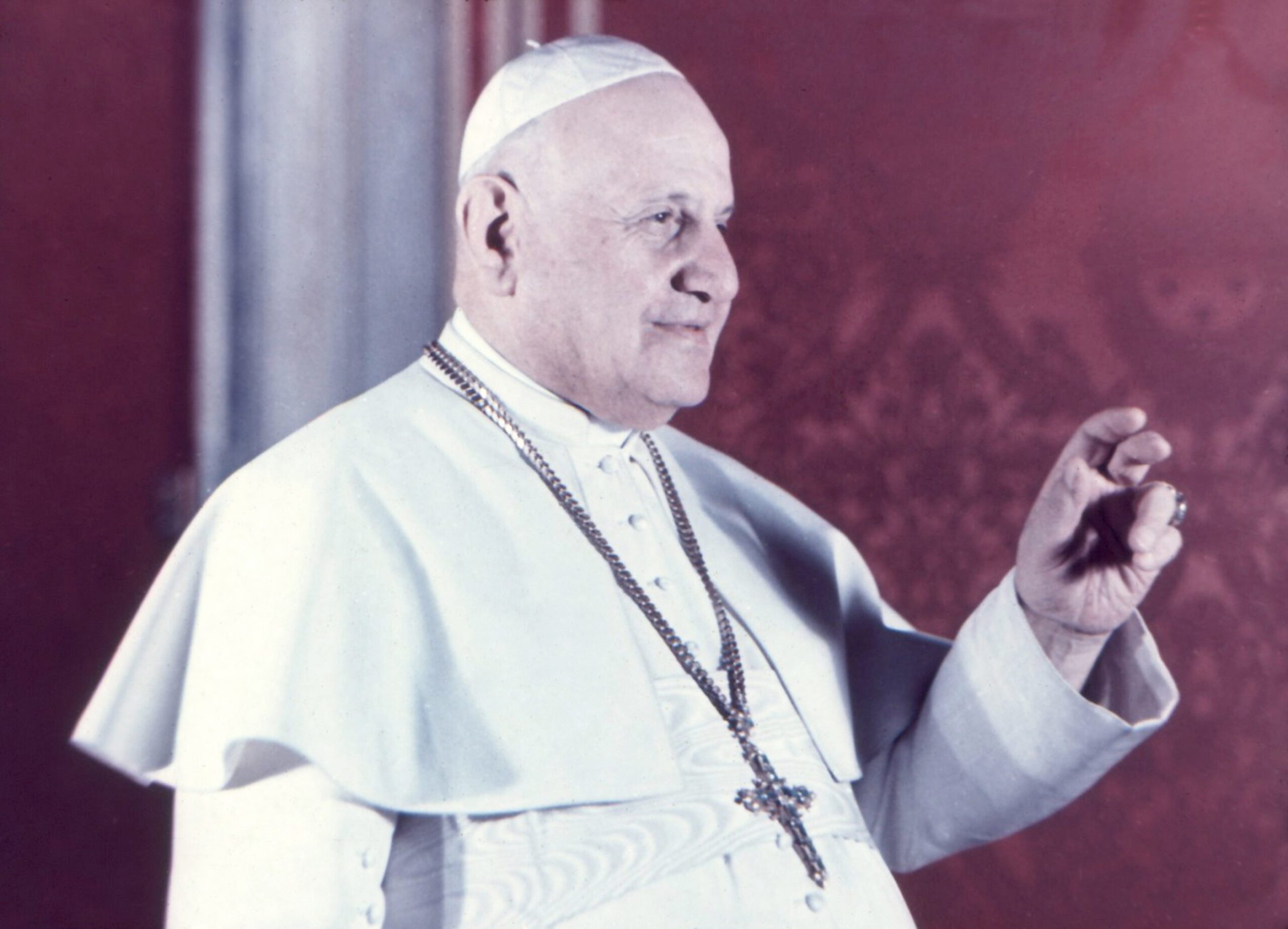
Over the years of his short pontificate (1958-1963) Pope John XXIII became a beloved figure worldwide. He was popularly known as “Good Pope John.” He is remembered for the convocation of the Second Vatican Council (1962-1965) with its aggiornamento agenda for the renewal of the Church. Beginning his pontificate at age seventy-seven, Angelo Roncalli brought a whole new pastoral and personal style to the papacy. Blessed John XXIII was beatified on September 3, 2000 during the Jubilee Year.
Many laudatory things can be noted about the life and ministry of John XXIII; this short piece seeks to bring out how joy and joviality, humor and happiness were characteristic of his personality. Books about this 261st pope have such titles as Wit and Wisdom of Good Pope John (Fesquet), A Joyful Soul: Pope John XXIII (Vereb), and Meet John XXIII: Joyful Pope and Father to All (Treece). Some vignettes from these books reveal the heart and person of John XXIII.
GLIMPSES OF LIFE. The sedia gestatoria (the mobile papal chair used in processions) was distasteful to John XXIII; he said that it was uncomfortable and made him dizzy (he compared it to a rocking-horse). One day, he overheard some Italian women speaking of his appearance and that he was old, obese, and homely. Pope John turned and benignly observed: “You must remember that being pope is not exactly a beauty contest.”
A diplomat newly-accredited to the Holy See was received by the Pope. He asked the Pontiff how many persons worked at the Vatican. “Oh, no more than half of them!” replied John XXIII, winking an eye.
Shortly before receiving President and Mrs. Kennedy, Pope John inquired as to the proper mode of addressing the wife of the President of the United States. The monsignor in charge of protocol told him that he could choose either Madame President or simply Madame. When John XXIII entered the audience hall, he spontaneously opened his arms, smiled broadly and exclaimed: “Ah, Jacqueline!”
As Apostolic Nuncio in France, a guest at a dinner banquet once asked Monsignor Roncalli: “Are you embarrassed when there are women present who wear low-necked dresses?” He replied: “When there’s a woman with a plunging neckline, the guests don’t look at her. They look at the Apostolic Nuncio to see how he’s taking it.”
To Doctor Gasparrini, the papal physician, John XXIII said that he should not worry or be disturbed because “when the moment to depart arrives, I won’t lose any time.”
GENUINE SPIRITUALITY. Indeed, the world loved Pope John XXIII and his cheerful, affectionate nature. He was an optimist and communicated this spirit to the Church –particularly through the Second Vatican Council. In his diary, he noted: “I have never met a pessimist who accomplished any good.” He retained his good humor in spite of many very difficult assignments (Bulgaria, Turkey, and Greece); he did not complain but chose to seize the moment and emphasize the potential good to be accomplished.
J
ohn XXIII’s outlook is, in fact, a spirituality that he communicated to the world. He took the call to holiness seriously throughout his entire life. He always wanted to be a saint –and he finally achieved that goal. He had absolute confidence in the ways of God. This profound trust was manifested in his simplicity, patience, gentleness and affability, qualities manifested in his encyclicals, family letters, his spiritual journal, and his homilies.
“We must bear all cheerfully,” Pope John XXIII asserted. “Our life, especially that part of it that we spend in the company of others, must not be sad and gloomy; we must not let our own boredom, restlessness, and melancholy depress those who are near to us and depend on us. In this life, we have to lift ourselves ever higher. There are various kinds of poetry, but the supreme poetry of this life is found in a joyful soul” (Vereb, 33).
John XXIII could be very forceful in asserting his conviction that the Christian faith should result in deep, joyful hope. In his opening speech to the Second Vatican Council, he said: “We feel we must disagree with those prophets of gloom who are always forecasting disaster, as though the end of the world were at hand.” He believed that Divine Providence was renewing humanity and through a perceptive reading of the “signs of the times,” one could discern that, by God’s designs, a new order of human relations was emerging in the contemporary world.
John XXIII, a man with a great heart, rejoiced in the opening of Vatican II on October 11, 1962. That same evening, he addressed the crowds gathered in the moonlit Saint Peter’s Square. He requested their prayers for the Council. Then, with fatherly affection he told all the parents to return to their homes and to give their children a big hug; he added: “Tell them that it is an affectionate embrace from the Pope!” (Fesquet, 139). John XXIII’s optimism and joy were infectious – and in the power of the Spirit, they certainly helped renew the Church, seeking to transform us into a truly joyful, missionary community of Jesus’ disciples.