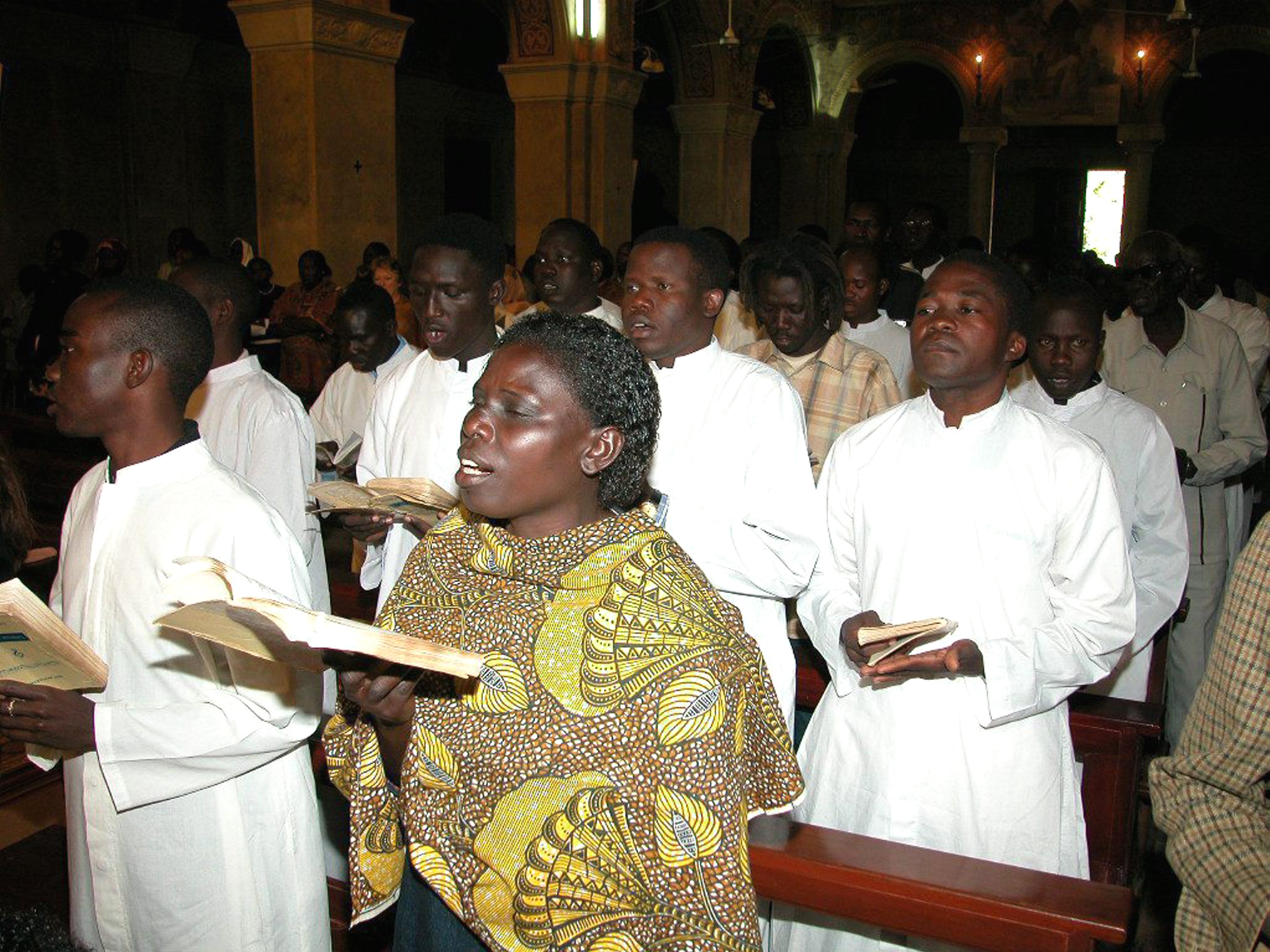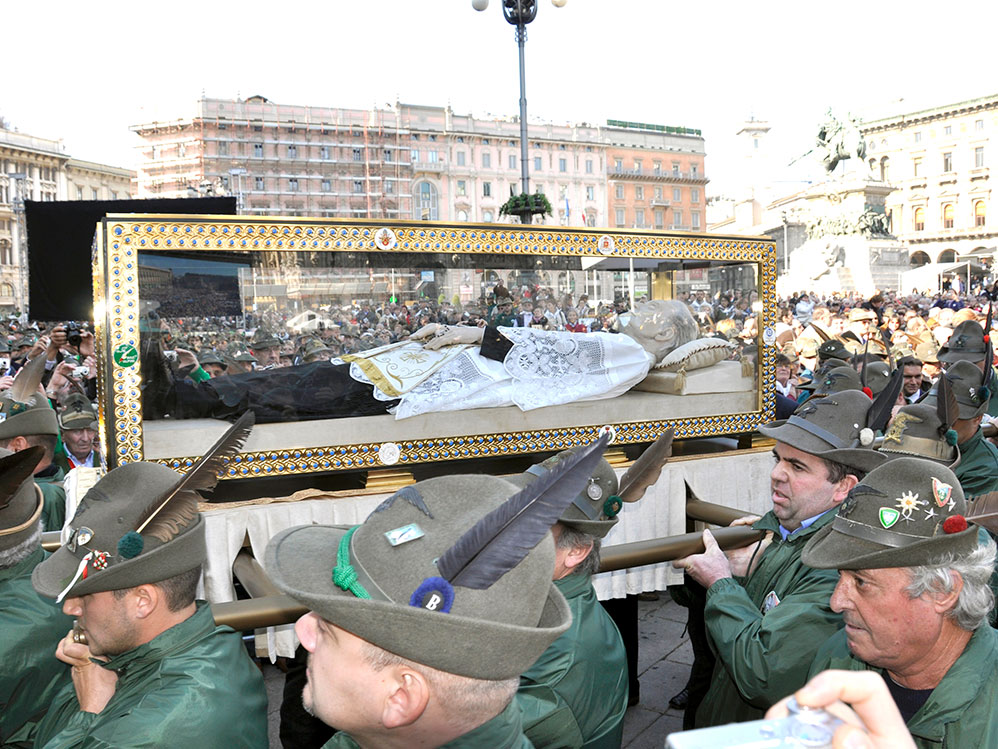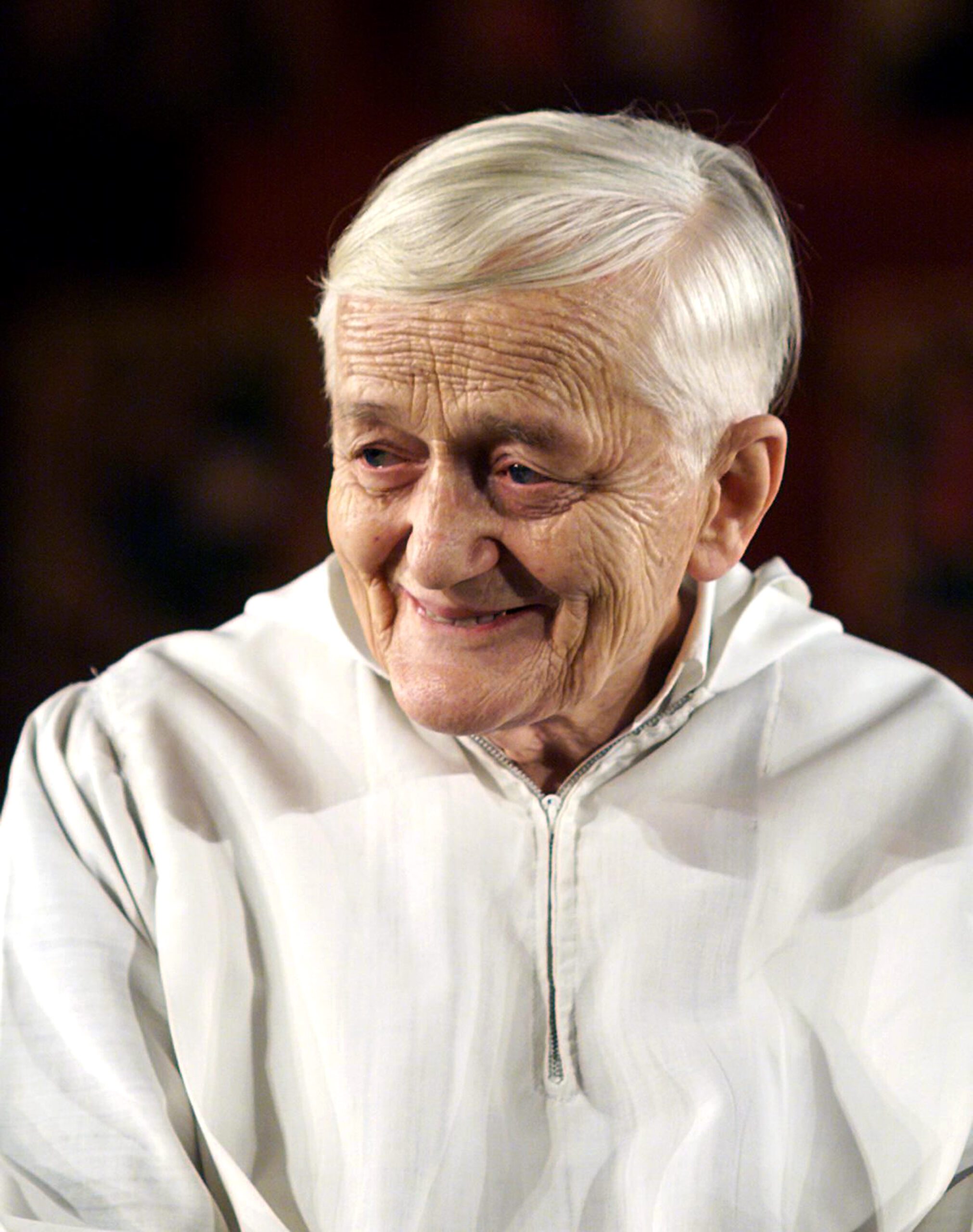

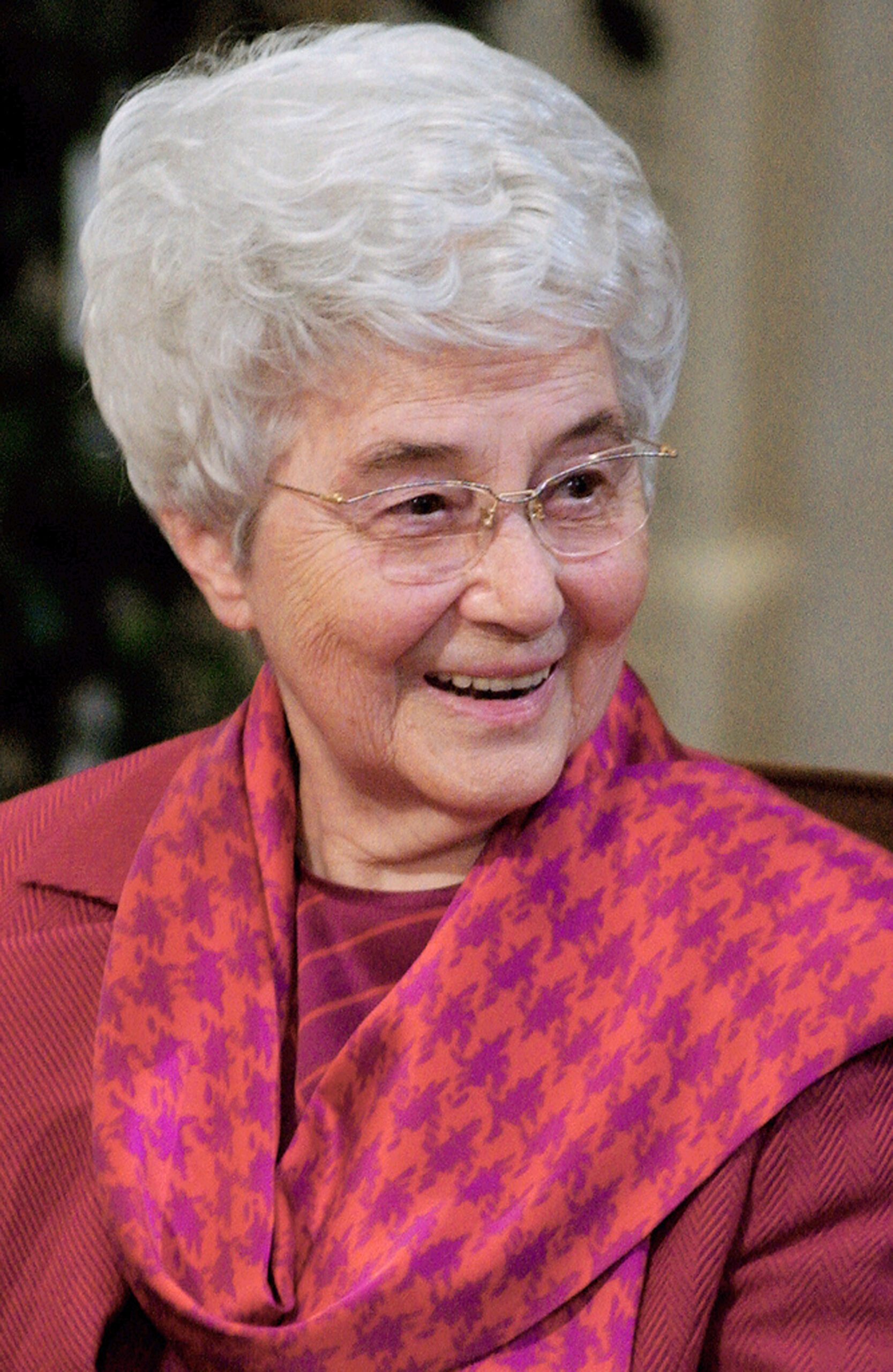
A “song to the love of God” − that is how Cardinal Tarcisio Bertone, the Pope’s secretary of state, defined the life of Chiara Lubich, the foundress of the Focolare Movement, at her funeral, on March 19, 2008, in Rome, at the Basilica of St. Paul’s Outside the Walls. Chiara had died on March 15, in her home near Rome, at age 88. Thousands of people participated in the Mass, including many Christians of other confessions, and people of other creeds or no faith at all. Many more people throughout the world followed the ceremony as it was broadcast live by many television networks.
There were three carnations on Chiara’s coffin, alluding to the day she decided to consecrate herself to God in the chapel of the Capuchin College of Trent, her hometown. That day was Dec. 7, 1943, and Chiara bought three carnations on her way to class, to leave them at the foot of the crucifix.
Cardinal Bertone, concluding his homily, gave thanks to the Lord for her testimony, “for her prophetic intentions that have preceded and prepared the great changes and the extraordinary events that the Church lived in the 20th century. The foundress of the Focolare Movement, with her silent and humble style, didn’t give origin to charitable works of human promotion but gave herself totally to the task of enkindling the fire of God’s love in the hearts of people.”
Pope Benedict XVI wrote in the telegram of participation: “There are many reasons to give thanks to the Lord for the gift He has given to the Church in this woman of intrepid faith, a meek messenger of hope and peace, the initiator of a great spiritual family that extends across multiple fields of evangelization.”
Only Mother Teresa of Calcutta could match Chiara’s influence as a woman in the Church. Both addressed synods of the world’s bishops, and both caught the imagination of the world even outside the Catholic Church, but while the Albanian nun founded traditional male and female religious orders, carrying out charitable works, Chiara leaves behind what was, in its time, one of the pioneering lay movements in the Church, and an organization that joins a deep spirituality to the commitment to social justice and ecumenism.
WHILE THE BOMBS WERE FALLING
In the final years of World War II, Trent, a town in Northern Italy, still under German occupation, endured heavy allied bombing. With death staring them in the face, Chiara and some other young women, her companions, felt the urgency of penetrating to the heart of the Christian message by closely studying the gospels.
By candlelight in a makeshift air raid shelter, they discovered the biblical phrase that was to be their inspiration for the next 60 years: “That all may be one” (John 17:21). Unity, achieved through mutual love, became the watchword of the group from that day on. Not surprisingly, the practice of reading the New Testament drew accusations of Protestantism and the predilection for the word “unity” aroused suspicions of communism.
When the cold wind blows and snow is on the ground, the mountain people take refuge in the warmth of a log fire that burns lively in the hearth: “Focolare” is the Italian word for hearth and this is the name that Chiara gave to their group that used to gather to read the Gospel and find strength and consolation in it. And “Focolare” remained the name of the whole movement.
UNITY OF ALL MANKIND
But already Chiara had set her sights on far more ambitious goals. For her, “that all may be one” could mean nothing less than the unity of all mankind. It was her vision and single-mindedness that propelled the astonishing growth of the nascent community. By the end of the 1940s, Focolare had spread throughout Italy; in the next decade it fanned out across Europe and, by the end of the 1960s, it had reached every continent.
But Chiara never saw her movement as of a purely religious nature. As early as 1948, when she moved the Focolare headquarters to Rome, she visited the Italian parliament where she met Igino Giordani, a founding member of the Christian Democratic Party. Giordani, who had a lifelong fascination with St. Catherine of Siena, saw in this young provincial woman a 20th-century Catherine, whose ideas would influence not only the Church but also the political and social fields. Then in his fifties, the veteran politician became Chiara’s most devoted follower and was regarded by her as a co-founder of the movement.
The Italian Prime Minister Alcide De Gasperi, he himself from Trent and one of the founding fathers of the European Union, was also impressed, and became a disciple. Much later, this aspect of Chiara’s activities resulted in a new school of economics − the Economy of Communion, which applied the movement’s practice of sharing material goods to business enterprises − and the International Political Movement for Unity, which encouraged cross-party collaboration and drew such political luminaries as Romano Prodi, the last Italian Prime Minister, who collaborated with Lubich on a number of projects.
A LIFE PROFILE
Chiara was born Silvia Lubich, the second of four children, in Trent, Northern Italy, in 1920. Her mother was a devout Catholic; her father, a Socialist who lost his job in the Mussolini era. She had to postpone university plans to keep the family afloat. In 1939, when she was nineteen, she visited Loreto to take part in a Catholic students’ rally. It was there, within the walls of the Holy House darkened with age, in silence and unexpectedly, as so often happens with the things of God, that Chiara encountered her charism for the first time.
Although she did not fully understand yet the complete meaning of this calling, she nevertheless experienced a deep certainty and joy. She became a lay member of the Franciscan order, taking the name Chiara − Italian for Clare − in imitation of the close collaborator of St. Francis of Assisi.
TWENTY YEARS AHEAD
Chiara Lubich was a 24-year-old primary school teacher when she launched her movement. The humble organization had a strong impact on the rather motionless Catholicism of the time. Many of its innovations − a reassessment of the importance of the laity, a return to scripture, a joyful liturgy using popular tunes of the day, an emphasis on the key gospel message of love and unity − anticipated the direction that the Second Vatican Council would take 20 years later.
After a thorough examination by the pre-conciliar Holy Office, much of it directed at Chiara herself by the notoriously strict Cardinal Ottaviani, Focolare was granted official Vatican approval in the mid-1960s. In this period, Chiara was founding new branches for priests, religious, seminarians, young people, professionals, families − even toddlers had their own special section.
She had begun to establish model towns (Mariapoli: Mary’s City) intended to serve as laboratories for the reconstruction of society − today there are 35 of them around the globe, although the foundress envisaged there should eventually be a thousand. Of the 2 million Focolare followers, around 140,000 are formally committed to the movement. A hard core of around 4,000 take vows of chastity and poverty and live in communities. Some are priests, but most have jobs and pool their wages with the community.
“We are like a small hand helping the Church to carry out Jesus’ wish: ‘That all may be one!’ This is how Chiara presented her “Work of Mary” (this is the official name of the Focolare Movement) to Pope John Paul II when he visited the headquarters at Rocca di Papa (Rome) to get to know them better. And six years later the Pope granted a unique privilege to Chiara in approving the movement’s statutes which stipulate that the president of the “Work of Mary” should always be a woman.
GLOBAL OUTREACH
As early as the 1950s Chiara enthusiastically took up the cause of ecumenism, something still rare in Catholic circles. Relations with German Lutherans began in 1959. In 1963, she spoke at Liverpool’s Anglican Cathedral and nurtured the first British Focolare groups. The close personal rapport between Chiara and Patriarch Athenagoras of Constantinople led to her acting as something of an emissary between the Orthodox leader and Pope Paul VI. Later she became involved in multi-faith dialogue and in 1994 was appointed an honorary president of the World Conference for Religion and Peace.
In the vast Sacred Hall in Tokyo, ten thousand Japanese listened to Chiara Lubich share the story of her spiritual journey while ten video monitors relayed the event to the foyer and the corridors outside which were packed with the overflow from the hall. It was December 28, 1981 and the first time someone from the West, who was both lay and Catholic, had addressed such an assembly of Buddhists. Only a few years earlier, it would have been difficult to imagine a similar event taking place.
To mark her 80th birthday in January 2000, in an extraordinary letter of homage, Pope John Paul II, who had made a practice of calling her personally each year on the feast of Saint Clare, hailed her as “a messenger of unity and mercy among many brothers and sisters in every corner of the world.”
Her religious awards included the Templeton Prize for progress in Religion presented by the Duke of Edinburgh at Guildhall in 1977 and the Gold Cross of St. Augustine, which she received from Archbishops Runcie and Carey, at Lambeth Palace.
UNFATHOMABLE DEPTHS
Chiara Lubich was extraordinarily popular all over the world. “I have only to say: ‘Greet Chiara,’ and everybody understands,” said pope John Paul II to an international gathering of twenty thousand young people at the Paleur, on March 13, 1990. On that occasion, the speeches of both the Pope and Chiara were transmitted live to all five continents through the Olympus satellite in a spectacular global encounter. During the Gulf War, a prayer chain launched by Chiara spurred 1.5 million people to stop working for a few minutes at midday and unite in praying for peace.
Extraordinary was the depth of her spirituality, that was marked by spontaneity and straightforwardness, and enabled her to move easily among the great religious leaders of our time, among young people from all over the world, both along the corridors of the Vatican and in the poorest slums. This might explain such a universal appeal.
Chiara’s own person reflected this spirituality, with her perfectly groomed silver hair, her discreet elegance of dress, her ready smile, her unfailing pleasant manner and the clarity with which she used to communicate complex insights. But we must not be deceived by the outer appearance. The one who writes knows for certain that, in the 80s, Chiara spent two years in complete isolation, refusing to see anybody… At what unfathomable depths was she following her Master’s passion?
Certainly, it is not by chance that she brought, as a strong point of the Focolare spirituality, the “Forsaken Jesus” about whom she wrote her last “Word of Life” contribution for Holy Friday 2008. It is a striking piece of writing, of a great theological and emotional depth: “Good Friday: Jesus’ death on the cross is His divine, heroic lesson on the meaning of love. He had given everything: a life lived in obedience at Mary’s side, amidst discomfort. Three years of preaching, three hours on the cross, from which He forgave His executioners.
“Only His divinity remained: His union with the Father, the most sweet and ineffable union which had made Him so powerful on earth as God’s Son, and so majestic on the cross. That awareness of God’s presence had to withdraw into the deepest recesses of His soul and become imperceptible, separating Him in some way from the One whom He had said was one with Him. Within Him, love was annihilated, light extinguished, wisdom silenced. Yes, Jesus forsaken is darkness, melancholy, contrast.
“To those who recognize that they are similar to Him and are willing to share His fate, he becomes: for the mute, words; for the doubtful, answer; for the blind, light; for the deaf, voice; for the weary, rest; for the desperate, hope; for the separated, unity; for the restless, peace. As Olivier Clément writes: “The abyss, opened for an instant by Jesus’ cry, is filled with the great wind of the resurrection.”
During Chiara’s funeral, Cardinal Bertone recalled, in his homily, the ardent desire for an encounter with Christ, which characterized her entire life and, even more intensely, in the last months and days when her illness worsened, stripping her of all physical energy. He said: “Now, all has truly been accomplished: the passionate yearning has been fulfilled. Chiara encounters the One whom she loved without seeing and, full of joy, can exclaim, ‘Yes, my Redeemer lives!’”