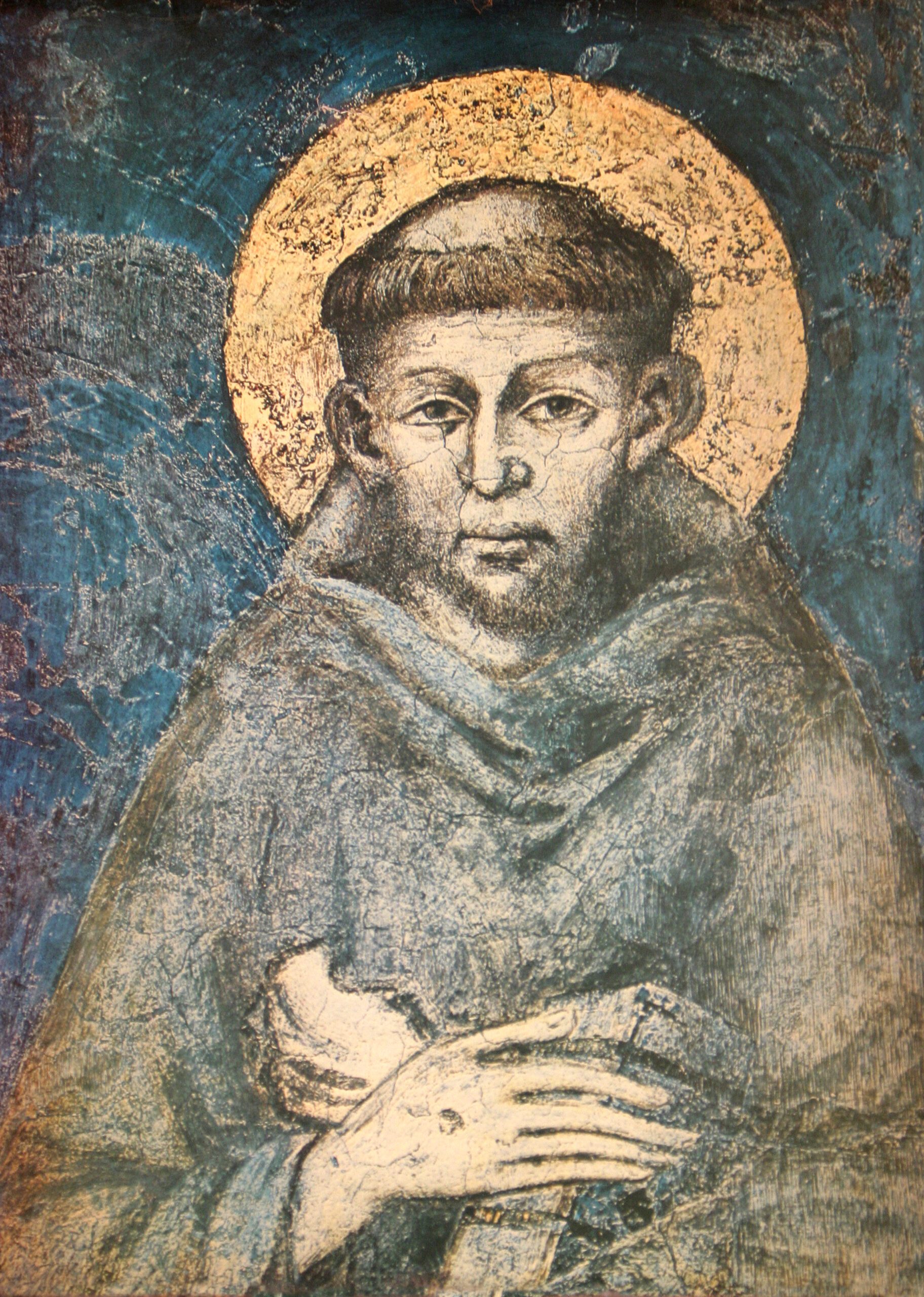
Francis was born in 1182 and spent a wild youth running around Assisi in northern Italy, until he joined the crusades, became a soldier, and went off to kill people in battle. But he ended up in prison for a year, became sick, and went home to recover. There he underwent a conversion, and decided to spend his life serving Jesus. One day, while praying at the church of San Damiano, the crucifix spoke to him and said, “Go, rebuild My church which is falling down.” Francis thought God wanted him to physically rebuild the collapsing church building, so he started making repairs on the church and other church buildings. But over time, Francis realized God wanted him to rebuild the entire Church around the world, through prayer, poverty, and peace.
Francis began to preach through the narrow streets of Assisi, saying “Pace e Bene!” meaning, “Peace and goodness to you!” Today, we might dismiss his greeting as sweet and quaint, but back then, he was laughed at and dismissed as a crazy fool. In those days, everyone was violent. Francis preached nonviolence, and in response, people threw rocks at him. For the first five years, he was ridiculed by everyone. He, in turn, blessed them, loved them, prayed for them, and eventually reconciled them with one another.
LADY POVERTY
One day, Francis met a man with leprosy and was so appalled by the disease that he turned away. Then he realized that Christ is present in the poorest person, so he turned back to the man and served him, even kissed him. From then on, Francis gave his life to those who were poor and marginalized. In the process, he decided to become as poor as possible, to wed “Lady Poverty.” He slept outdoors and in caves, served those who were hungry and sick, led prayer services, and fixed broken churches. Others soon joined him, and the “Order of Friars Minor” eventually was formed.
When officials demanded a rule for his Order, Francis opened his missal three times at random to the words: “If you will be perfect, go, sell what you have, and give to the poor.” “Take nothing for your journey.” “If anyone wishes to come after me, let them deny themselves, take up the cross and follow me.” These Gospel verses became his rule.
Francis knew up close the sins, domination, and corruption of the Church, but he loved it. He thought the best way to change priests and bishops was to call them to God. Once he was urged to condemn a priest who was living with a woman and their children. When he went to the family’s home and met the priest, he bent down and kissed the man’s feet.
AN ANTI-CRUSADER
Francis did far more than love animals, preach to the birds, and build the first nativity crèche. He renounced violence and war, and announced that he and his followers would be people of nonviolence and peace. In his most dramatic episode, he joined the crusades, not as a warrior but this time as a practitioner of Gospel nonviolence. In 1219, he began a year-long, unarmed walk right through a war zone from Italy to northern Africa, where he managed to meet the Sultan, Melek-el-Kamel, the leading Muslim of the time. Before the meeting, Francis begged the Christian warrior commander, Cardinal Pelagius, to stop the killings and the wars. The Sultan was so impressed by Francis’ kindness and gentleness that he announced, “If all Christians are like this, I would not hesitate to become one.” He offered Francis gifts and a large sum of money, but Francis turned them all down.
Francis’ journey through the war zone to meet the Muslim leader is the equivalent of traveling to Iraq today. Instead of killing the Sultan, he loved the Sultan and proved himself a true practitioner of Gospel nonviolence.
Cardinal Pelagius, on the other hand, reflected the culture’s ongoing justification of war and killing, even in the name of Jesus. He was no different than the priests, military chaplains, bishops, and cardinals today who support war, the bombing of Iraqis, and the maintenance of weapons of mass destruction. He refused to hear Francis’ call to conversion and nonviolence, just as many church leaders today refuse to hear the call.
DENIED LIKE JESUS
According to my friend, Franciscan Father Richard Rohr, scholars now state that Francis’ real crisis began on his journey back home. First of all, the crusaders wanted to kill him as a heretic, so the Sultan’s soldiers had to protect him from the other Catholic warriors. Then, when he arrived home, the friars began to grumble. They did not like his “politics,” his outreach to the Muslim enemies. Eventually, they turned against him. To press the point, Francis added to his “later rule” that all friars are to love their enemies “as the Lord commands” (Chapter X and Admonitions). “Francis took the message of Jesus absolutely seriously, as if it were personally directed toward him,” Brazilian Franciscan theologian Leonardo Boff writes. “He accepted it totally.” Today’s “rule,” however, is: Refuse to love your enemies. Refuse to meet with your enemies. And always, refuse to support those who do love your enemies.
At a large gathering of friars, according to legend, Francis insisted that they were not to own anything, and that they were to beg for their food, serve the poor, and preach the good news of peace, “sometimes using words.” Tensions mounted. The friars wanted to build houses, so they rejected Francis and his orders. They did not support his nonviolence or his voluntary poverty.
Francis was so distraught that he eventually resigned the administration of the Order. He fell into a severe depression and walked off to a hermitage on the mountain of La Verna, where he spent his last years in solitude, prayer, penance, sickness, hunger, and sorrow.
Yet it was there, in that spiritual darkness, that Francis plumbed the depths of contemplative nonviolence. “My Lord Jesus Christ,” he prayed, “grant me two graces before I die. The first is that, during my life, I may feel in my body as much as possible the pain which You, dear Jesus, sustained in the hour of Your most bitter passion. The second is that I may feel in my heart, as much as possible, the excessive love with which You, Son of God, were inflamed to willingly endure such suffering for us sinners.” He spent long days on the mountaintop reflecting on the martyrdom of Jesus.
PEACE IN THE HEART
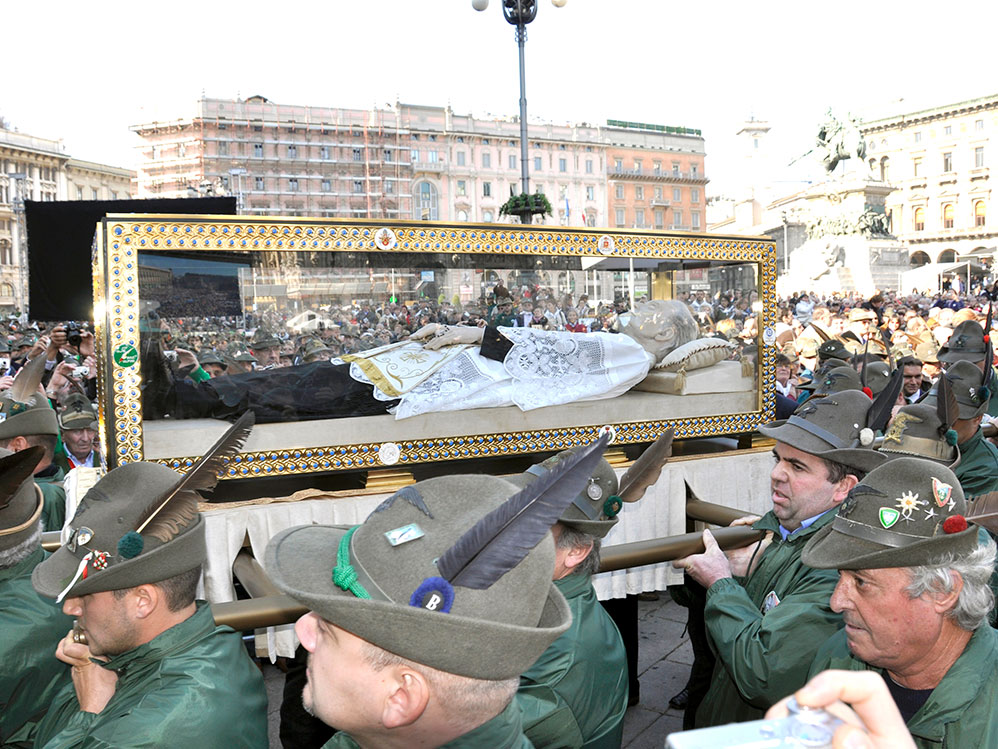
One morning in 1224, a seraph with six wings flew toward him. Up close, Francis realized it was a vision of the Crucified Christ. All of a sudden, Francis was filled with both intense pain and a universal, sacrificial, unconditional love for the whole human race. Rays of light shot out from Christ’s wounds and, after the vision, Francis discovered the stigmata on his body. After months of suffering, he asked to be taken back to Assisi where he died outside the Portiuncula on October 3, 1226. Recent scientific studies of his bones concluded that Francis suffered from both leprosy and starvation.
‘We have only just begun to practice the Gospel,” Francis told his followers as he died. “While you are proclaiming peace with your lips,” he wrote, “be careful to have it even more fully in your heart.” He once explained: “If you own possessions, you need weapons to protect them and so we do not own anything and we are at peace with everyone.”
Francis is not just for the birds. His life example and witness hold the key to the solutions of all the world’s problems. He may be the greatest of Jesus’ witnesses. “I have done my part,” Francis said to the friars around him as he died. “May Christ teach you to do yours.” May we all do our part, like Francis, and become instruments of Christ’s peace.
www.johndear.org — Excerpts from John Dear’s new book, “You Will Be My Witnesses,” available from Orbis Books.