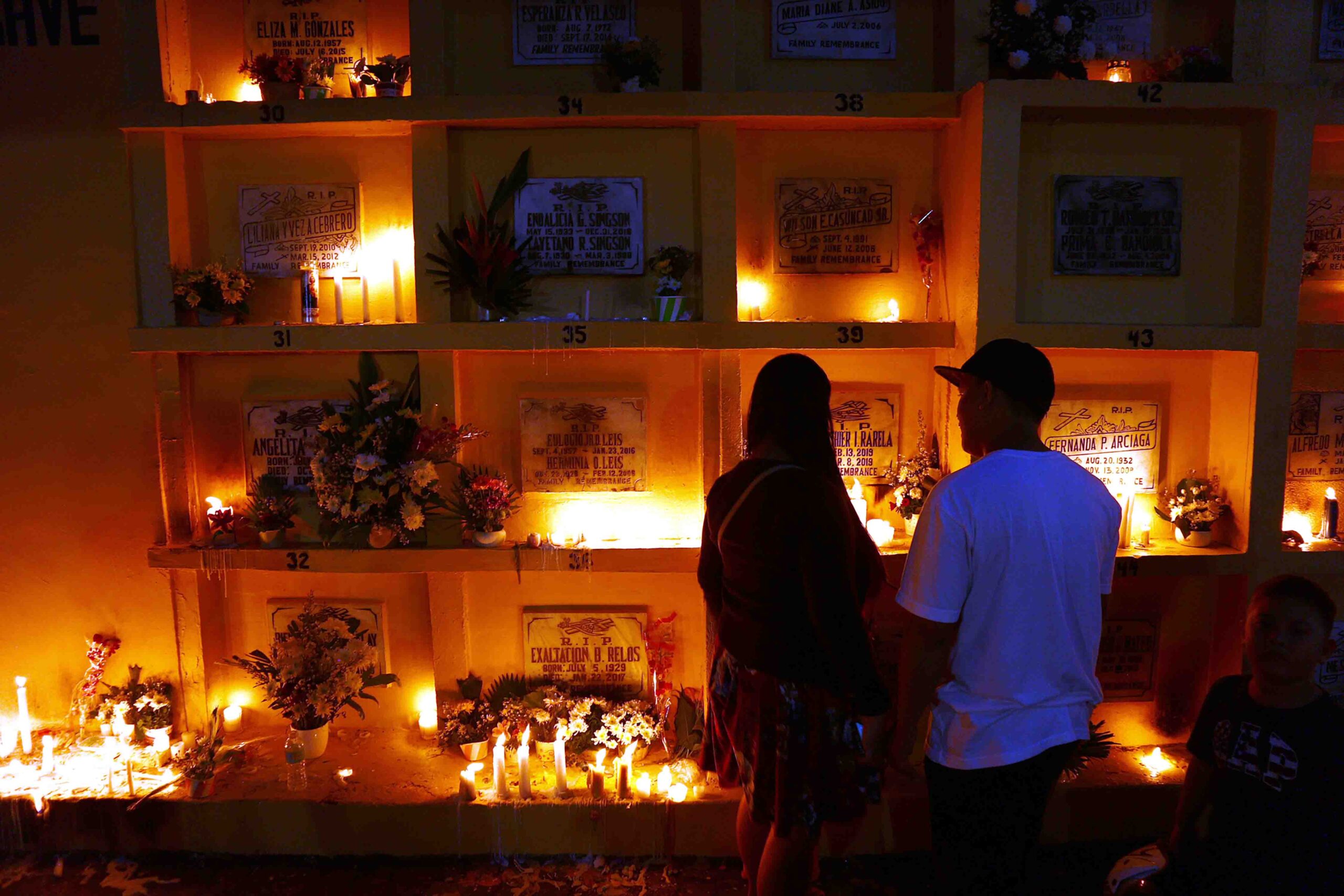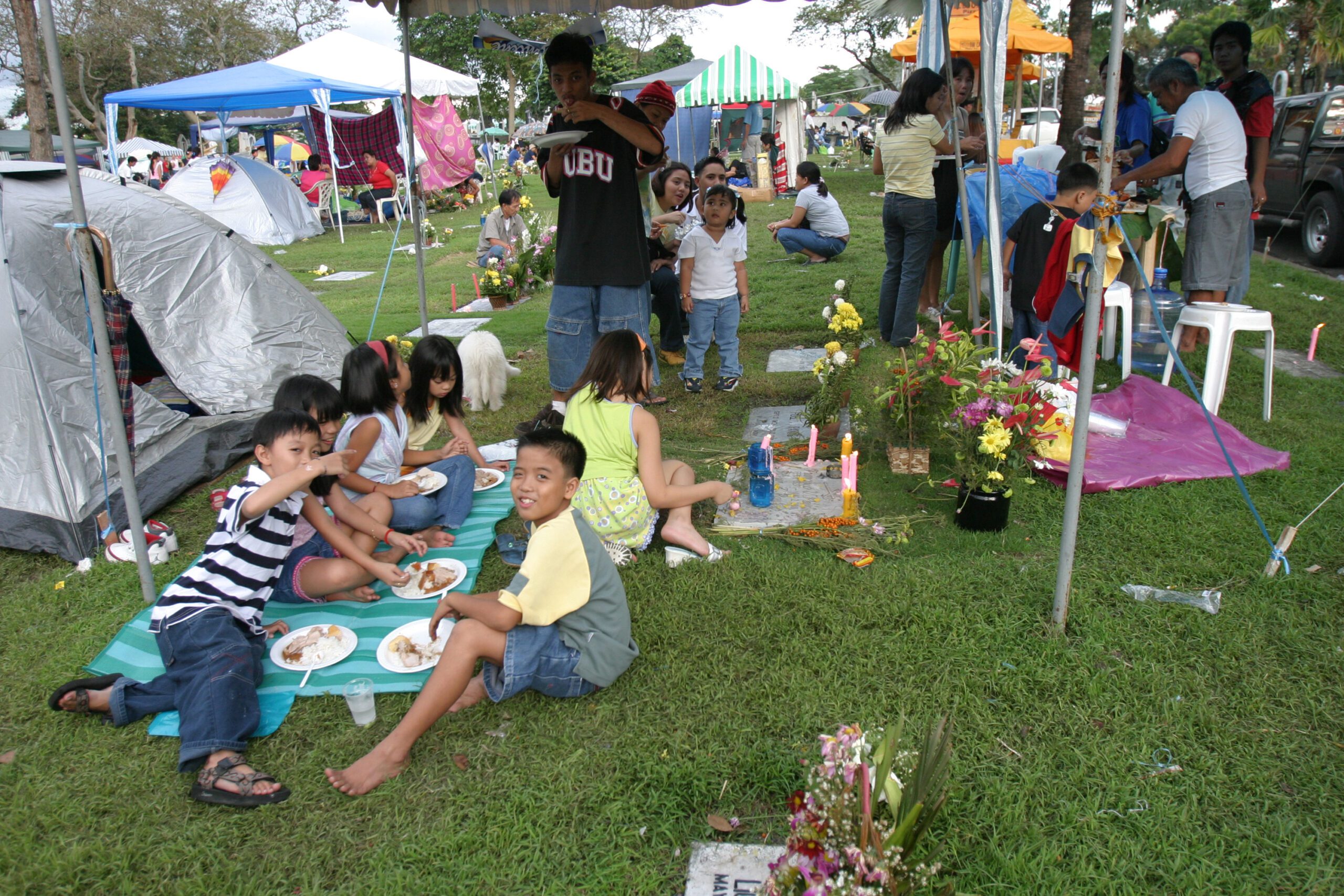
The practices of a nine-day novena, or pasiyam, and forty days, although the Rosary is recited therein, still carry the ancient belief of a gap or period of time before the final destination. When my dad died a couple of years ago, I remember being asked, “When is your father’s 40th day?” and I thought of the traditional Tagalog practice of holding on to the precolonial belief that the spirit of the dead roams around the earth for forty days or remains hanging around for a considerable time before departing to the afterworld.
Why are most people afraid of death? Why is it scary? While alive, the gray matter works endlessly, your vital organs are functioning, you do 18 breaths per minute, your oxygen level is 98, and your heart is pumping 80 times per minute (bpm). Clinical death happens when these bodily functions stop.
That death is the separation of the body (corpus) from our soul (anima) is a philosophical concept, notably proposed by Plato in his Phaedo, where Socrates defines death as the completion of this separation. This dualistic view (corpus et anima) posits that humans are composed of both a physical body and an immaterial soul, though it is rejected by materialists and atheists who deny the existence of a soul.
The symbolism of that forbidden fruit in the Genesis account is not only pure knowledge but life itself (cf. Genesis, 2:17 and 3:3). Adam’s rude attempt to grasp life itself and to avoid death led him to sin. In other words, because he wanted not to die, Adam succumbed to the temptation to live forever like God and disobeyed God.
YHWH God told Adam, “In the day that you eat of it you shall die…” (Genesis, 2:17). Through his disobedience, Adam broke off from the fountain-source of life. The fatal punishment is symbolized by his disgraceful exile from paradise.
The early Christians saw death as “the wage paid by sin” (Romans, 6:23). Death assumes the character of punishment as a consequence of sin. St. Paul offers the explanation why every member of humankind without exception has to die. “It was through one man that sin came into the world and through sin death…” (Romans, 5:12).
In the cases of our Lord and his Blessed Mother, since they are free from original and personal sins, their death is never reckoned as a punishment for sin but as part of the human cycle (cf. Thomas Aquinas, Summa Theologica, II, Q. 164). It’s not sane to think that Jesus and Mary were punished. So, Jesus ascended into heaven, while God never allowed Mary’s body to be corrupted, and therefore “Mary, ever virgin, when the course of her earthly life was finished, was taken up body and soul into the glory of heaven” (Pius XII, Munificentissimus Deus, 1950).
CHRISTIAN MEANING OF DEATH
“The Word was made Flesh” (John, 1:14), and Jesus shared our humanity, assumed the flesh of the Homo sapiens, and he himself suffered death. Bear in mind, the Son of God chose to die a shameful death. Because of the frail humanity that he assumed, he felt the anguish and the misery as he faced death. In the Garden of Gethsemane, Jesus begged the Father to take the cup of suffering away. He knew that to drink its wine is to drink the poison of death, according to Ven. Fulton Sheen.
The obedience of Jesus, the New Adam, has transformed the disobedience of the Old Adam, transforming the curse of death into a blessing (cf. Catechism of the Catholic Church, 1009), so much so that St. Paul writes, “My desire is to depart and be with Christ” (Philippians, 1:23).
St. Teresa of Avila said in her autobiography, “I want to see God and, in order to see Him, I must die.” Another Teresa, St. Therese of Lisieux, intimated in The Last Conversations, “I am not dying; I am entering life,” she had written to one of her spiritual brothers, Fr. Bellière (Lettres, 244).
SPLIT-SECOND AFTER DEATH
Contrary to the old Tagalog belief, we are given neither nine nor forty days to roam the earth or hang around after we die. Our Catholic faith says judgment is instant. There’s no rewind, no free time, and no take two or take three, like in movies or commercial shootings. There’s no second chance, like how Frank Sinatra sang, “Let me try again.” There’s nothing between the individual’s death and his destiny, for beyond death there is simply no more justification and no more second chance.
Merit and demerit, sin, confession, and forgiveness for the person are possible only in life. In death the possibility of merit and demerit for the person concerned ceases. In other words, there is no justification after death. Therefore, the dead with venial sins who cannot help themselves needed the help of the living (cf. “Communion of Saints–Pilgrim Church, Suffering Church in Purgatory, and Triumphant Church”).
The unfeigned encounter with Jesus Christ, our just Judge, will happen immediately in death, a face-to-face encounter, no less. When that precise moment occurs, say, right now, at this very minute, just imagine finding yourself standing before the Divine Judge in majesty, and what will you do?
Seconds after death, all acts and deeds of a lifetime–flaws, warts, relationships, and good works–flash in a split second. How would you feel? The glorious Christ is looking at you eyeball to eyeball? And what will you tell Him? Feel the “moment of truth?” Particular judgment is that “moment of truth,” that very minute when our Blessed Lord confronts and evaluates us, without the benefit of a relative freedom to roam around for a few days to reflect or put things into order.
Why immediately? To make us accountable, as Saint Alphonsus de Ligouri once said in his striking homily on particular judgment. He said that we shall be immediately and strictly accountable for every word, every deed, every kindness or lack of it, and every omission after we breathe our last.
THE DOGMA OF PURGATORY
As the Communion of Saints, as Pope Pius XII teaches, all three are interlinked mystically, meaning we are all one Body with Jesus Christ as the Head (Mystici Corporis). The Catholic Church is the Mystical Body of Christ, which comprises the Triumphant Church in heaven, the Pilgrim Church on earth, and the Suffering Church in purgatory.
In Heaven there’s no space for imperfection, warts, and all; the Book of Revelation 21:27 says, “But nothing unclean shall enter it (heaven).” In other words, there are persons who do not deserve the eternal separation from God in Hell but, at the same time, are not yet ready to completely enjoy the crown of heavenly glory.
Our faith accepts the different levels of gravity of sins, given that some sins are less serious than others. A mortal sin is the willful violation of God’s law in serious matters enumerated in the Ten Commandments, such as murder, adultery, sodomy, idolatry, grave disrespect to parents and elders, robbery and kidnapping, rape, and all heinous crimes.
But not all sins are mortal. The recognition of the different levels of gravity in sins is to understand the dogma of Purgatory. Hence, the question: Is the act of murder (always premeditated or well-planned) more serious and contemptible than homicide in self-defense?
Purgatory, as our Catholic faith tells us, is the temporary stopover for those who die in the state of grace and God’s friendship but are still too imperfect to merit the rewards of heaven due to venial sins. Stopping over there to undergo purification, all souls in purgatory, though, are assured of eternal salvation–hence, the term “temporary stopover.”
PRAYERS FOR THE DEAD
Pope Benedict XVI teaches us how prayers can ease the burden of others, even of our loved ones in purgatory. He said, “The souls of the departed can, however, receive solace and refreshment through the Eucharist, prayer, and almsgiving. The belief that love can reach into the afterlife, that reciprocal giving and receiving is possible, in which our affection for one another continues beyond the limits of death. This has been a fundamental conviction of Christianity throughout the ages, and it remains a source of comfort today.”
“No one lives alone. No one is saved alone,” declares the Supreme Pontiff in his encyclical letter Spe Salvi and insists that kindness can do wonders for the souls of the departed. And the most wonderful prayer acceptable to God is the Holy Mass offered on behalf of the souls in purgatory. It works.
José Mario Bautista Maximiano is the lead convenor of the Love Our Pope Movement (LOPM) and author of the book Church Reforms 4: Pope Leo XIV, Church Reforms, and Synodality (Claretian, 2025). Church Reforms 1, 2, 3, and 4 are available at Lazada and Shopee. Email: jomaximiano@gmail.com