
Sad and Growing Data

INTRODUCTION

About 45.2 million people have been forced to leave their homes due to conflict and/or violence. According to the U.N., this means that each day, another 23,000 people begin to search for safety from harm or persecution: the world has a new refugee or internally displaced person every 4.1 seconds.

WRITTEN BY

SHARE THE WORD

PUBLISHED ON

How many? On World Refugee Day, June 20th, the United Nations High Commission for Refugees (UNHCR) released an estimate that, globally, 45.2 million people have been forced to leave their homes due to conflict and/or violence. That is equal to the population of South Korea or Colombia, three million more than in 2012 and the highest total number since 1994. Of these, 15.4 million people are refugees forced to flee from their countries to seek safety in another country, most often a neighboring one; 7.6 million of them were uprooted last year alone. In addition, there are 28.8 million internally displaced persons (IDPs) who were forced to flee from their homes but have been able to remain in their own countries. Nearly another million have officially become “asylum seekers” in another country; they are seeking legal recognition of their status as refugees and the right to legally reside in the host country for an indefinite period.

Antonio Guterres, the UN High Commissioner for Refugees, explains that these alarming numbers mean that “each day, another 23,000 people begin to search for safety from harm or persecution – the world has a new refugee or internally displaced person every 4.1 seconds.” The high number of refugees reflects the failure of the international community to prevent or halt armed conflict.

From which countries do the refugees flee? The UNHCR reports that, at this time, the largest number comes from five countries: Afghanistan, Iraq, Somalia, Sudan and Syria. However, a steady stream of refugees also flee from ongoing situations, such as the endless violence in the eastern part of the Democratic Republic of Congo or from the violently oppressive governments of Ethiopia and Eritrea. Significant numbers also flee from Myanmar, Colombia and Vietnam.

A BURDEN ON POOR COUNTRIES
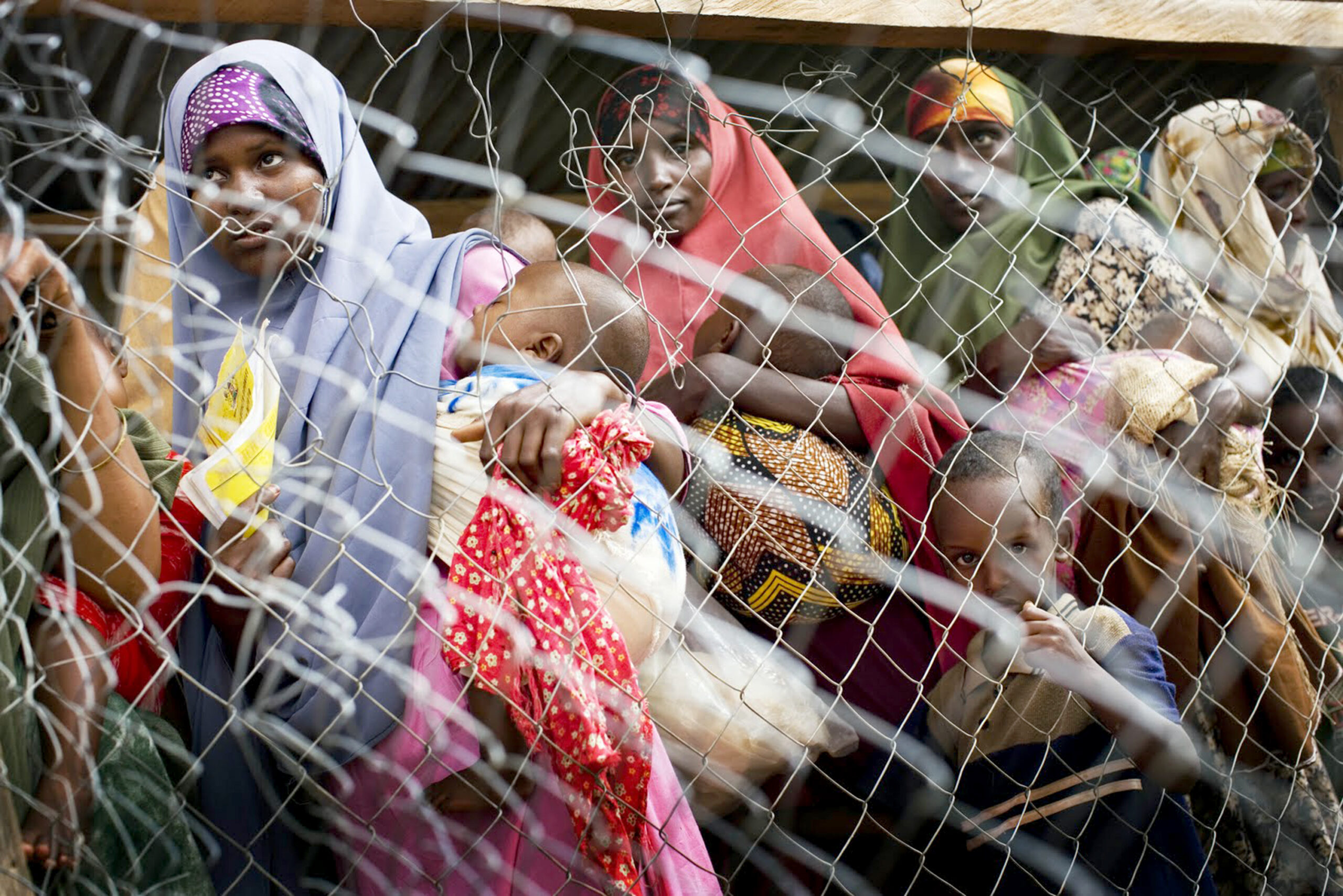
Where do they go? At least, initially, most flee to a neighboring country, and often these are relatively poor or overcrowded countries that cannot provide adequate assistance. Pakistan, Iran, Kenya, the DR Congo, Sudan and Yemen are hosts to many refugees. Eighty percent of the world’s refugees are staying in developing countries. A big number of refugees from Darfur and Mali are in Chad, one of the world’s poorest countries and one with its own armed conflicts. Kenya is host to the largest refugee camp in the world; the Dadaab camp near the border of Somalia may hold a half-million Somali refugees. Kenya is also host to many refugees from Ethiopia, Eritrea, Sudan, Rwanda and the Democratic Republic of Congo. Refugees place an enormous economic burden on poor host countries. For example, in 2011, Pakistan was host to 1.9 million refugees. That comes down to 710 refugees for each U.S. dollar of its per capita Gross Domestic Product.

The conflict in Syria constitutes the worst crisis at this moment; 1.6 million Syrian refugees are crowding into Turkey, Jordan and Lebanon. Jordan is host to roughly half a million Syrian refugees. The Al-Zaatari refugee camp in Jordan is now the second largest in the world, with 160,000 total occupants, at least 60% of them under the age of 18. On average, 66 babies are born in that camp every day. Before the upsurge of the armed conflict in Syria, Jordan already had three quarter of a million refugees, mostly Palestinians and Iraqis, and now has one and a quarter million. Tiny Jordan is expected to be host to two million refugees by the end of 2013. The presence of these refugees places an enormous strain on Jordan’s resources for healthcare, education, sanitation, etc. Jordan has already spent nearly a billion U.S. dollars to give minimal assistance to the flood of refugees from Syria alone.

Where do the refugees stay in the host countries and who assist them? A lot of the refugees have no other option than to stay in officially-designated refugee camps where a minimum of food, water and temporary shelter is provided. Sometimes, these are desperate survival situations of continuous boredom with little opportunity for education and none for employment. The UNHCR often sets up and runs these camps, but the UNHCR depends on voluntary donations and is chronically underfunded in proportion to the number and needs of refugees.

Various humanitarian organizations seek to assist the refugees in these camps and elsewhere with healthcare or education but, in most cases, their relatively meager resources are no match to the enormity of the needs that they confront. Even when the host governments have the best of intentions, they often lack adequate resources to even provide proper documentation to the refugees present in their countries or to do so in a timely manner.

DESPERATE TO ESCAPE
It is no wonder that many refugees are desperate to escape from these camps. Many African refugees have fled from camps in Kenya, Zambia and Bostwana to the Republic of South Africa (RSA) to seek asylum in the hope of finding jobs and opportunities for education; about 20% of the world’s asylum seekers are in RSA. Although RSA permits freedom of movement, the overall situation of refugees is hardly better than elsewhere.

The RSA government provides temporary documents to asylum seekers, but is very slow to process asylum applications. Often, for many years, refugees must travel to the city where they first registered as asylum seekers to renew their provisional permits on a monthly or quarterly basis. It may take three, five or more years before their applications are processed. If they are officially recognized as refugees, they are then given temporary residence permits. Meanwhile, without permanent documents, it is almost impossible to find work in a country that has 40% unemployment.

Millions of refugees have poured into RSA in recent years, especially from Zimbabwe. In RSA, foreign Africans face ongoing xenophobia and resentment from people who accuse them of coming to steal their jobs. In 2008, there were massive riots and attacks on foreign African nationals throughout RSA. More than sixty people were atrociously murdered; hundreds more were seriously wounded and 50,000 left homeless. Since 2008, African foreigners are the victims of ongoing criminal attacks that are disproportionate to their percentage of the total population.

A good number of refugees, through the mediation of the UNHCR and non-governmental organizations that collaborate with it, such as the Jesuit Refugee Services, ultimately seek asylum in countries farther away where they hope to be able to build a secure future for themselves and their children. Germany, Australia, New Zealand, the United States and Sweden give residential status to a certain number of refugees. Germany is the industrialized country that has settled the largest refugee population.

WAITING FOR THE NEXT WAVE
Many refugees remain in unsettled situations for five years or more; about a third of current refugees are in this situation. Some, such as the Afghans who first fled the Soviet invasion in 1979, have been refugees for as many as thirty years. Some countries do not welcome refugees, whether in general or those coming from particular countries but force them to return to their own countries, even when it is well known that they will face persecution or other dangers. Israel and Egypt force Eritreans to return to Eritrea where they face persecution.

This is called “refoulement” and is a gross violation of international law and legally binding international conventions.

In addition to refugees, the UNHCR cares for about 3.5 million “stateless people” who have no legally-established nationality. Estimates of the global number of stateless people run as high as 12 million.

The purpose of the UNHCR is to assure international protection for refugees and stateless persons, and to assist governments in finding solutions to refugee situations. The basis for the activities of the UNHCR is the 1951 Convention on the Status of Refugees, an agreement between states regarding how they will treat refugees. The Convention has been ratified by 144 countries out of the U.N.’s total of 193, and entered into force in 1954. It was later supplemented by a Protocol adopted in 1967. The U.S.A. never ratified the Convention but does accept the binding nature of the Protocol; some other countries are party to the Convention but not the Protocol.

The statistics and information given in this article do not include small farmers who have been forced off their lands through “land-grabbing” by corrupt or incompetent government officials to lease or sell to other countries, corporations or investment groups – lands that hve been occupied for generations by small farmers. In addition, the next big wave of refugees and IDPs are expected to be those forced from their homes by the consequences of global climate change, such as drought, flooding or an unpredictable crop-growing season.

Share Your Thoughts

All comments are moderated

From The Same Issue

The articles and content about this issue

From The Same Issue

The articles and content about this issue

From This Topic

The articles and content about this topic

From This Topic

The articles and content about this topic

Spiritual Reflection

The least is the greatest

Spiritual Reflection

Accepting The Reign Of God

Explore Other Topics

Browse other coverage

Explore Other Topics

Browse other coverage

WM SPECIAL

Presents, discusses and draws readers to reflect on issues of outmost relevance to the world today.


FRONTIERS

Very often, mission is carried out in frontier situations around the world. Those who embrace these situations have much to share.


UNITY IN DIVERSITY

Writer Ilsa Reyes will be exploring the richness of Pope Francis’s latest encyclical Fratelli Tutti with a view of helping our readers to get a grasp of the this beautiful papal document.


FRONTLINE

Puts to the front committed and inspiring people around the world who embrace humanitarian and religious causes with altruism and passion.


IN FOCUS

Focus on a given theme of interest touching upon social, economic and religious issues.


FAITH@50

As the Philippines prepares to celebrate 500 years of the arrival of Christianity. Fr. James Kroeger leads us in this series into a discovery journey of the landmark events in the history of faith in the Philippine archipelago.


INSIGHT

Aims to nurture and inspire our hearts and minds while pondering upon timely themes.


FILIPINO FOCUS

The large archipelago of the Philippines, in its richness of peoples and cultures, offers varied and challenging situations for mission.


FOLLOW ME

Reflections and vocation stories that shape up the lives of young people.


MISSION IS FUN

As humor and goodness of heart are qualities of Christian and missionary life, the new column “Mission is fun” will be publishing some anecdotes and stories that have happened in a missionary context to lighten up the spirits and trigger a smile in our faces.


LIVING COMMUNION

To help readers of World Mission live this year dedicated to Ecumenism, Interreligious Dialogue and Indigenous Peoples, Tita Puangco, writer and lecturer, shares in this section insights on the spirituality of communion.


WINDS OF THE SPIRIT

A historic view of the Catholic movements that emerged from the grassroots as an inspiration by the Holy Spirit.


BRIDGE BUILDERS

On the Year of Ecumenism, Interreligious Dialogue and Indigenous Peoples, radio host and communicator Ilsa Reyes, in her monthly column, encourages Christians and people of good will to be one with their fellow people of other sects, religions and tribes.


INTERVIEW

Questions to a personality of the Church or secular world on matters of interest that touch upon the lives of people.


WORLD TOUCH

News from the Church, the missionary world and environment that inform and form the consciences.


CARE OF THE EARTH

A feature on environmental issues that are affecting the whole world with the view of raising awareness and prompting action.


EDITORIAL

The editor gives his personal take on a given topic related to the life of the Church, the society or the world.


YOUNG HEART

A monthly column on themes touching the lives of young people in the Year of the Youth in the Philippines by radio host and communicator I lsa Reyes.


SCROLL

A missionary living in the Chinese world shares his life-experiences made up of challenges and joyous encounters with common people.


EXTRAORDINARY PEOPLE

Life stories of people who deserve to be known for who they were, what they did and what they stood for in their journey on earth.


ONE BY ONE

Stories of people whom a missionary met in his life and who were touched by Jesus in mysterious ways.


INCREASE OUR FAITH

Critical reflection from a Christian perspective on current issues.


SPECIAL MOMENTS

Comboni missionary Fr. Lorenzo Carraro makes a journey through history pinpointing landmark events that changed the course of humanity.


PROFILE

A biographical sketch of a public person, known for his/her influence in the society and in the Church, showing an exemplary commitment to the service of others.


WM REPORTS

Gives fresh, truthful, and comprehensive information on issues that are of concern to all.


LIFE'S ESSENTIALS

A column aimed at helping the readers live their Christian mission by focusing on what is essential in life and what it entails.


ASIAN FOCUS

Peoples, events, religion, culture and the society of Asia in focus.


THE SEARCHER'S PATH

The human heart always searches for greatness in God’s eyes, treading the path to the fullness of life - no matter what it takes.


INDIAN FOCUS

The subcontinent of India with its richness and variety of cultures and religions is given center stage.


AFRICAN FOCUS

The African continent in focus where Christianity is growing the fastest in the world.


JOURNEY MOMENTS

Well-known writer and public speaker, Fr. Jerry Orbos, accompanies our journey of life and faith with moments of wit and inspiration based on the biblical and human wisdom.


IGNATIUS STEPS

On the year dedicated to St. Ignatius of Loyala, Fr. Lorenzo Carraro walks us through the main themes of the Ignatian spirituality.


THE SEVEN LAST WORDS OF JESUS

Fr. John Taneburgo helps us to meditate every month on each of the Seven Last Words that Jesus uttered from the cross.


INSIDE THE HOLY BOOK

In this section, Fr. Lorenzo delves into the secrets and depths of the Sacred Scriptures opening for us the treasures of the Sacred Book so that the reader may delight in the knowledge of the Word of God.


CONVERSATIONS

Reflections about the synodal journey on a conversational and informal style to trigger reflection and sharing about the synodal path the Church has embarked upon.


VATICAN II

This 'mini-course' series provides a comprehensive exploration of Vatican II, tracing its origins, key moments, and transformative impact on the Catholic Church.


COMBONIS IN ASIA

This series offers an in-depth look at the Comboni Missionaries in Asia, highlighting their communities, apostolates, and the unique priorities guiding their mission. The articles provide insights into the challenges, triumphs, and the enduring values that define the Comboni presence in Asia.


BEYOND THE SYNOD

Following the Synod on Synodality, this series examines how dioceses, parishes, and lay organizations in the Philippines are interpreting and applying the principles of the synod, the challenges encountered, and the diverse voices shaping the synodal journey toward a renewed Church.


A TASTE OF TRADITION

This series introduces the Fathers of the Church, featuring the most prominent figures from the early centuries of Christianity. Each article explores the lives, teachings, and enduring influence of these foundational thinkers, highlighting their contributions the spiritual heritage of the Church.


A YEAR OF PRAYER

In preparation for the 2025 Jubilee Year under the theme “Pilgrims of Hope,” 2024 has been designated a Year of Prayer. World Mission (courtesy of Aleteia) publishes every month a prayer by a saint to help our readers grow in the spirit of prayer in preparation for the Jubilee Year.


OUR WORLD

In Our World, the author explores the main trends shaping contemporary humanity from a critical and ethical perspective. Each article examines pressing issues such as technological advancement, environmental crises, social justice, and shifting cultural values, inviting readers to reflect on the moral implications and challenges of our rapidly changing world.


CATHOLIC SOCIAL DOCTRINE

This series unpacks the principles of Catholic Social Doctrine, offering a deep dive into the Church's teachings on social justice, human dignity, and the common good.


HOPEFUL LIVING

Hopeful Living’ is the new section for 2026, authored by Fr. James Kroeger, who dedicated most of his missionary life to the Philippines. In this monthly contribution, he will explore various aspects of the virtue of hope. His aim is to help readers align their Christian lives more closely with a hopeful outlook.


PHILIPPINE CROSSROADS

Filipino Catholic scholar Jose Bautista writes each month about how the Philippines is at a crossroads, considering the recent flood control issues and other corruption scandals that have engulfed the nation. He incorporates the Church’s response and its moral perspective regarding these social challenges.


BIBLE QUIZ

Test your knowledge and deepen your understanding with our Bible Quiz! Each quiz offers fun and challenging questions that explore key stories, themes, and figures from both the Old and New Testaments.


Shopping Cart