The Presence Of The Dead

INTRODUCTION

Relatives come from all over the world. There are comforts such as radio, TV and taped music. Also food, drinks and games. For the Filipinos, wakes are obligatory family reunions, the Feast of the Dead is a form of communion with the departed. Because the truth is that they are “real,” able to intercede and give advice, even to “eat” the essence of the food offerings: they remain present.

WRITTEN BY

SHARE THE WORD

PUBLISHED ON

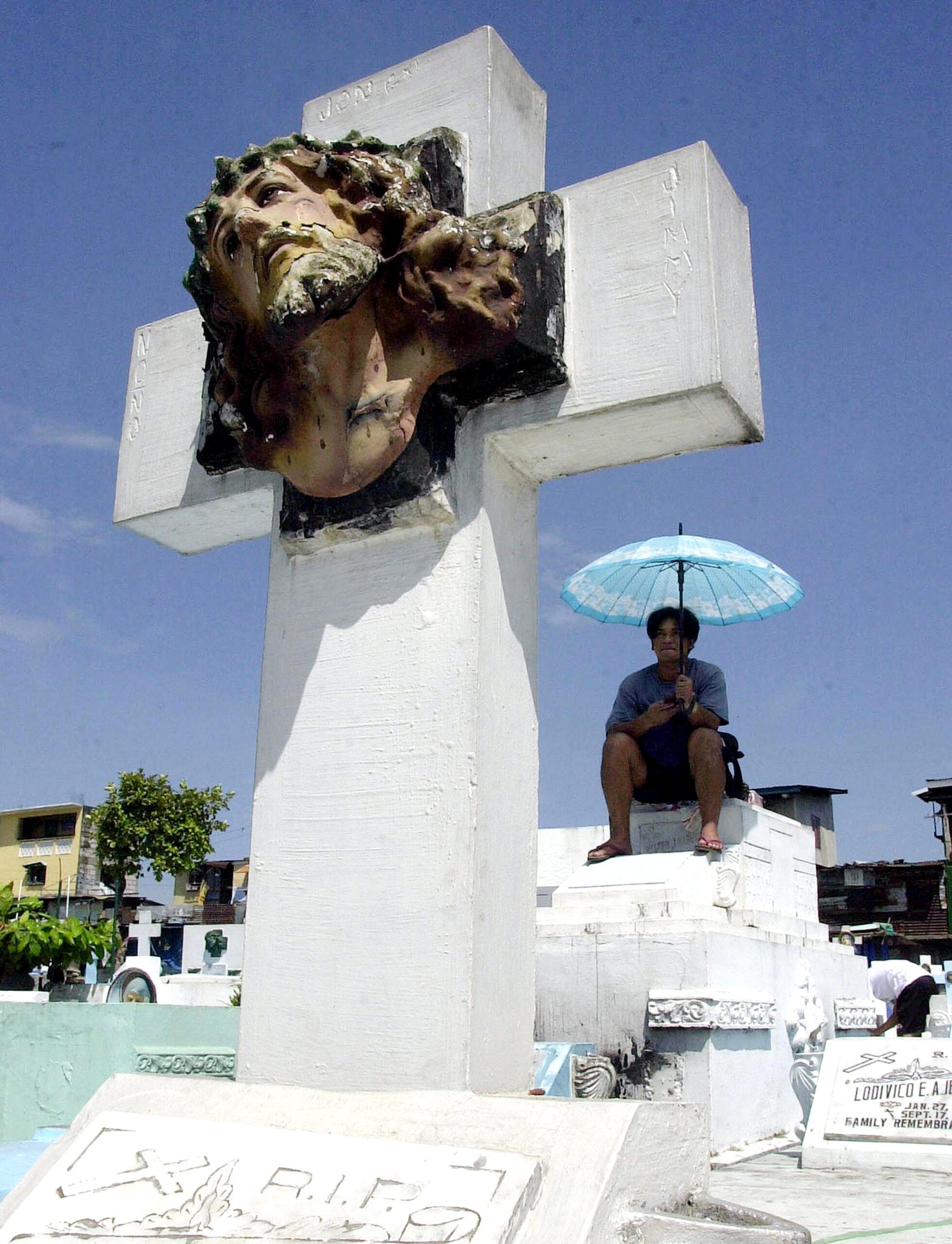
On November 1 or earlier, Filipinos throng to the cemeteries to visit their departed. The place is aglow with candles and electric lights and awash with flowers. The occasion becomes a picnic, complete with meals, even with the comforts of home such as radio and TV and taped music. Many of the relatives camp in the cemeteries and even spend the whole night to pray and to commune with the departed. The Fiesta ng mga Patay (Feast of the Dead) may strike non-Filipinos as odd. But we find similar practices in Mexico and Southeast Asian countries like China and Thailand and elsewhere in the world.

The Fiesta ng mga Patay is an extension of the wake. The wake is one of several occasions for family reunion. Why should struggling Overseas Contract Workers spend precious cash to attend the funeral of their loved ones at home? Is it not better to remit the money than to spend it in “useless” travel and the almost “obligatory” gifts (pasalubong)? This question often comes from non-Filipino observers who are amazed at the phenomenon. But wakes are like obligatory family reunions. Their values dictate it. That is why the wake has often to be extended in order to wait for relatives abroad to travel back home.

THE SPIRITS ARE REAL
When I attended my late brother’s wake in Richmond, Virginia, I could only see his body on the schedule allowed by the funeral parlor. But such is not the case in the Philippines where one can visit the body lying in state all around the clock. The mourners keep themselves awake by amusements like playing mahjongg and card games. Wakes are also accompanied with eating and drinking. In earlier times, they were likewise social occasions for single boys to meet girls.

Greek philosophy distinguishes the soul from the body, which corresponds to the split between the spiritual and the physical. The Filipino counterpart of the said distinction is the seen and the unseen. The unseen spirits for Filipinos are as real as the seen and therefore are “natural.” Because Filipinos believe that the unseen spirits can be hurt or even get wet. Filipinos say “tabi po” (please excuse me) before throwing anything outside the window — even if nobody is around.

The Filipino social philosophy of being group-oriented extends to the departed. Because the departed relatives and the living are one, the departed are like the saints who will intercede (lakad) their petitions to God. If Filipinos in real life ask more exalted persons to be their negotiators, the departed seem to have that role. The feast, therefore, illustrates the Communion of Saints.

ADVICE AND COMMUNICATION
Advice and tarot. A friend of mine, an engineer, told me that when he has problems that need decisions, he goes to the tomb of his departed parents in the cemetery in order to ask for their advice. He says that he often gets the right answers. Outside the Quiapo church in Manila, many people consult the departed through the psychics outside the church. The psychics often use tarot cards.

The medium’s accusation. In Metro Manila, on the night of June 29, 1991 six young men entered a house of an eighteen-year old girl, Carmela Vizconde, then raped and murdered her, together with her mother and her sister. The father, Lauro Vizconde, was at a loss on who did it, not until he consulted a medium who invoked the departed during a séance. The departed allegedly revealed the identity of the culprits, including a look-out girl. But such evidence could not be valid in court. After four years, the girl, Jessica Alfaro, who was conscience — stricken, came out to reveal the truth in court. Her testimony in December 1995 led to the conviction of the six young men: they were scions of prominent rich families and the head was the son of a former senator.

Food as flowers. Whenever I am asked to bless the dead during funerals or celebrate Mass during death anniversaries, especially of the poor and ordinary people, I invariably notice that a plate of food lies before the picture of the departed. The Ilocano word for it is atang, or alay in Tagalog and halad in Cebuano. Once when traveling in Ilocos Sur, I chanced to see a bamboo staked beside a deserted road. On top was a small square plywood which contained a full meal, including basi (rice wine), cigarettes and matches. Food offering for the dead is not only Filipino but also Asian. One finds food offerings — especially fruits — in Buddhist temples. This is equivalent to flower offerings in the West. If the spirits “smell” the flowers, they also “eat” the essence of food offerings.

ALL SAINTS’ DAY
If November 2 is All Souls’ Day, why do most Filipinos go all out on November 1, which is All Saints’ Day? We see the same pattern in other instances. During town fiestas, the eve or bisperas is more elaborately celebrated than the fiesta day itself. Unlike the official liturgical year which emphasizes Advent as the preparation to Christmas, the same does not seem to be the case in the Philippines. While Christmas liturgically begins on the midnight of December 24, Christmas in the Philippines is more celebrated during the nine-day early dawn Novena Masses (Simbang Gabi) before Christmas and the climax is Christmas Eve. Christmas Day itself seems anti — climatic when most people take it easy or even sleep. The excitement of Simbang Gabi seems to have worn itself out on Christmas Day.

The foregoing examples indicate the Filipino philosophy of time, that is, being now-oriented and less tomorrow-oriented. In eschatology, we speak of the tension between the already and the not-yet. It seems Filipino time points more to the already or to the now and the present. If November 1 is All Saints’ Day, this is also the day for the non-canonized saints — their departed relatives and friends.

Share Your Thoughts

All comments are moderated

From The Same Issue

The articles and content about this issue

From The Same Issue

The articles and content about this issue

From This Topic

The articles and content about this topic

From This Topic

The articles and content about this topic

Explore Other Topics

Browse other coverage

Explore Other Topics

Browse other coverage

WM SPECIAL

Presents, discusses and draws readers to reflect on issues of outmost relevance to the world today.


FRONTIERS

Very often, mission is carried out in frontier situations around the world. Those who embrace these situations have much to share.


UNITY IN DIVERSITY

Writer Ilsa Reyes will be exploring the richness of Pope Francis’s latest encyclical Fratelli Tutti with a view of helping our readers to get a grasp of the this beautiful papal document.


FRONTLINE

Puts to the front committed and inspiring people around the world who embrace humanitarian and religious causes with altruism and passion.


IN FOCUS

Focus on a given theme of interest touching upon social, economic and religious issues.


FAITH@50

As the Philippines prepares to celebrate 500 years of the arrival of Christianity. Fr. James Kroeger leads us in this series into a discovery journey of the landmark events in the history of faith in the Philippine archipelago.


INSIGHT

Aims to nurture and inspire our hearts and minds while pondering upon timely themes.


FILIPINO FOCUS

The large archipelago of the Philippines, in its richness of peoples and cultures, offers varied and challenging situations for mission.


FOLLOW ME

Reflections and vocation stories that shape up the lives of young people.


MISSION IS FUN

As humor and goodness of heart are qualities of Christian and missionary life, the new column “Mission is fun” will be publishing some anecdotes and stories that have happened in a missionary context to lighten up the spirits and trigger a smile in our faces.


LIVING COMMUNION

To help readers of World Mission live this year dedicated to Ecumenism, Interreligious Dialogue and Indigenous Peoples, Tita Puangco, writer and lecturer, shares in this section insights on the spirituality of communion.


WINDS OF THE SPIRIT

A historic view of the Catholic movements that emerged from the grassroots as an inspiration by the Holy Spirit.


BRIDGE BUILDERS

On the Year of Ecumenism, Interreligious Dialogue and Indigenous Peoples, radio host and communicator Ilsa Reyes, in her monthly column, encourages Christians and people of good will to be one with their fellow people of other sects, religions and tribes.


INTERVIEW

Questions to a personality of the Church or secular world on matters of interest that touch upon the lives of people.


WORLD TOUCH

News from the Church, the missionary world and environment that inform and form the consciences.


CARE OF THE EARTH

A feature on environmental issues that are affecting the whole world with the view of raising awareness and prompting action.


EDITORIAL

The editor gives his personal take on a given topic related to the life of the Church, the society or the world.


YOUNG HEART

A monthly column on themes touching the lives of young people in the Year of the Youth in the Philippines by radio host and communicator I lsa Reyes.


SCROLL

A missionary living in the Chinese world shares his life-experiences made up of challenges and joyous encounters with common people.


EXTRAORDINARY PEOPLE

Life stories of people who deserve to be known for who they were, what they did and what they stood for in their journey on earth.


ONE BY ONE

Stories of people whom a missionary met in his life and who were touched by Jesus in mysterious ways.


INCREASE OUR FAITH

Critical reflection from a Christian perspective on current issues.


SPECIAL MOMENTS

Comboni missionary Fr. Lorenzo Carraro makes a journey through history pinpointing landmark events that changed the course of humanity.


PROFILE

A biographical sketch of a public person, known for his/her influence in the society and in the Church, showing an exemplary commitment to the service of others.


WM REPORTS

Gives fresh, truthful, and comprehensive information on issues that are of concern to all.


LIFE'S ESSENTIALS

A column aimed at helping the readers live their Christian mission by focusing on what is essential in life and what it entails.


ASIAN FOCUS

Peoples, events, religion, culture and the society of Asia in focus.


THE SEARCHER'S PATH

The human heart always searches for greatness in God’s eyes, treading the path to the fullness of life - no matter what it takes.


INDIAN FOCUS

The subcontinent of India with its richness and variety of cultures and religions is given center stage.


AFRICAN FOCUS

The African continent in focus where Christianity is growing the fastest in the world.


JOURNEY MOMENTS

Well-known writer and public speaker, Fr. Jerry Orbos, accompanies our journey of life and faith with moments of wit and inspiration based on the biblical and human wisdom.


IGNATIUS STEPS

On the year dedicated to St. Ignatius of Loyala, Fr. Lorenzo Carraro walks us through the main themes of the Ignatian spirituality.


THE SEVEN LAST WORDS OF JESUS

Fr. John Taneburgo helps us to meditate every month on each of the Seven Last Words that Jesus uttered from the cross.


INSIDE THE HOLY BOOK

In this section, Fr. Lorenzo delves into the secrets and depths of the Sacred Scriptures opening for us the treasures of the Sacred Book so that the reader may delight in the knowledge of the Word of God.


CONVERSATIONS

Reflections about the synodal journey on a conversational and informal style to trigger reflection and sharing about the synodal path the Church has embarked upon.


VATICAN II

This 'mini-course' series provides a comprehensive exploration of Vatican II, tracing its origins, key moments, and transformative impact on the Catholic Church.


COMBONIS IN ASIA

This series offers an in-depth look at the Comboni Missionaries in Asia, highlighting their communities, apostolates, and the unique priorities guiding their mission. The articles provide insights into the challenges, triumphs, and the enduring values that define the Comboni presence in Asia.


BEYOND THE SYNOD

Following the Synod on Synodality, this series examines how dioceses, parishes, and lay organizations in the Philippines are interpreting and applying the principles of the synod, the challenges encountered, and the diverse voices shaping the synodal journey toward a renewed Church.


A TASTE OF TRADITION

This series introduces the Fathers of the Church, featuring the most prominent figures from the early centuries of Christianity. Each article explores the lives, teachings, and enduring influence of these foundational thinkers, highlighting their contributions the spiritual heritage of the Church.


A YEAR OF PRAYER

In preparation for the 2025 Jubilee Year under the theme “Pilgrims of Hope,” 2024 has been designated a Year of Prayer. World Mission (courtesy of Aleteia) publishes every month a prayer by a saint to help our readers grow in the spirit of prayer in preparation for the Jubilee Year.


OUR WORLD

In Our World, the author explores the main trends shaping contemporary humanity from a critical and ethical perspective. Each article examines pressing issues such as technological advancement, environmental crises, social justice, and shifting cultural values, inviting readers to reflect on the moral implications and challenges of our rapidly changing world.


CATHOLIC SOCIAL DOCTRINE

This series unpacks the principles of Catholic Social Doctrine, offering a deep dive into the Church's teachings on social justice, human dignity, and the common good.


HOPEFUL LIVING

Hopeful Living’ is the new section for 2026, authored by Fr. James Kroeger, who dedicated most of his missionary life to the Philippines. In this monthly contribution, he will explore various aspects of the virtue of hope. His aim is to help readers align their Christian lives more closely with a hopeful outlook.


PHILIPPINE CROSSROADS

Filipino Catholic scholar Jose Bautista writes each month about how the Philippines is at a crossroads, considering the recent flood control issues and other corruption scandals that have engulfed the nation. He incorporates the Church’s response and its moral perspective regarding these social challenges.


BIBLE QUIZ

Test your knowledge and deepen your understanding with our Bible Quiz! Each quiz offers fun and challenging questions that explore key stories, themes, and figures from both the Old and New Testaments.


Shopping Cart