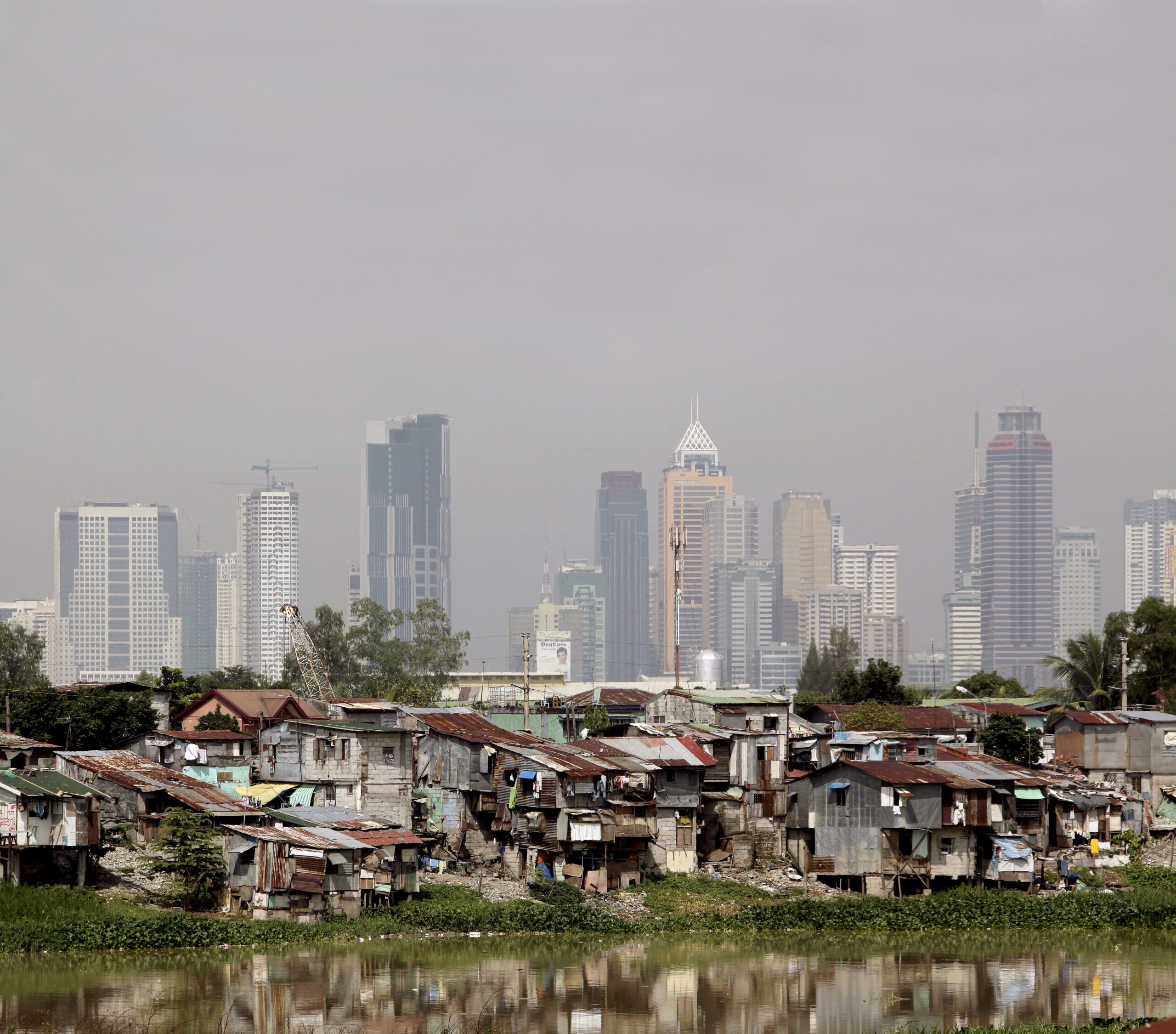
From social survey research, one can discover what terms like “poor” and “rich” mean to the people of a country, in contrast to what the terms mean to development experts. The (many) meanings that the people attach to the terms, when summarized, are called bottom-up poverty lines and richness lines. Such lines differ from the top-down definitions constructed by the experts, unless the latter made it a point to scientifically consult the general public in the first place.
For over 25 years, Social Weather Stations (SWS) has been conducting national surveys that measure, among many other bottom-up indicators of well-being, self-rated poverty and self-rated poverty thresholds in the Philippines. In the latest SWS survey of March 2011, 51% of families rated themselves as mahirap, the most common Filipino word for poor.
After (not before) rating themselves as mahirap, the poor are asked how much money the family would need for monthly home expenses in order not to feel mahirap any more. The March 2011 median of the answers of the poor in the Philippines was 9,000 pesos per month. This is not extravagant. It is US$209 at the current exchange rate of 43 pesos per dollar, i.e., about US$42 for a median family of 5 members, or US$1.40 per person per day.
AN INDICATOR OF POVERTY
Note that the median answer of the poor is what would satisfy only the poorer half of them, and not all of them. The self-rated or “aspired” poverty threshold is itself an indicator of the degree of poverty, since, for any given family size and location, it is the relatively poorer families who aspire for less. I think one-half of the median poverty threshold may be a useful benchmark for counting families in extreme poverty; if poverty is relatively equally distributed, then few will be below it.
In Filipino, the most common term for “rich” is mayaman. This word has been probed in a number of SWS surveys, through the question “How much is the minimum monthly home budget that your family would need in order to feel mayaman?” The median answer (over all the respondents, not only those who feel they are poor) has turned out to be only about three times the size of the median poverty threshold; this is a measure of the gap between the “barely rich” and the “barely poor.”
Thus, my best guess for the current bottom-up richness line in the Philippines is 27,000 pesos per month, or 324,000 pesos per year (just over US$7,500 per year), in family expenditures. Such a line is very modest by cosmopolitan standards. It would put the mayaman as families in the ninth and tenth deciles of income, i.e., the upper 20%, most of whom, obviously, are not superrich, let alone famous. They are not self-rated mayaman, but those considered mayaman by most Filipinos’ standards. It is a telling sign of general poverty in the Philippines that it takes relatively little to be perceived by most Filipinos as mayaman.
I think there are probably as many degrees of mayaman as there are of mahirap. Incomes in the Philippines are so unequally distributed that the richest 1% has at least as much income as the poorest 30%. (The phrase, at least, must be stressed since incomes from criminal and/or corrupt activities – the incomes that most deserve to be redistributed to the poor – would certainly be concealed from interviewers of the government’s income survey.) Thus, there is definitely plenty of income available for redistribution. Does the existence of a supply imply the existence of a demand for it? This question can be answered by research on Filipino values.
A HIGHLY UNEQUAL SOCIETY
One way to assess income-inequity (which is the unfairness of the income distribution) is to compare people’s perceptions of income-inequality with their ideals about them. In 2009, an SWS national survey found 71% feeling either that the structure of Philippine society today consists of: (a) “a small elite at the top, very few people in the middle, and the great mass of people at the bottom,” or (b) “a society like a pyramid, with a small elite at the top, more people in the middle, and most at the bottom.” The general Filipino perception that their society is highly unequal is quite realistic.
The same survey found 67% feeling either that the ideal Philippine society should be: (c) “a society with most people in the middle,” or (d) “many people near the top, and only a few near the bottom.” Thus, most Filipinos do aspire for an egalitarian society.
Yet, most Filipinos do not resent income differentials per se. From a survey of the early 1980s, I remember finding a strong consensus that the factors of education, work experience, talent – this applies especially to entertainment personalities and sports heroes – and even sheer luck are acceptable reasons for some persons to earn more than others.
A MORAL DUTY TO BE GENEROUS
What struck me most from that survey is the strong Filipino attitude that persons with the good fortune to be rich have a moral duty to be generous to the poor. Thus, the famed generosity of movie star Fernando Poe, Jr. and boxing champion Manny Pacquiao has endeared them to the Filipino masses. It is the reluctance of those who can afford it to share their largesse with the poor that most Filipinos will readily resent.
The challenge of the fiscal mode of redistribution – meaning taxing the rich to pay for social services like education and health for the poor – is to make the general public see a clear connection to the social generosity that Filipinos believe in. Let it be easier for taxpayers to accept that their sacrifices will make the poor better off, by eliminating wastefulness and corruption involved in government spending. Lessen, perhaps, the resistance to taxes on tobacco products and alcoholic beverages by earmarking sin-tax revenues for public health programs. In general, put lessons from research to work towards achieving a more egalitarian society.
1. These are subjective indicators; but the subjectivity pertains to the survey respondents, not to the researchers. They were measured at the national level in 1983 and 1985, semi-annually in 1986-1991, and quarterly ever since 1992. See www.sws.org.ph for the data series and pertinent technical papers.
2. Other Filipino words denote worse degrees of deprivation than mahirap.
3. It differs across the country according to the local cost of living. In Metro Manila, the highest cost area, the March 2011 median was 15,000 pesos per month. In any area, the bottom-up poverty threshold is directly related to family size.
4. In the 2009 Family Income and Expenditure Survey, the ninth decile’s average annual income was 342,000 pesos, and the tenth or richest decile’s average income was 728,000 pesos. Based on research by former national statistician, Tomas “Butch” Africa, I figure that the 10th decile consists of those with average income of 1.85 million pesos in percentile 100 and those with an average of only 602,000 pesos in percentiles 91-99. See my Philippine Daily Inquirer column “Income inequality and inequity,” 12 March 2011.
5. A fifth type: “A pyramid, except that just a few people are at the bottom,” had a very few calling; it is neither the present society nor the ideal one.
*Contact SWS: www.sws.org.ph or mahar.mangahas@sws.org.ph.