
With the sun blazing on a bright mid-October Saturday afternoon, Sr. Mariolina Cattaneo stood on the roof terrace of the main Comboni residence in East Jerusalem and pointed to the concrete separation walls. She mused about the futility of building walls–in this case an edifice built to ensure Israeli security and, ironically, utilizing Palestinian labor. The segment near the Comboni residence was completed in 2009.
“In the end, walls don’t separate,” said Cattaneo, the interim coordinator for the small community of Comboni Missionary Sisters, “they only divide.” Cattaneo believes this barrier, about 440 miles long and twice as high in some spots as the Berlin Wall, will one day be dismantled as a relic of a sad moment.
Her words hung in the air. “It’s heavy. It’s sad. It speaks of something that cannot last. A division that will not last.” But right now, the divisions are potent and all too real. As proof, there are two groups of Comboni sisters based in the greater Jerusalem area–first in Bethany, or Al-Eizariya in Arabic, on the occupied West Bank, and second in East Jerusalem, which is also part of the West Bank but is claimed by Israel.
BRIDGING WALLS
The separation wall forces the sisters to turn what should be a three-minute walk from one community to the other into an 11-mile journey by car or bus–one that, when traffic is heavy, can take up to two hours, said Sr. Cecilia Sierra, who is from Mexico. The delay is often worsened, she added, by the need to pass through a security checkpoint.
“It’s one community, but we’re divided by a wall,” said Sierra who, along with Sr. Lourdes García, also from Mexico, ministers from Al-Eizariya. But Cattaneo and the other Comboni sisters working in the Jerusalem area–there are seven in all, with five based at the residence in East Jerusalem and the two Mexican sisters based in Al-Eizariya–hope that their presence acts as a bridge in a divided land. The sisters try in small but meaningful ways to create the kind of connection symbolized by Jesus’ life, ministry and example, with a persistent belief that, as Cattaneo said, “If you build a wall, we find a solution. People always find ways to overcome walls, to overcome divisions,” she said. “The question is now how to do that, to stop people from being afraid of each other. The only thing that makes sense is to have people talk to each other.”
“After October 7, 2023, the world changed.” García said that in the midst of ongoing political and social tensions, the Combonis remain committed to nurturing hope through various ministries.
Before Hamas’ brutal Oct. 7, 2023, attacks, abductions and murders of Israeli civilians, the sisters engaged in efforts to nurture dialogue between Jewish and Palestinian Christian women, such as hosting interfaith and intercultural exchanges at the Comboni residence. But with the Gaza tragedy, everything stopped, the sisters said. They added that they are more than willing to shepherd such dialogue in the future. But for the moment, even with the shaky Gaza ceasefire, they say, continuing security concerns and wariness on both sides make that difficult.
Still, Cattaneo said, the possibility of reviving dialogue does exist, long-term. “We will in time,” she said when asked if the sisters will try. “But can we say that the war is over? There is an overall effort, but rebuilding trust requires much more time.”
GAZA WAR TRAGEDY
“We are all the sons and daughters of one God.” Cattaneo regrets not being a part of those previous moments of dialogue. She arrived from Italy soon after the war in Gaza began and said both Jews and Palestinians “were in shock, both sides.”
Sr. Lorena Sesatty, also from Mexico, recalls the earlier times fondly, saying people of different nationalities shared community life together for short-or long-term stays, emulating the international reality of the Comboni sisters, themselves–the five sisters living in the East Jerusalem residence hail from Italy, Mexico and Egypt. In the meantime, the Comboni sisters’ ministries continue despite the challenges facing the Holy Land.
Sesatty, a trained therapist, works in Bethlehem at a counseling service providing psychological support for families, couples and young people undergoing difficulties–not uncommon for residents of the West Bank. They face an economy in tatters, with many not permitted to return to jobs in Israel because they cannot renew their security permits, which are necessary for Palestinians.
“When you go into the communities,” she said, “people are traumatized.” In their ministry in the West Bank, Sierra and García encounter that pain all the time–and it is a trauma that goes back decades.
The Comboni ministry based in Al-Eizariya dates from 1966, but entered a new era in May 2011 when, after the second intifada, the Bethany community launched its mission in the village of Al-Eizariya and in the Bedouin villages of the Judean Desert, located east of Jerusalem.
The ministry “Threads of Peace,” now accompanies some 200 Jahalin Bedouin women living in 11 villages through workshops and providing tools, training and resources. The workshops help produce crafts and products, such as embroidery, sewing and soap-making, which provides welcome income for the women and their families. “It is a vital lifeline that strengthens the communities and keeps hope alive,” Sierra said.
BEDOUIN COMMUNITY
The challenges faced by the Bedouins and herder communities in the Palestinian territories occupied by Israel are considerable, according to a 2017 United Nations report, which said that as a “semi-nomadic people, Bedouins suffer the brunt of the [Israeli military] occupation, are isolated from mainstream Palestinian society, and have increasingly faced an erosion of their traditional way of life and its potential for survival.”
Among the difficulties they face, the U.N. report said that there are challenges in accessing state services or the justice system, restrictions on freedom of movement, and “forced displacement due to the construction and expansion of illegal settlements, restrictive zoning and planning regimes, land confiscation, the denial of building permits, house demolitions, and a lack of law enforcement in response to settler violence.”
The isolation and difficulties faced by the Bedouins were evident during the long day the two sisters spent at the three villages. The roads linking the Bedouin villages to main highways were rutted and uneven, challenging the durability of the sisters’ small Subaru hatchback.
It was also uncommonly hot for mid-October, and the sunlight was pounding–bright and intense. But once the sisters arrived, they were greeted warmly like family. They spent most of the time with village women on projects, such as producing Christmas cards and handmade crafts to be sold abroad as holiday gifts.
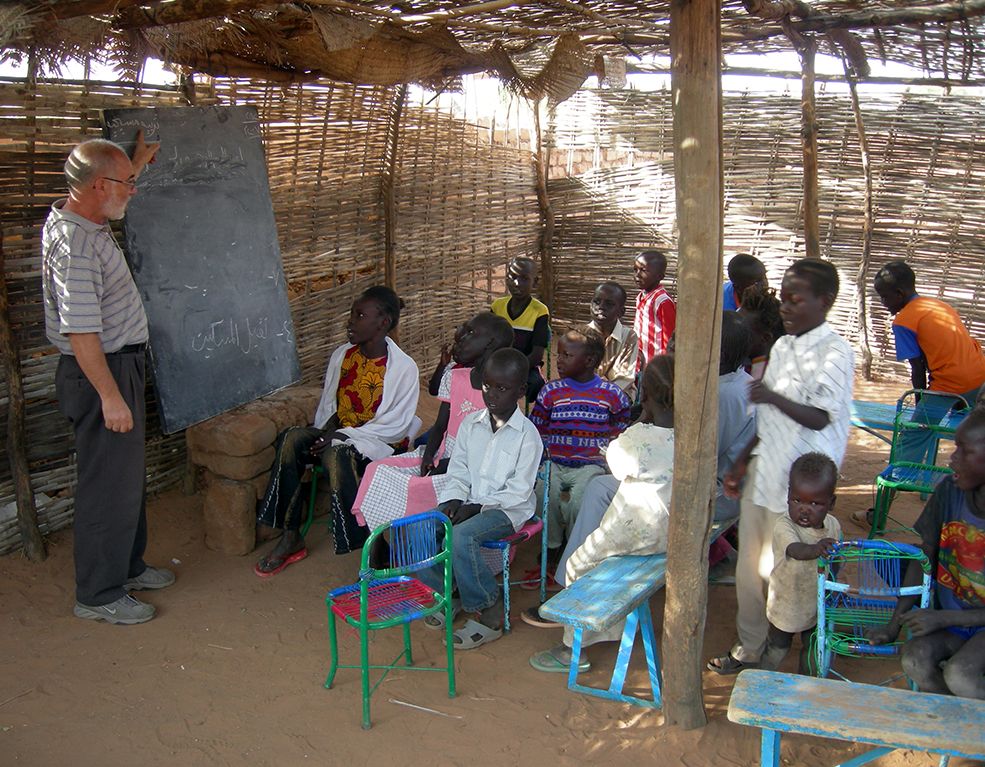
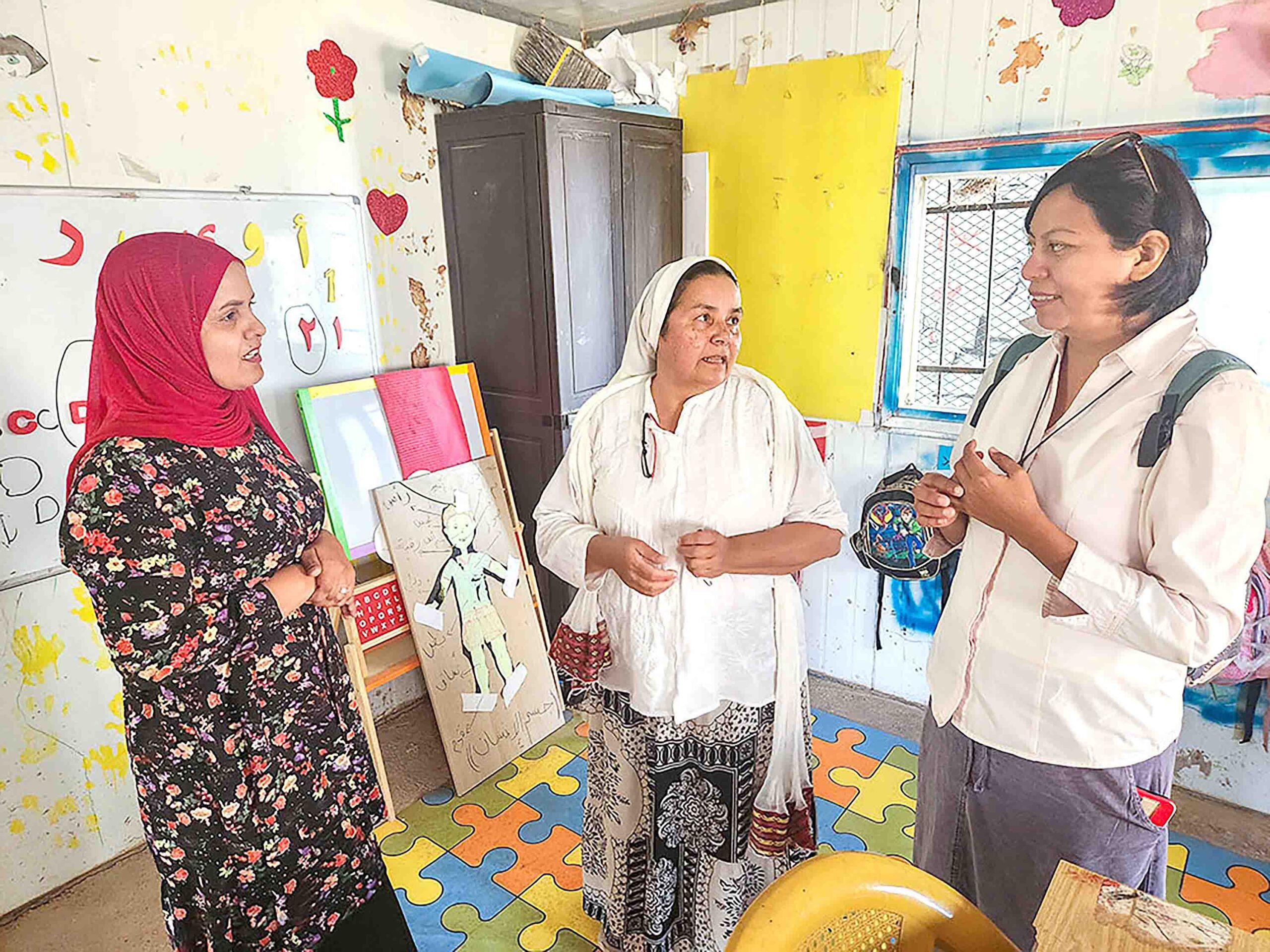
In Abu-hindi, 23 students aged 8-12 are learning the basics, and one of the teachers, who did not want to be identified, said that congregational support–including for some teacher training–is “important and good. Thanks to them, we are able to teach.”
All three of the communities visited are faced with threats by Israeli settlers who make it known that they have designs on the Bedouins’ land. (Other Bedouin villages on the West Bank have faced similar threats.) At Tabana, two Israeli fighter jets unexpectedly swooped overhead. In the third village, Hathrura, surveillance cameras set up by authorities were a common sight.
And in all three of the villages, women delighted and ebullient to work with Sierra on crafts insisted they did not want their photographs or names published in any article by a visiting journalist.
That fact pointed to ongoing divisions symbolized by the separation wall, a reality that Cattaneo, who is trained as a theologian, believes has potent biblical symbolism. She noted that in the Letter to the Ephesians (2:14), the Apostle Paul, speaking of differences between Jews and Gentiles, said of Jesus: “For he is our peace; in his flesh he has made both groups into one and has broken down the dividing wall, that is, the hostility between us.”
NATIONAL BORDERS
In that spirit, Cattaneo believes that the hatred displayed by ideologues will ultimately dissipate. And that the “normal people”–Jews and Palestinians who can share a laugh or joke on the street, as she has witnessed–will be able to create, perhaps imperfectly, a functional coexistence, if not peace. She thinks Christians–including Palestinian Christians–are in some ways best suited to help that along because part of their identity transcends and “goes beyond national borders.”
“Being Christian means you are part of something universal,” she said. For the sisters working in the Bedouin villages, it is important to be seen “as the face of the church, as points of encounter,” García said and to affirm to the Bedouin communities that “God loves them, that God is still here, that God wants them to live a better life.”
Faced with the fragile and often fraught relationships common right now in the Holy Land, people of goodwill on each side, Cattaneo said, represent “a seed of a peace process. For groups working for peace, it’s hard to break the [dominant] narrative.” What Cattaneo called a “culture of separation” is still very much a reality. Published in Global Sisters Report