
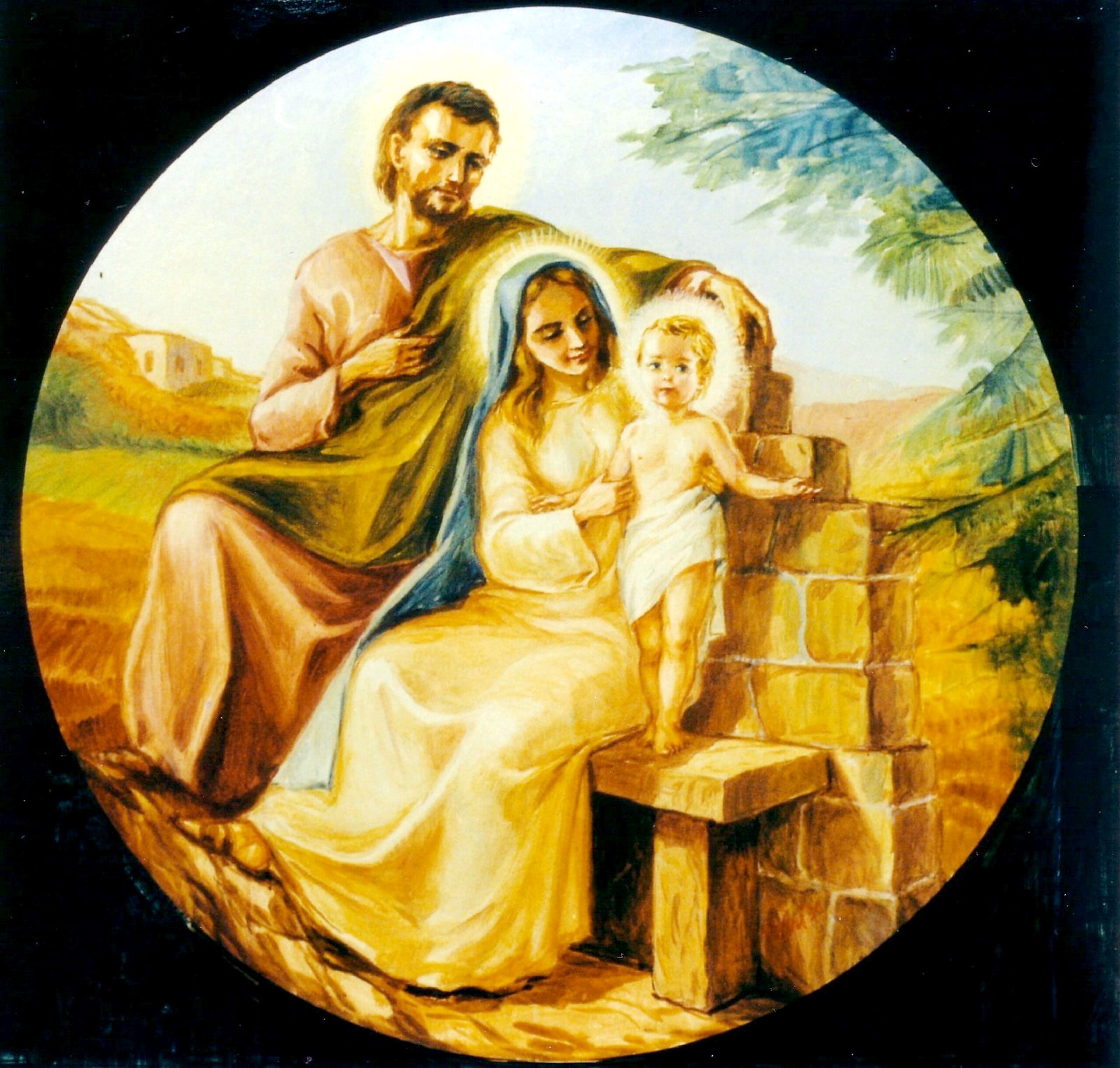
At the heart of Lent, on March 19, the Church celebrates the feast of St. Joseph, as it does for Mary during Advent, on December 8, the feast of the Immaculate Conception. Often represented as a venerable old man with a beard and white hair or sometimes bald, looking sad and reserved or with a worried countenance, bent under the weight of his fate… we could say that Joseph mirrors the mood of a certain Lenten spirit of other times!
The values that characterize him – silence, obedience and service – are also not fashionable. No wonder, therefore, that devotion to this saint has been declining over the past decades, despite the apostolic exhortation of Pope John Paul II, Redemptoris Custos (1989), considered the Magna Carta of the theology of St. Joseph. However, St. Joseph is a key figure in understanding some of the essential dimensions of Christian vocation. Here are four of them: to protect life, to practice justice, to let God be the protagonist of our lives, and to cultivate the mystical dimension.
In Hebrew, the name Joseph means “God adds, God will increase;” therefore, a call to fertility and fruitfulness, to overabundance of life! Joseph is a descendant of David, a Nazarean, a carpenter (tékton), a profession related to construction. In the Gospels, he is presented sometimes as the husband of Mary, something unusual because, generally, it was the wife who belonged to her husband. But it is also said that Mary was the wife of Joseph (Mt 1: 18) and that Jesus was the carpenter’s son (Mt 13: 55).
Joseph anticipates and lives the word of Jesus that “only one is our Father” (Mt 23: 9). He embodies, in a very special way, this divine fatherhood (cf. Eph 3: 15). He is a father without exercising carnal paternity, but he is a father indeed, because “being a father is first and foremost to be a servant of life and growth” (Pope Benedict XVI). Like the ancient patriarchs, he, too, receives communications from God through dreams. This is a sign of a unique vocation and of a particular relationship with God. Joseph is the last of the ancient patriarchs, but the first of a new progeny, of those “born, not of blood, nor of the impulse of the flesh, nor of the will of man, but of God” (Jn 1: 13). This fatherhood is a dimension of Christian vocation. We are called, like Joseph, to adopt and protect life. To be fruitful and live at the service of life, without trying to possess it – freely. Joseph teaches us how one can love without owning people – unselfishly.
Fatherhood/motherhood is an urgent value to be promoted today, in a society of ‘vagrancy’ looking for new experiences, rich of ‘prodigal sons’ but poor of ‘fathers’ and ‘mothers’. Real fatherhood/motherhood means to be able to wait patiently at home, to embrace those children when they return home, disillusioned with life and hungry for love. So often, they find their house empty, with no one waiting for them!
A MODEL OF JUSTICE
The Gospel defines Joseph as a righteous, a just man (Mt 1: 19). ‘Just’ because, being faithful, he adjusts his life to the Word of his Lord. But also because, being wise, he’s able to adjust himself to the events of life, he fits into reality. Indeed, when he realizes that Mary is pregnant, his first reaction is to comply with the law by repudiating Mary, but decides to do it in secret. Thus, he introduces a new element of prudence and wisdom. He maintains his confidence in Mary, without being swayed by suspicion. Why? Because he’s accustomed to “a long listening attendance of another word that touches and penetrates him” (Frédérique Oltra, Carmelite).
Being just, he is the “faithful and wise administrator that the Lord puts in front of his house staff” (Lk 12: 42). Joseph knows that he is a servant and has to serve well. The good will is not enough. So, the biblical text speaks of a man “wise and faithful” (Mt 24: 45). “Intelligence without fidelity and fidelity without intelligence are insufficient” to assume the responsibility which God entrusts to us” (Benedict XVI).
To practice justice is part of our vocation. To be just as Joseph was, is a justice that leads us to behave according to justice and occupy our just place in life, serving. A justice illuminated by love, “the fulfilment of the law” (Rom 13: 10), something we are lacking today. There is much talk of justice but we lack righteous men.
A MODEL OF DISCRETION
Joseph appears as a discreet man, a reserved person. Always “out of the picture,” as an author said, with a certain wit: Two sisters were browsing through their new religion book, when they saw a painting of the Virgin Mary with the Child Jesus. “Look,” said the elder sister, “this is Jesus, and this is His mother.” “And where is the father?” asked her little sister. She thought for a moment and then said: “Ah, he took the picture.”
Man of silence: the facts speak for him. Man of obedience: the gospel emphasizes his perfect fulfilment of the instructions received from the angel in a dream (Mt 1: 24). As the Song of Songs says: While sleeping, his heart remains vigilant (Song 5: 2). Forgetting himself, Joseph lives for the baby and his mother (Mt 2: 13. 19). Like John the Baptist, he believes that he must decrease in order that they may grow. His life belongs to them, fully. And so, at a certain moment, he ‘disappears’ … so as not to overshadow his son!
Each of us is called to follow this testimony: being discreet like Joseph, putting our lives at the service of Christ’s mission; learning to put ourselves aside, to withdraw behind the scenes. Neither is it easy nor obvious. We live in a society that encourages personal fulfilment and protagonism. From our childhood, we dream with our own life project. But vocation implies renouncing this human dream, as Joseph and Mary did, to embrace God’s dream, learning to be eclipsed so that God’s plan may be realized in us!
A MODEL OF CONTEMPLATION
Joseph is the saint of silence, one who never speaks. But his silence is a rich and deep one that challenges us. Why such silence? Because Joseph lives ‘inside’ the mystery! This is not a matter of words but an attitude of life. Given the unexpected and incomprehensible fact of Mary’s pregnancy, Joseph thinks to withdraw quietly. It is the word of the angel, “Do not be afraid to take Mary as your wife, because she conceived by the action of the Holy Spirit” (Mt 1: 20) that introduces Joseph into the mystery, as Gabriel did with Mary.
As the theologian Calvin Borel once said: “This word does not eliminate the mystery, does not explain what really happened… or how. This word introduces Joseph into the mystery that had already absorbed Mary. Joseph is no longer in front but inside the mystery. It is not like the people of Israel in front of the cloud in the desert, he is introduced inside the cloud, like Moses or the three apostles on Mount Tabor.” Before, he was ‘out’ of the mystery, facing it, and so doubted and feared. Now, he’s led by it, as Mary after her ‘fiat.’ Now, inside the mystery, even without understanding it, he cannot doubt it.
T
o dwell in the mystery of God is the essential aspect of every vocation. This requires a willingness to let oneself be introduced to it. Otherwise, the one called by God will remain ‘out’ and will not find motivations to live up to his vocation. He will be, at best, a good ‘employee’ or a ‘mercenary’ and, at worst, a ‘parasitic’ or ‘unfaithful servant’ (Lk 12: 46).
In conclusion, Joseph is certainly not the man portrayed by a certain iconography. Surrounded by mystery, within a family that he loved and where he felt loved, identified with his vocation of protecting the Author of Life, exercising his profession competently, he was… A HAPPY MAN, a son of his Son’s Resurrection! (Lk 20: 36).