

Christian joy” are the final words with which Pope Benedict XVI concludes his recently published book, entitled Jesus of Nazareth: Holy Week (2011). The Pope asserts that joy is a manifestation of what it means to believe in Jesus, the Risen Lord. Joy should characterize the members of the Church, the community of Jesus’ disciples. Authentic joy flows from the heart of Christianity, a faith that is founded on the merciful love of our Trinitarian God.
Christian joy is a pervasive theme in the thought of Benedict XVI, notwithstanding popular impressions to the contrary. Addressing his fellow cardinals on the day before his election, Cardinal Joseph Ratzinger prayed that the Lord would give the Church “a shepherd who will guide us to the knowledge of Christ, to His love and to true joy.” In his homily for the Mass of his inauguration as pope, Benedict XVI noted that the pastoral ministry that he – and all priests – are tasked to perform is “a service to joy, to God’s joy which longs to break into the world.”
EXPLORING JOY. Human persons are created for joy, just as certainly as we are made to breathe, to laugh and enjoy life, to feel emotions and to love. Whether one agrees or disagrees, this positive destiny of humanity reflects a Christian perspective on the goal of human life. Recall that when God completed His creation and fashioned humans, He noted that all was “very good.”
Jesus Himself affirms the dignity and value of the human through His own incarnation. The second-century theologian, Saint Irenaeus, declared that Gloria Dei, homo vivens; the glory of God is a person who is fully alive. Jesuit Pierre Teilhard de Chardin wrote: “Joy is the most infallible sign of the presence of God.” Indeed, Christian joy is a convincing sign of being fully alive with God’s life.
Joy may be described as a deep awareness of happiness or contentment. In the perspective of Saint Thomas Aquinas, joy, in the strict sense, results when a person, on the level of his higher faculties, finds peace and satisfaction in the possession of a known and loved good. Joy is experienced when a person is in harmony with nature, self, others and God. To possess joy suggests that a person comes to a place of rest and peace; joy implies that one lives in right relationships. Joy is not something imaginary; it is a concrete reality and experience.
Some have misunderstood the nature of true joy. One must not confuse joy with being in a state of perpetual emotional happiness. Joy has an affective dimension, but it is not primarily a feeling or an emotion. Rather, joy is a state of mind and an inner peace in one’s soul; it results from a personal awareness that God is within and that we enjoy the abiding presence of Jesus through the gift of the Holy Spirit. In addition, one cannot “rationalize” joy or produce it by constant human effort or hard work. Likewise, joy cannot be worked out from a theory, nor can it be constructed artificially. Joy comes as a gift of God to open-hearted persons.
True joy goes hand-in-hand with adult commitments and a willingness to shoulder daily responsibilities. Joyful persons willingly endure hardships and sacrifices which emerge from one’s state in life; they are ready to bear the burdens of others and to manifest genuine concern for their welfare. Deep joy results as a kind of “by-product” of one’s daily sacrifices of time and personal convenience. This daily availability may even expose one to misunderstanding, vulnerability, and criticism. Such “mini-martyrdoms” do not destroy one’s tranquility and the joy that comes from the Lord. By choosing life with its many vicissitudes, challenges and problems, one is choosing joy!
FRAGILITY OF JOY. In his reflection On Christian Joy (1975), Pope Paul VI noted that “joy is always imperfect, fragile and threatened.” There is no perfect happiness in this world; humanity constantly experiences the gap between the human desire for joy and the realities of daily life. Even in the midst of comfort, health and material security, “boredom, depression and sadness unhappily remain the lot of many.” Paul VI mentions problems connected with industrial progress, threats to human life, personal loneliness, isolation, and emptiness, hunger and starvation, fruitless wars and even genocide. He admits that often “there seems to be no adequate human solution” to these problems afflicting humanity. He asks: Is it realistic to speak of joy – in any sense of the word?
Paul VI sees three approaches to bring light to such situations, for Christians to be credible in the world. As a first response, people must unite to secure at least a minimum of relief for afflicted peoples. The commandment of love of neighbor must be practiced – otherwise “it would be unbecoming to speak of joy.” Secondly, the Church can patiently teach people to appreciate the simple human pleasures they possess (family members, the beauty of nature, committed love between parents, simple meals shared among friends, etc.). Thirdly, Christians are to give witness to the meaning and sanctity of life and its ultimate goal in God; this witness credibly emerges through constant prayerful reflection on God’s loving plan for humanity – coupled with compassionate service.
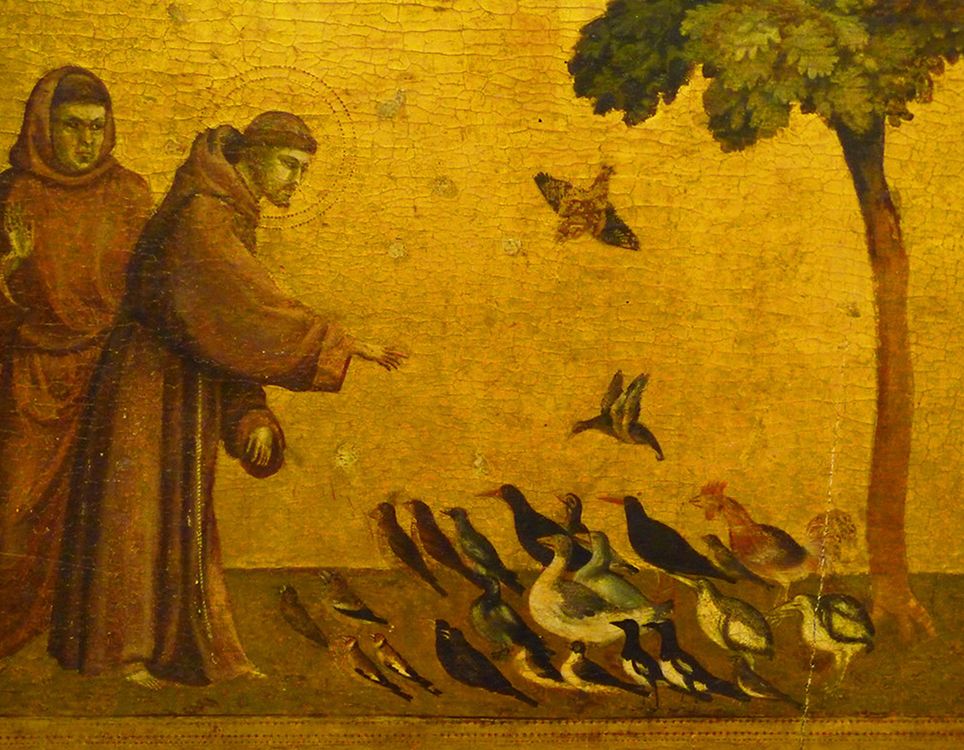
Saint Francis of Assisi provides several insights into the nature of joy in his “True and Perfect Joy” (De Vera et Perfecta Laetitia). Francis vividly narrates his personal experience when he was rejected at the door of his own monastery, since the doorkeeper thought he was a deranged stranger. Francis remained patient; he retained his inner peace and calm. Rejection did not destroy the inner joy in his heart and soul. For Francis, this was an experience of “true joy.”
Francis contrasted “true joy” with “perfect joy” (something that is unattainable, at least in this life). Indeed, the joy that we experience is not perfect; it is fragile; it is not without defects and flaws. Still, however, it does move us toward God, inner peace, and human well-being. For Francis and for us all, “true joy” is experienced when we strive to live our faith, loyal to the person of Christ and in service of others. Authentic joy is relational; it grows in the measure that we share it with others. Our joy is “true” when, even in the face of failure and rejection, we stand committed to Jesus Christ and His Gospel values.
SCRIPTURAL INSIGHTS. Paul VI asserts: “In essence, Christian joy is the supernatural sharing in the unfathomable joy, both divine and human, which is at the heart of Jesus Christ glorified.” In a word, Christian joy is intimately linked to the person of Jesus. And, the Gospels portray a fully human Jesus. He ate and drank with His many friends, leading to the accusation that He was “a glutton and a drunkard, a friend of tax collectors and sinners” (Lk. 8:34). Jesus developed deep friendships with His disciples, women, as well as the marginalized and outcasts. He compared Himself with a bridegroom, fostering an atmosphere of joy and celebration (Mt. 9:14-15). Jesus thoroughly enjoyed the presence of children (Mk. 10:13-16), even though His disciples tried to turn them away.
The Gospels abound with examples which affirm Jesus’ joyful, welcoming personality. There was joy when the deaf heard, the blind saw, and the lame walked. All rejoiced when a little boy shared his meager provisions so that Jesus could feed the thousands. Jesus joyfully forgave Zaccheus and other tax collectors and sinners. Jesus brought joy into the lives of the Samaritan woman at Jacob’s well and the woman caught in adultery. Jesus advised His disciples to be of good cheer, since He has conquered the world (Jn. 16:33). He told His followers not to worry, because their Heavenly Father takes care of the birds (Mt. 6:26) and knows their personal needs (Mt. 6:32).
The Gospel of Luke has been called the “Gospel of Joy,” since it begins and ends on a joyful note and is suffused with an aura of peace and joy; parenthetically, note that all five biblical scenes of the joyful mysteries of the rosary are drawn from the Gospel of Luke. The first word spoken by the angel Gabriel to Mary is an invitation to joy: “Rejoice, O favored one, the Lord is with you” (Lk. 1:28). When Mary visits Elizabeth, the child in her womb “leapt for joy” (Lk. 1:44). Mary’s Magnificat is a canticle of joy (Lk. 1:46-55), proclaiming God’s deeds of compassionate justice and salvation.
When Zechariah is told that his wife Elizabeth will bear a son, he also hears the angel’s words regarding John: “He will be your joy and delight and many will rejoice at his birth” (Lk. 1:14). Of all the evangelists, it is only Luke who records the visit of Elizabeth’s neighbors when John is born: “When her neighbors and relations heard that the Lord had shown her so great a kindness, they shared her joy” (Lk. 1:58).
Luke, sometimes considered “Mary’s biographer,” records the joy that surrounds Jesus’ birth. The message of the angel to the shepherds is: “Do not be afraid. Listen, I bring you news of great joy, a joy to be shared by the whole people” (Lk. 2:10). Mary treasured all these things in her heart. One can only imagine the jubilation that both Simeon and Anna experienced at the presentation in the temple; their eyes had seen God’s salvation. What relief Mary and Joseph must have felt when they found the boy Jesus safe in the temple! Once again, Mary contemplated these experiences in her heart.
In these events of the Lucan infancy narrative, one readily sees that joy and sorrow are never far from each other. In his The Gospel of Luke (8) William Barclay writes: “To be chosen by God so often means, at one and the same time, a crown of joy and a cross of sorrow. The piercing truth is that God does not choose a person for ease and comfort and selfish joy, but for a great task that will take all that head and heart and hand can bring to it.” Yet, Luke’s overriding emphasis always remains with joy, because he is speaking of sorrow that will be turned into joy. Luke concludes his Gospel with the Ascension, after which the disciples “went back to Jerusalem full of joy” (Lk. 24:52).
PASCHAL JOY. Scripture, as already shown, is replete with passages that affirm the joy that Jesus’ presence brings to the world. Yet, in the Gospels – as in all of life – sorrow and joy commingle. Undoubtedly, all human life has a paschal configuration; its pattern continually moves through death to renewed life. The paschal paradigm of human existence, universally shared by everyone, sees people struggling to move through darkness to light, through captivity to freedom, through dryness to growth, through alienation to union, through suffering and brokenness to wholeness: in a word, through sorrow to joy. Therefore, the description of joy that is probably most accurate for Christians emphasizes that all joy is paschal joy.
The Christian faith itself is, at heart, a paschal faith. It realistically recognizes that all reality has a paschal paradigm and that all human life is shaped by rhythms of life through death. A Christian faith-vision continues to find elements of this mystery hidden in the history and lives, cultures and religions of peoples everywhere. Paschal joy emerges when faith-filled people live through life’s limit situations of suffering and brokenness and then rise once again to renewed life.
The cross of Jesus is the paramount Christian symbol, because it reminds believers of the centrality of the paschal mystery in their faith-lives. Japanese theologian Kosuke Koyama notes: “If Jesus Christ of the Cross stands at the center of Christian theology, the Christian Church, the body of Christ, must be called the Church of the Cross.” In fact, all Church pastoral and missionary activity focuses on the paschal nature of life, of faith, of joy and salvation. Evangelization and ministry are always cruciform, always signed by the cross. Crux probat omnia.
Saint Paul spoke of his paschal consciousness in writing to the Corinthian community: “For I decided to know nothing among you except Jesus Christ and Him crucified” (I Cor. 2:2). To Jews who demanded miracles and Greeks who searched for wisdom, Paul proclaimed a Crucified Christ. This message was offensive to the Jews and nonsense to the Gentiles (cf. I Cor. 1:22-25). All the Gospels affirm that the Cross is the only path whereby one follows Jesus (Mt. 10:38, 16:24; Mk. 8:34; Lk. 9:23, 14:27; Jn. 10:11; 19:37) to the joyous victory of the Resurrection (Mt. 28:8-10; Mk. 16:12-15; Lk. 24:32, 45-46; Jn. 20:25; 21:7).
Pope John Paul II wrote in Ecclesia in Asia (12): “The mission of the Savior reached its culmination in the Paschal Mystery.” Thus, the proclamation of the Crucified-Risen Savior is central to Christian faith and the Church’s mission. South African missiologist David Bosch notes in Transforming Mission (585) how the Gospels consistently affirm that “in the Suffering Jesus, God embraces the suffering of the world for the sake of humanity…. Moreover, in Christ, God does not necessarily save us from suffering, but in and through it…. Christ suffers when we suffer. The pain people suffer is the pain of Christ Himself.” Christians are called to live into the mystery of the Cross and into the mystery of the Resurrection. Here, in Christ’s Paschal Mystery, one discovers the well-spring of true Christian joy. Only in close identification with the Crucified-Risen Savior does one discover the joy of paschal newness and transformation.
SECRETS OF THE SAINTS. Each day, in the Eucharist, we affirm, after having prayed the Our Father, that we “wait in joyful hope for the coming of our Savior, Jesus Christ.” Genuine “joyful hope” has not ceased to spring up in the Church for over twenty centuries, particularly in the hearts of the saints. Since their lives help illustrate the mystery of Christian joy, four representative examples are briefly presented here.
The Blessed Virgin Mary presents the Church with a model of joy. Earlier, it was noted how Luke the Evangelist, in his infancy narratives, chronicles Mary’s experiences of joy. Mary rejoiced deeply in God who accomplishes wonderful things, noting in her Magnificat that His name is holy, He is merciful and raises the lowly, He is radically faithful to His promises. The profound joys of Mary did not spare her from sharing in suffering; a sword pierced her heart (Lk. 2:35). Her fiat was profoundly tested as she, the Mother of Sorrows, stood at the foot of the Cross (Jn. 19:25-27), associated with the sacrifice of her innocent Son, the suffering Servant. Her experience of joy must have been overwhelming when she encountered her Risen Son, a joy the Church recalls as it prays: Regina Coeli, Laetare, Alleluia (Queen of Heaven, Rejoice, Alleluia)! She intimately shared the joy of the outpouring of the Spirit on Pentecost Day (Acts 1:14). In the litany of the Blessed Virgin Mary, Christians address her as the cause of our joy: Causa nostrae laetitiae.
Martyrs present a pure expression of their burning joy as they embrace the cross of Jesus with faithful love. The life of Father Maximilian Kolbe is known to many; he died in the concentration camp of Auschwitz, a place of terror, genocide, and untold human cruelty, where between 1.1 and 1.5 million people perished. In the summer of 1941 when ten men from Cell-block 14A were randomly selected to be sent to the underground starvation bunker (because someone had escaped), Father Kolbe volunteered to take the place of Franciszek Gajowniczek and died on August 14, 1941. Pope John Paul II canonized him on October 10, 1982 in Saint Peter’s Square. Franciszek Gajowniczek, wearing his striped prison uniform, was present at the moving ceremony (as was this writer who was in Rome for studies). With the purest of love, Kolbe joyfully offered himself to save an unknown fellow-prisoner.
Another attractive figure for many people, whether Christians or followers of other living faiths, is il poverello, the poor man of Assisi. Francis found joy in his discovery of holy poverty. He lived his commitments radically, often in extreme self-denial. In his person he became a transparent model of God’s glory for his fellow friars. Francis’ invitation to joy is recorded in Franciscan literature: “Be careful not to show [yourselves] externally sad and cloudy hypocrites; rather [you] should show [yourselves] jubilant in the Lord and merry and conveniently gracious.” Francis’ joy has been contagious – for over 800 years!
Saint Thérèse of Lisieux (1873-1897), who died at age 24, achieved heights of sanctity through her method of spirituality, known as “the Little Way.” Simply put, she joyfully performed her everyday actions and accepted sufferings out of pure love for God. She entrusted her littleness to God, noting: “I am only a very little soul, who can only offer very little things to our Lord.” She saw herself as one “Little Flower” among the thousands of flowers on the hillside, but still glorifying God. She proclaimed: “My vocation is love! … In the heart of the Church, who is my Mother, I will be love. So I shall be everything and so my dreams will be fulfilled!” At another point, she described her vocation as simply “to make Love loved.” Thérèse’s joyful spirit continually overflows in the Church.
EUCHARIST: BANQUET OF JOY AND SERVICE. From its beginnings, the Church has celebrated the Eucharist with great joy. As noted in a succinct description of the early Christian community (Acts 2:42-47), the believers were assiduous in prayer … in frequenting the temple, and in their homes, they broke bread and took their food with joy and simplicity of heart.” The joyous communion of Christians emerges from their experience of the Risen Lord in their midst. Thomas Aquinas wrote in his sequence which is used for the feast of Corpus Christi: “Let us form a joyful chorus, may our lauds ascend sonorous….” Pope Paul VI affirms that the Eucharist is “the sign and source of Christian joy.”
The celebration of the Eucharist is not to remain focused inwardly; it impels Christians to seek to address with sincere dedication the material and spiritual needs of the wider community. Pope John Paul II wrote some penetrating words in his document for the “Year of the Eucharist” (2004-2005). In Mane Nobiscum Domine (28) the pope noted: “I think for example of the tragedy of hunger which plagues hundreds of millions of human beings, the diseases which afflict developing countries, the loneliness of the elderly, the hardships faced by the unemployed, the struggles of immigrants…. We cannot delude ourselves: by our mutual love and, in particular, by our concern for those in need, we will be recognized as true followers of Christ (cf. Jn. 13:35; Mt. 25:31-46). This will be the criterion by which the authenticity of our Eucharistic celebrations is judged.”
In his Ecclesia de Eucharistia (20) the same pope notes that the Eucharist “increases, rather than lessens, our sense of responsibility for the world today.” He challenges Christians by quoting the poignant words of Saint John Chrysostom: “Do you wish to honor the Body of Christ? Do not ignore Him when He is naked. Do not pay Him homage in the temple clad in silk, only then to neglect Him outside where He is cold and ill-clad. He who said: ‘This is My body’ is the same who said: ‘You saw Me hungry and you gave Me no food,’ and ‘Whatever you did to the least of My brothers you did also to Me.’ … What good is it if the Eucharistic table is overloaded with golden chalices when your brother is dying of hunger? Start by satisfying his hunger and then, with what is left, you may adorn the altar, as well.” Indeed, the Eucharist which joyfully celebrates Christ’s Paschal Mystery must serve as the genesis of all pastoral service and missionary evangelization.
JOY AND EVANGELIZATION. Joy is crucial to the proclamation of the Gospel in today’s complex world; it is a solid anchor amidst all the vagaries and uncertainties of daily living. Insights into the pivotal relationship between joy and evangelization are frequently found in the writings of Pope Paul VI (1963-1978), who purposely took the name Paul since he desired to be known as a “missionary pope.” A little-known but striking fact is that Paul VI wrote two closely interrrelated apostolic exhortations during the 1975 jubilee year: Evangelii Nuntiandi (Evangelization in the Modern World: EN) and Gaudete in Domino (On Christian Joy: GD).
Paul VI constantly asserted that if the Gospel is not heard from “joyful evangelizers,” it will not be heard at all by contemporary humanity. He asserted that one main obstacle to effective mission today is the “lack of joy and hope.” He prayed that a deep commitment to evangelization would be “the great joy of our consecrated lives”; he believed that joy would enable the world of our time “to receive the Good News not from evangelizers who are dejected, discouraged, impatient or anxious, but from ministers of the Gospel whose lives glow with fervor, who have first received the joy of Christ” (EN, 80). God’s love must transform the lives of Christians, making them joy-filled heralds of the Gospel.
Successful proclamation needs evangelizers who are energized by the vision of Isaiah the prophet: “How beautiful on the mountains are the feet of one who brings good news…. The watchmen … [and] the ruins of Jerusalem … will break into shouts of joy together…. All the ends of the earth shall see the saving power of God” (Is. 52:7-10). A genuine herald of good news is one who has been transformed by a deep God-encounter; he is on fire; she is a fountain of God’s love and joy. Such a person is not dutifully fulfilling an assigned task; he radiates God’s love; she is willing “to spend and be spent’ (cf. II Cor. 12:15) to proclaim the Gospel. Such persons deeply believe and live by Jesus’ words: “I have told you this so that My own joy may be in you and your joy may be complete” (Jn. 15:11).
One who is transformed by God’s gift of joy readily initiates encounters with people, actively seeking to know them and their material and spiritual needs. He can give honest advice and encouragement to people caught in various difficulties of life. She can speak to people from the heart, offer genuine companionship, and enable people to experience God’s providential care.
Transformed by joy, he is deeply evangelical and charismatic. One may assert that “befriending in joyful solidarity” forms the heart of genuine mission; it was the primary approach of Jesus during the years of His public ministry.
CHOOSING AND CELEBRATING JOY. Quotes abound about the meaning of joy, each one expressing a particular insight. The following are among some of my favorite non-biblical quotes about joy. Blessed Abbot Columba Marmion asserts that “Joy is the echo of God’s life within us.” From an anonymous source, one hears: “A sad Christian is a bad Christian!” Robert Schuller notes: “Joy is not the absence of suffering. It is the presence of God.” For Mother Teresa, “Joy is prayer. Joy is strength. Joy is love. Joy is the net of love by which you can catch souls. She gives most who gives with joy.” An unknown author wrote: “The best argument for Christianity is joyful Christians.” And, I am challenged by the satirical comment of Nietzsche: “I might believe in the Redeemer if His followers looked more redeemed.”
These many quotes, as well as this entire presentation, speak to me in various ways. However, the central message that I continually hear is: Choose life! Choose joy! Celebrate life and its joys! I am reminded of the words from Deuteronomy (30:19): “Today I set before you life or death, blessing or curse. Choose life, then, so that you and your descendants may live in the love of Yahweh, your God.” Joy is a choice in response to God’s Spirit. Often it is a difficult choice. It is always a paschal choice. It is a choice for the light even when there is so much darkness. It is a choice for truth even in the midst of deceptions. However, I believe that once one chooses to claim the joys hidden in the midst of life’s vicissitudes, life itself becomes a celebration. Joy never denies sadness and suffering, but it transforms them into new opportunities for additional joy. Am I naïve, unrealistic, or only sentimental?
My life experience (40+ years of missionary service in the Philippines and Bangladesh) convinces me that Pope Paul VI has enunciated a fundamental truth: the truly effective missionary is a joyful evangelizer, alive in the life of the Trinity. This principle is valid for every Christian, called by baptism to be a missionary. Parents and children, teachers and farmers, priests and religious, women and men, rich and poor, we all can effectively communicate God’s message of love and salvation through our joy-filled witness of life. We must listen frequently to the admonition of Saint Paul: “Rejoice in the Lord always. I shall say it again: rejoice! Your kindness should be known to all. The Lord is near” (Gal. 4:4). Be transformed by joy! Surrender to the Lord, for He is: Jesu, Joy of Man’s Desiring!
* Fr. James H. Kroeger, M.M. is professor of theology and mission studies at Loyola School of Theology and Mother of Life Catechetical Center in Manila.