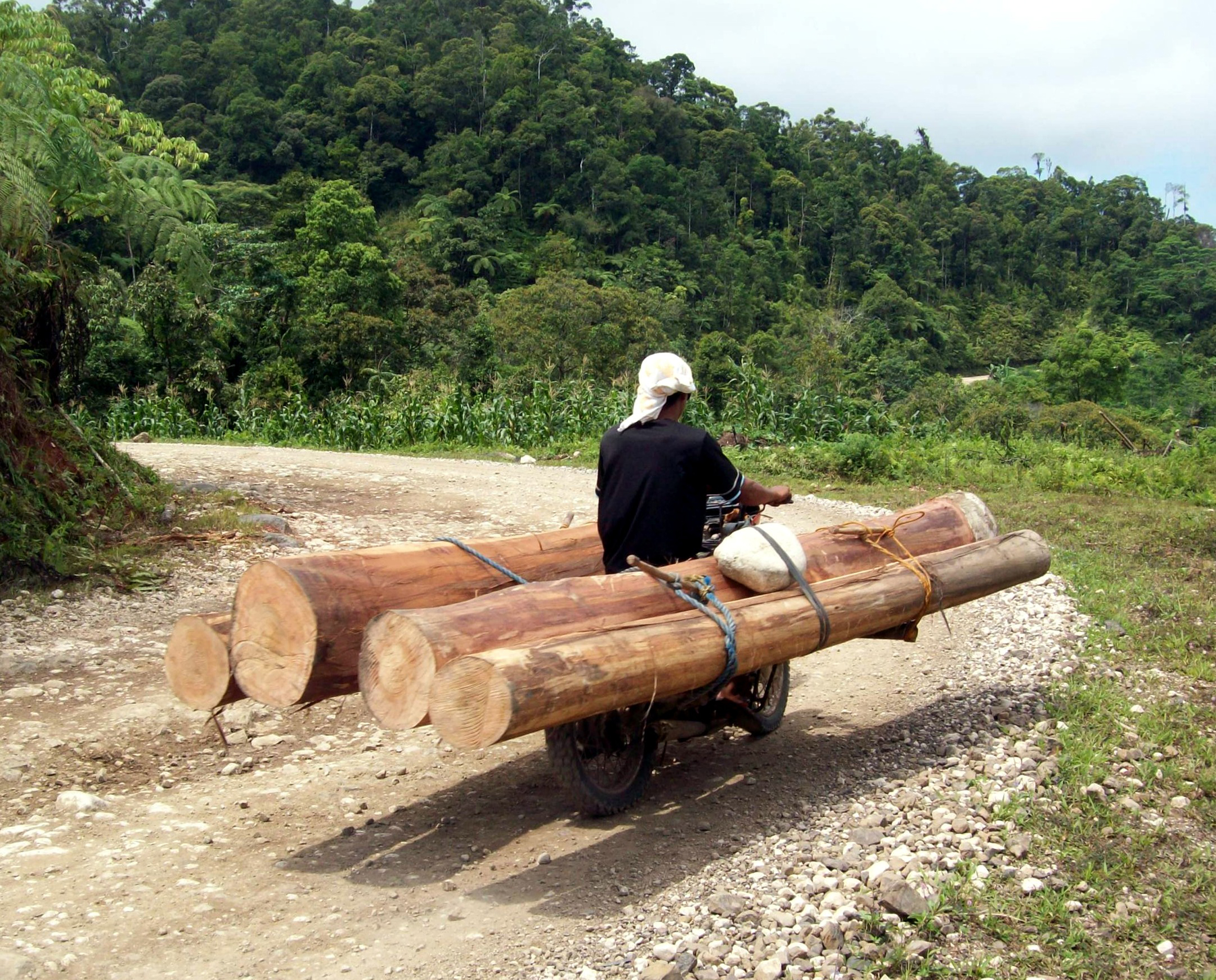
A few hundred years ago, at least 95% of the Philippines was covered by rain forest; only a few patches of open woodland and seasonal forest, mostly in Luzon, broke the expanse of moist, verdant land,” reported Dr. Lawrence R. Heaney, an American curator who holds honorary appointments at the Philippine National Museum. By the time Portuguese explorer Ferdinand Magellan rediscovered the country, scattered coastal areas had been cleared for agriculture and villages. Three hundred years later, rainforest still covered about 70% of the country.
In the 1990s, the Catholic Bishops’ Conference of the Philippines warned against an ecological debacle in the country should deforestation continued unabated. No one listened; it was business as usual. “Our natural forests have gone down from 17 million hectares in the early 1900s to less than one million hectares of primary natural forests today,” deplored Blas Tabaranza, Jr., chief operating officer of the environmental group Haribon. “The rate of destruction is very alarming; one day, the future Filipino generations may be deprived of natural resources.”
“Most of the (Philippines’) once rich forest is gone,” said the Sustainable Forest Management published by the Food and Agriculture Organization (FAO). “Forest recovery, through natural and artificial means, never coped with the destruction rate.” In February 2011, President Benigno C. Aquino III, signed Executive Order 23, which declared a moratorium on “the cutting and harvesting of timber in all natural and residual forests” throughout the country. More often than not, deforestation is often equated with calamities like landslides and flash floods. Deforestation is also associated with the persisting disappearance of wildlife resources, particularly those endemic in the country like waling-waling and Philippine eagle.
Most of the country’s forest areas are located in the uplands. In the Philippine context, the uplands are rolling to steep lands, with slopes ranging upward from 18%. About 60% of the country’s total land area of 30 million hectares is upland. Once the securely upland is devoid of its forest cover, soil erosion ensues. According to soil scientists, 58% of the country’s total land area is susceptible to erosion. “For one, the magnitude of soil erosion in cultivated sloping areas has reached an alarming proportion,” deplored Angel C. Alcala, former secretary of the Department of Environment and Natural Resources (DENR).
MORE PRECIOUS THAN GOLD
“The soil is the world’s most precious natural resource,” commented Edouard Saouma, former director-general of the UN Food and Agriculture Organization. “Yet, it is not valued as it should be. Gold, oil, minerals and precious stones command prices which have led us to treat soil as mere dirt.” Soil, aptly described as “the bridge between the inanimate and the living,” consists of weathered and decomposed bedrock, water, air, organic material formed from plant and animal decay, and thousands of different life forms, mainly micro-organisms and insects. All play their part in maintaining the complex ecology of a healthy soil. In the humid tropics, starting from a sandy base, a soil can be formed in as little as 200 years. But the process normally takes far longer. Under most conditions, soil is formed at a rate of one centimeter every 100 to 400 years, and it takes 3,000 to 12,000 years to build enough soil to form productive land.
Under normal conditions, each hectare of land loses somewhere between 0.004 and 0.05 tons of soil to erosion each year – far less than what is replaced by natural soil building processes.
On lands that have been logged or converted to crops and grazing, however, erosion typically takes away 17 tons in a year in the United States or Europe and 30 to 40 tons in Asia, Africa, or South America. On severely degraded land, the hemorrhage can rise to 100 tons in a year. “No other soil phenomenon is more destructive worldwide than soil erosion,” wrote Nyle C. Brady in his book, The Nature and Properties of Soils. “It involves losing water and plant nutrients at rates far higher than those occurring through leaching. More tragically, however, it can result in the loss of the entire soil.”
Soil erosion threatens food production, declare authors Lester R. Brown and Edward C. Wolf. In their collaborative book, Soil Erosion: Quiet Crisis in the World Economy, the two contend: “The loss of topsoil affects the ability to grow food in two ways. It reduces the inherent productivity of land, both through the loss of nutrients and degradation of the physical structure. It also increases the costs of food production.” The two authors continue: “When farmers lose topsoil, they may increase land productivity by substituting energy in the form of fertilizer. Farmers losing topsoil may experience either a loss in land productivity or a rise in costs (of inputs). But if productivity drops too low or costs rise too high, farmers are forced to abandon their land.”
WORSE THAN AN OUTSIDE ENEMY
“Soil erosion is an enemy to any nation – far worse than any outside enemy coming into a country and conquering it is difficult because it is an enemy you cannot see vividly,” warned Harold R. Watson, an American agriculturist who received a Ramon Magsaysay Award in 1985 for peace and international understanding. “It’s a slow creeping enemy that soon possesses the land.”
Another consequence of deforestation with reference to food security is water shortage. Experts claim that without vegetative cover, especially trees, the land’s water absorption capacity is greatly reduced. Water is drawn in two fundamental ways: from wells, tapping underground sources of water called aquifers; or from surface flows – that is, from lakes, rivers, and man-made reservoirs. “Water is the most precious asset on earth,” says Dr. Sandra Postel, director of the Massachusetts-based Global Water Policy Project. “It is the basis of life.”
“Water for agriculture is critical for food security,” points out Dr. Mark W. Rosegrant, a senior research fellow at the Washington-based International Food Policy Research Institute. An estimated 40% of today’s agricultural products and 60% of the world’s grain are grown on irrigated land. “Agriculture is, by far, the biggest consumer of water worldwide,” observed the Laguna-based International Rice Research Institute (IRRI). For instance, to raise a ton of rice, a thousand gallons of water is needed. Within the agricultural sector, crop production receives the greatest attention, but fish and livestock also require water. “Animals (including fish) consume a relatively small volume of water in comparison to crop consumption and can produce a very high value of output,” says Dr. Ruth Meinzen-Dick, a development sociologist who has done extensive research on water management. “As worldwide demand for animal products increases, the importance of supplying water for aquaculture and livestock is also likely to increase.”
“The link between water and food is strong,” says Brown, who is the president of Earth Policy Institute. “We drink, in one form or another, nearly 4 liters of water per day. But the food we consume each day requires at least 2,000 liters to produce, 500 times as much.”
Unless deforestation is curtailed soon, food crisis in the Philippines looms!