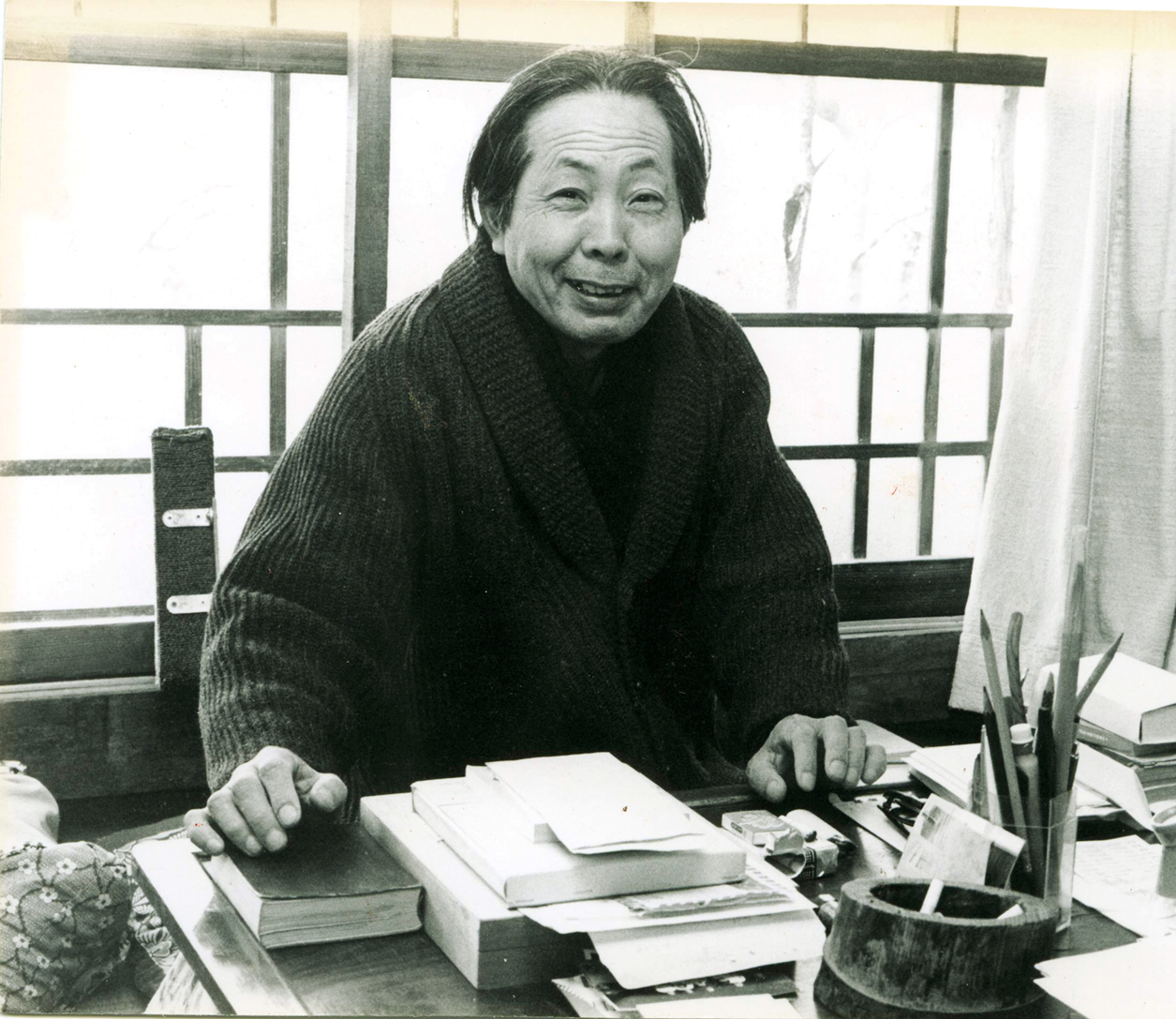
At the turn of the millennium in 2000, Mohandas Gandhi (known as Mahatma, “Great Soul”) was identified as the “Asian of the Century.” Born in 1869 to an observant Vaishnava Hindu household, Gandhi learned religiosity, integrity, compassion, and hospitality from his parents. He was educated as a lawyer in England and began his career in South Africa, where he became involved in the human rights struggle.
Returning to India in 1915, he advocated a policy of nonviolent resistance to British rule; his approach is known as Satyagraha (“Effort at Truth”) and is based on the principle of Ahimsa (“Nonviolence”) which he garnered from religions such as Hinduism, Christianity, and Islam. Suffering imprisonment for civil disobedience, his spiritual convictions were the source of great inner strength that allowed him to endure many hardships in the struggle for freedom. In 1947, he was instrumental in negotiating India’s formal independence from Britain; in January 1948 this apostle of nonviolence was assassinated by a young Hindu fanatic.
Gandhi’s achievements were not in the realm of scientific discoveries or material inventions. His contribution is to the religious and moral heritage of the world; he gave humanity “Gifts of the Spirit.” He is the “Asian of the Century” because he fought for the underprivileged, for peace and equality, for nonviolence and the empowerment of people. He lived up to the moral standards he demanded of his followers. This Asian inspired millions worldwide, including Martin Luther King Jr. and Nelson Mandela.
Gandhi’s example leads one to ask: What are the “Gifts of the Spirit,” emerging from a transformed heart, that Asia, her peoples, cultures, and religions can offer to the world? What can humanity – and the Churches – imbibe from the “Asian Spirit” to build a more humane world?
THE WISDOM OF ASIAN SOUL
The spiritual and cultural gifts that Asia possesses and offers humanity have been poetically described in Ecclesia is Asia (6); a rather lengthy citation is appropriate. “The people of Asia take pride in their religious and cultural values, such as love of silence and contemplation, simplicity, harmony, detachment, nonviolence, the spirit of hard work, discipline, frugal living, the thirst for learning and philosophical enquiry. They hold dear the values of respect for life, compassion for all beings, closeness to nature, filial piety towards parents, elders and ancestors, and a highly developed sense of community. In particular, they hold the family to be the vital source of strength, a closely-knit community with a powerful sense of solidarity.” Asian family life is one of those “Gifts of the Spirit” that can enrich humanity and the Church.
“Asian peoples are known for their spirit of religious tolerance and peaceful co-existence. Without denying the existence of bitter tensions and violent conflicts, it can still be said that Asia has often demonstrated a remarkable capacity for accommodation and a natural openness to the mutual enrichment of peoples in the midst of a plurality of religions and cultures.Moreover, despite the influence of modernization and secularization, Asian religions are showing signs of great vitality and a capacity for renewal, as seen in reform movements within various religious groups. Many people, especially the young, experience a deep thirst for spiritual values, as the rise of new religious movements clearly demonstrates.”
Seeking to describe “Asia’s gifts,” Ecclesia in Asia continues: “All of this indicates an innate spiritual insight and moral wisdom in the Asian soul, and it is the core around which a growing sense of ‘being Asian’ is built. This ‘being Asian’ is best discovered and affirmed not in confrontation and opposition, but in the spirit of complementarity and harmony. In this framework of complementarity and harmony, the Church can communicate the Gospel in a way which is faithful both to her own tradition and to the Asian soul.”
THE RICHES OF DIVERSITY
Great diversity of religions characterizes the Asian continent; this reality is to be treasured as a gift. Some selected statistics highlight the multireligious reality of Asia, home to approximately four billion people; nearly two-thirds of humanity is Asian. Both China and India each have a population of over one billion people. Eighty-five percent of all the world’s non-Christians (e.g. Muslim, Buddhist, Hindu) live in Asia. Islam numbers some 700 million followers in Asia alone; Catholics (approximately 110-115 million) represent less than 3% of all Asians.
These factual statistics should be understood positively. These Asian billions are typically people of faith; they are believers and seek to live moral lives and follow their consciences. To appreciate these multitudes, Christians should adopt the perspectives of the Asian Catholic bishops. In its documents, the FABC (Federation of Asian Bishops’ Conferences) writes with great sensitivity.
The First FABC Plenary Assembly in 1974 gave this positive orientation toward Asian cultures and religions in its final statement – expressed with poetic elegance. It asserts that building up a faith community “involves a dialogue with the great religious traditions of our peoples. In this dialogue, we accept them as significant and positive elements in the economy of God’s design of salvation. In them, we recognize and respect profound spiritual and ethical meanings and values. Over many centuries, they have been the treasury of the religious experience of our ancestors from which our contemporaries do not cease to draw light and strength. They have been (and continue to be) the authentic expression of the noblest longings of their hearts, and the home of their contemplation and prayer. They have helped to give shape to the histories and cultures of our nations. How then can we not give them reverence and honor? And how can we not acknowledge that God has drawn our peoples to Himself through them? (FABC I, 14-15).
LESSONS TO THE WORLD
In addition to a general appreciation of the Asia’s religious and cultural traditions, one can identify what can be learned from the diverse traditions of Asia. During the 1998 special “Asian Synod” held in Rome, the bishops of Malaysia, Singapore, and Brunei noted what the Church – and all humanity – can learn from the followers of other religious faiths:
Ω From Muslims, the Church can learn about prayer, fasting, and almsgiving.
Ω From Hindus, the Church can learn about meditation and contemplation.
Ω From Buddhists, the Church can learn about detachment from material goods and respect for life.
Ω From Confucianism, the Church can learn about filial piety and respect for elders.
Ω From Taoism, the Church can learn about simplicity and humility.
Ω From animists, the Church can learn about reverence and respect for nature and gratitude for harvests.
Ω The Church can learn from the rich symbolism and rites existing in their diversity of worship.
Ω The Church can, like the Asian religions, learn to be more open, receptive, sensitive, tolerant, and forgiving in the midst of a plurality of religions.
This simple narration of the “treasures of the heart” that are embodied in the numerous Asians of various living faiths already alerts one to the gifts that Asia brings to the wider humanity. And, it must be noted, these gifts are not a “one-time” offering or donation (like most material gifts); they are “Gifts of the Spirit” that continue to fruitfully enrich those open to receive them.
THE IMPORTANCE OF DIALOGUE
In the vocabulary of media and information age, one naturally considers the question of “access.” If Asia’s people, their religions and cultures possess such beautiful gifts (undoubtedly they certainly do), how can one share in these treasures? Dialogue is a primary means and way for bridging peoples, religions, and cultures; dialogue fosters authentic human relationships and is a necessary condition and instrument for mutual enrichment.
A dialogical approach, understood as fostering mutually enriching relationships across cultural-religious diversities (not mere academic discussion), is the only possible avenue to build human solidarity, given the multiracial, multilinguistic, multireligious, and multicultural reality of Asia and the wider world. Such a dialogical approach is not only an external methodology that the Church adapts; the Church herself is called to become, in the midst of diverse peoples, “a community of dialogue.” This dialogical model is, in fact, a new way of being Church – in Asia and beyond.
As a community of dialogue, the Church is never centered on itself but on the coming true of God’s dream for the world. Such an engaged Church will necessarily be transformed in the process. Such a renewed Church may at last become a Church of Asia and not simply a Church in Asia; it may then be perceived as an alien presence no longer. In this model of Church, dialogue, liberation, inculturation and proclamation are but different aspects of opening the “Gifts of the Spirit,” particularly in the Asian context.
This approach of mutual enrichment is consistent with the comprehensive view of mission and evangelization promoted by Asia’s bishops. “Mission may find its greatest urgency in Asia; it also finds in our continent a distinctive mode [dialogue]…. Mission in Asia will also seek, through dialogue, to serve the cause of unity of the peoples of Asia marked by such a diversity of beliefs, cultures, and sociopolitical structures” (FABC V, 4.1-2). This is how the Church “lives and breathes” in Asia. Here, one finds the Holy Spirit at work. This is an authentic reception and continuation of the Second Vatican Council in Asia.
INTEGRATION OF THE BEST TRADITIONS
Readers may question if these “Gifts of the Spirit” are only high-sounding words and idealistic rhetoric. Unless translated into renewed attitudes, relationships, and daily deeds of service, they may remain merely empty possibilities. This is a challenge for the Church in collaboration with all Asians of goodwill; together they need to capitalize on the cultural-religious values of Asia’s peoples to promote a true “culture of life.” An Asian “spirituality” of fraternal harmony is needed. The Church can both give and receive from the spiritual treasury of Asia’s venerable religions.
Indeed, Asia has much to contribute to authentic spirituality; some examples are: “a richly-developed prayer of the whole person in unity of body-psyche-spirit; prayer of deep interiority and immanence; traditions of asceticism and renunciation; techniques of contemplation found in the ancient eastern religions; simplified prayer forms and other popular expressions of faith and piety of those whose hearts and minds so readily turn to God in their daily lives” (FABC IIa, 24). The spiritual riches and religious values by which Asians have been nourished through centuries and millennia are precious gifts to be shared.
This integration has been promoted by Asia’s bishops who have noted: “In keeping with the economy of the Incarnation…, our local Churches should ‘take over the riches of our nations, which have been given to Christ as inheritance.’ Important above all, in our present context, are those ways of prayer which have been developed by the native genius of our peoples…. We are daily more convinced that the Spirit is leading us in our time … to an integration – profound and organic in character – of all that is best in our traditional ways of prayer and worship, into the treasury of our Christian heritage” (FABC II, 30-31).
FAITH-BASED ALLIANCES
In the reflection of Asian religious leaders, Asian values (especially interiority, harmony, and a holistic approach to life) could profitably be applied in many areas, especially those of peacemaking and environmental protection. This assertion does not imply that Asia is free from forces that generate conflicts and wars, intolerance and marginalization, and serious environmental degradation; the temptation to succumb to the “culture of death” is as strong in Asia as in other parts of the world. Yet, positive approaches can emerge.
The “Asian Way,” an approach which emphasizes the dominant value of harmony in all of life’s relationships, seeks this harmony with one’s self, fellow humans, creation, and God. From this basis, faith-based alliances can be forged to raise a collective interreligious voice to bring about peace, justice, and reconciliation. Based on faith convictions and in collaboration with believing Muslims, Buddhist, Hindus and others, the Church continues to insist on negotiated and non-military resolution of conflicts, the cessation of weapons’ manufacturing, the abolition of landmines, and the reapportionment of national budgets for authentic human development. Since war creates more problems than it ever solves, dialogue is the only just and noble path to genuine reconciliation.
Persons of faith are deeply aware that the patient and wise art of peacemaking is only promoted with God’s blessings. Thus, inspiration for committed peacemaking can be drawn from the scriptures of all Asians; together they can labor to put sentiments of peace in the hearts of those tempted to follow paths of violence, so that the prophetic vision can become a reality: “they shall beat their swords into ploughshares, and their spears into pruning hooks; nation shall not lift the sword against nation, neither shall they learn war anymore” (Is. 2:4).
A CREATION-CENTERED SPIRITUALITY
In Asia, as elsewhere, serious environmental damage continues, along with its concomitant destructive effects on human life. This challenge can be more adequately addressed collectively by peoples of diverse faiths who, because they acknowledge God as the Creator (e.g. Muslims and Christians), have a deeper sense of reverence for the whole of God’s creation. Religious leaders need to address the management of the earth’s resources; people, especially the young, need education in environmental responsibility. All need to practice stewardship over the creation that God has entrusted to humanity. All must be conscious that the protection of the environment is not only a business or technical question; it is at heart an ethical and religious issue.
Once again, the inspiration and motivation to engage environmental issues can be anchored in religious and cultural traditions (e.g. reverence for nature found in Buddhism and traditional, indigenous beliefs). Humanity is called to discern God’s very presence in the universe (e.g. Psalm 104) and co-create with Him, making the earth more fruitful for all inhabitants.
Visionary Asian leaders and religious voices need to emphasize “the urgent responsibility of believers of all faiths to open themselves to the voice of nature and its mystery, to return to primordial attachment to and respect for nature, to grow in a creation-centered spirituality, to come together in silence and love before creation, to accept that God-given order and harmony of nature, to counteract the forces of exploitation and ruin, because harmony with nature brings harmony of hearts and harmony in human relationships” (FABC Papers 75: 56).
Respect for the action of the Spirit in a Christian perspective, these many and diverse gifts give witness to the action of the befriending Holy Spirit. John Paul II has noted: “The Spirit’s presence and activity affect not only individuals but also society and history, people’s cultures and religions. Indeed, the Spirit is at the origin of the noble ideals and undertakings which benefit humanity on its journey through history” (RM 28). People of faith need a profound reverence that includes both respect for humanity in its quest for answers to the deepest questions of life, as well as respect for the profound action of the Spirit upon all humanity (cf. RM 29).
The opening section of this reflection noted that there is nearly unanimous agreement that the “Asian of the Century” (for the twentieth century) was none other than Mahatma Gandhi. One recalls many other great Asians who contributed profound “Gifts of the Spirit”: Bengali poet Rabindranath Tagore, the Dalai Lama of Tibet, Burmese leader Aung San Suu Kyi, Deng Xiaoping of China, Indira Gandhi of India, and Corazon Aquino of the Philippines. From their unique Asian perspective, they contributed to the authentic development of humanity in diverse areas of society, politics, arts, culture, and religion. Indeed, Asia has contributed much to enrich humanity.
However, a final question may be asked. Who is the “Greatest Asian of All Times”? Probably, there would also be nearly unanimous agreement on the answer: the humble carpenter’s son from Nazareth who gave humanity great and wonderful gifts of the spirit, because He Himself was the unique incarnate “Gift of the Spirit.” Humanity has been enriched in marvelous ways, because in “the fullness of time” (Gal. 4:4), God sent His only-begotten Son, Jesus the Christ, who took flesh as an Asian!
James H. Kroeger, M.M. has recently published Once Upon a Time in Asia (Manila: Claretian Publications).