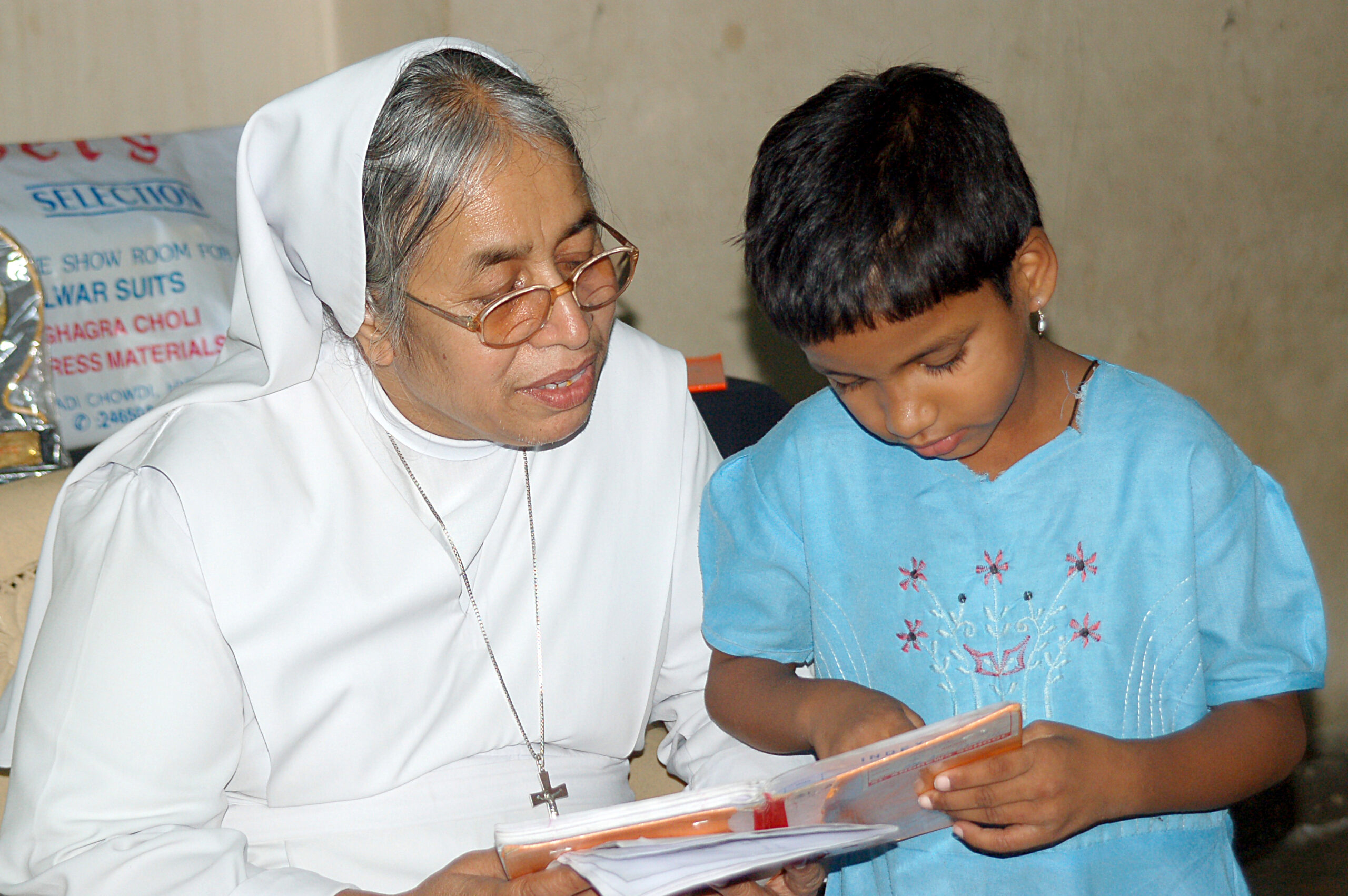


We first do a social investigation in the place where we will partner with a parish,” said Sr. Ruth S. Baguinon, executive director of SPCC. “We find out what the situation of the children is in the area” and use that as a basis for designing a program. What nuns found was often less visible than the dramatic cases that make headlines.
In Cebu, where the program began parish work in 2005, children experienced corporal punishment, verbal abuse, neglect, and a lack of parental care. Some children were left to play beside the sea or near roads without adequate supervision. Some were visibly neglected.
“It was very normal for parents to use corporal punishment as part of disciplining their children,” said Emma M. Santillan, SPCC’s program director in Cebu. Verbal abuse that humiliated children was also common. In other communities, the problem began even before a child entered school.
The sisters encountered children in major cities who had never been registered at birth. Some were already 12 years old. Their parents had given them names. But they had no birth certificates. For Baguinon, the absence of a birth certificate is not merely an administrative inconvenience. “The child’s first right is to have a name,” she said. Without a birth certificate, a child may be unable to enroll in school, losing access to another fundamental right: education. Poverty was often behind the failure to register children, she said.
The sisters were learning an important lesson: protecting children means looking beyond the most obvious forms of violence. And increasingly, by something that may not even be physically present in the room. A screen.
THE NEW PLAYGROUND
For children growing up today, the internet can be a classroom, playground, social space and source of entertainment all at once. It can also be a hunting ground for predators. In communities where SPCC works, even children in mountainous and remote areas may have access to mobile phones. Parents, meanwhile, may have limited knowledge of what their children are seeing or doing online
Children may be targeted by online groomers who gradually gain their trust. They may be persuaded to send photographs or videos of themselves without understanding the consequences. Some children may believe that showing their bodies is acceptable as long as there is no physical touching. But the material can be shared, sold, or used to humiliate them.
The sisters have encountered cases of online sexual exploitation in which even parents were involved in exploiting their own children. Baguinon described one case involving a child as young as one month old. The parent believed there was no violation because there was no physical touching.
THE LANGUAGE PROTECTION
More than 5,000 children have been reached through its programs, including book-reading activities that incorporate lessons on children’s rights. Formation sessions and children’s congresses also teach children about their rights and protection. More than 3,000 children, young people and adults have been trained as advocates nationwide.
A child who does not know what abuse is may interpret an inappropriate touch, humiliating treatment or online grooming as something she simply has to endure. A child who has learned about boundaries and rights may recognize that the behavior is wrong. And recognition can be the first step toward disclosure. That has happened repeatedly in the program.
One former participant attended a book-reading activity, later became involved in the program, underwent formation, and eventually became a child-rights advocate. Another beneficiary became interested in the advocacy work, studied social work, and eventually joined SPCC as a staff member.
A woman who initially attended a parish training because she was simply invited eventually recognized her own experience of abuse in what she was learning. She became an advocate and later joined the parish management core team. In another family, advocacy began with the mother. She attended the training, brought her children, and eventually her husband also became an advocate.
In Cebu, two young beneficiaries who received educational assistance were inspired by the advocacy and later studied social work. They now work with nongovernmental organizations serving children who need special protection. Two other former participants eventually became religious sisters in another congregation, where they remain involved in ministry for children.
The transformation is perhaps most visible when children themselves become the ones who notice that something is wrong. Baguinon remembers a 13-year-old girl who had undergone the program’s formation. A classmate told her that she was being molested at home. Instead of keeping the information to herself, the girl brought her classmate to the school principal and informed barangay officials. That is precisely what SPCC hopes its advocates will do, Baguinon said.
They become the “eyes and ears” of their communities. Some become active in barangay child protection councils. It is a significant shift in the way child protection is understood. The sisters encounter what Baguinon describes as a Filipino “culture of silence.” Families may fear stigma or embarrassment. Some victims do not want others to know what happened because they worry about bringing shame to their families.
The silence can become even more complicated when the alleged abuser is a respected church worker. Baguinon has encountered cases in which an abused person wanted a priest removed from a parish but did not want him removed from the priesthood. There have also been cases in which victims were simply told to pray. But, Baguinon asks, where is the pastoral and moral responsibility to protect them?
TRUSTED PERSON IS THE ABUSER
The Church is not immune from the problem it is trying to address. SPCC has received complaints involving church personnel, including priests and religious brothers. In one case from 2019, a parish priest sexually abused a minor who was a parish youth leader. The abuse happened repeatedly and involved grooming.
The girl did not initially understand her experience in those terms. She eventually disclosed it during a formation session where she had learned about children’s rights. She said she had fallen in love with the priest. The education she received did not erase what had happened. But it gave her a framework for understanding it and, eventually, for speaking about it.
In another case, from 2016, a priest and a religious brother were involved in the abuse of a group of girls who were youth choir members. The grooming included invitations to movies and outings before sexual touching occurred. The religious brother did not continue in religious life. The priest remained a priest, Baguinon said.
For a Church whose ministry depends heavily on trust, such cases make safeguarding more than a policy requirement. They make it a test of whether institutions are willing to protect the vulnerable even when doing so is uncomfortable.
Despite 25 years of work, getting child protection programs into parishes remains difficult. Baguinon recalls approaching a diocese in 2016 and being told that child protection was not, at that moment, a mission priority. Other parish leaders see it as an additional task in already crowded schedules. There are also financial and personnel concerns.
Of 10 parishes approached by the program, roughly six would accept the partnership. Others have said they were not ready or preferred to handle child protection themselves. Santillan has encountered similar resistance. Some parishes prioritize liturgical activities, spiritual programs or church infrastructure and beautification. Others point to government social-welfare programs.
But Santillan believes child protection should not be viewed as a choice between church priorities. “It is an essential part of the Church mission,” she said. “It is not optional.”
A DIFFERENT KIND OF FUTURE
SPCC now has partnerships with more than 100 parishes nationwide. It has also begun working more directly with dioceses and archdioceses, allowing local Church structures to eventually take ownership of the program. In Novaliches, for example, the program has been turned over to the diocese. Baguinon said it can take as long as 15 years to reach that point.
In Cebu, where parish work began in 2005, the program became an archdiocesan partner in 2020. The sisters now hope to reach more children, particularly in remote communities where awareness of child protection remains limited.
Mindanao is among the areas they hope to reach more extensively. Baguinon sees government and Church cooperation as essential to expanding the work. There are children still being beaten at home. Children being humiliated. Children being neglected. Children being groomed online. Children whose identities are not properly registered. Children who are afraid to tell anyone what has happened to them.
But there are also children learning something different. They are learning that their bodies belong to them. That humiliation is not discipline. That silence is not the only response to abuse. That they can ask for help. Twenty-five years ago, the sisters entered communities to teach children about their rights.
Today, some of the children they taught have become social workers, advocates and religious sisters. Others have become the people their communities can turn to when something goes wrong. The dangers facing children have changed. Some have become harder to see, hidden behind screens and passwords and private messages.
But the answer may still begin with something remarkably simple. Teach a child that she has a right to be safe. Then teach her that she has a voice. And make sure there is someone willing to listen when she uses it.