The Christian tradition is inherently a storytelling religion. Jesus almost never expressed propositional claims about what constitutes right belief (“orthodoxy”) and rarely spoke in a didactic form apart from instructing his followers to love God and their neighbors, including their perceived enemies.
Life is not reducible to a bullet-point list of facts and figures. Rather, life is narrative. Because human existence is inherently mysterious and the fullness of our identities and strivings is incomprehensible–even to ourselves–we tell stories to make sense of the world and to better understand ourselves and others. This is why Jesus also told stories to others about who God is and who we are called to be.
Admittedly not “of this world,” the kingdom or reign of God can only be likened to rich, complex, and engaging narratives expressed in parables and similes. The renowned New Testament scholar Amy-Jill Levine picked up on this fact in her accurate and aptly titled 2015 book about these parables, Short Stories by Jesus.
FULL MEANING
She notes that not only were the stories told by Jesus in His time effective in communicating the sensus plenior (or “fuller meaning”) of God’s reign to the original listeners, but also so effective and necessary is the storytelling form that versions of these narratives were told and retold and retold again by his followers to subsequent generations through oral tradition until they were written down in the current redacted form we find in the canonical Gospels.
And we continue to tell these stories today. Just as the origins of the Christian message and community are traced back to Jesus’ own preaching ministry, which is shaped by His storytelling, the origins of the Franciscan movement are similarly narrative in character.
From the earliest days of the experimental Franciscan way of life, friars, sisters, ecclesiastical observers, and various medieval chroniclers told striking stories about what was unfolding in the otherwise unremarkable town of Assisi in the Umbrian region of today’s Italy. The stories were necessary because what the narrators were describing exceeded what could merely be reported.
Like Christianity more broadly, the Franciscan tradition cannot be reduced to simple bullet points or easy slogans. Part of what makes that an impossible task is that St. Francis of Assisi rooted his style of Christian life in one simple, direct aim: to live the Gospel of our Lord Jesus Christ. And if the mission of the Franciscan movement is, as St. Francis would say, to “walk in the footprints of Christ,” then the means of expressing what that looks like in practice can only be genuinely conveyed in narrative form.
FRANCISCAN NARRATIVE
Likewise, when asked what “true joy” looks like, what characteristics make up the “ideal Franciscan brother,” or how his lifelong journey of conversion began, St. Francis told stories that were retold and passed down through generations. They invited hearers to place themselves within the narratives and imagine living in ways more aligned with the Gospel in everyday life.
The narrative character of the Franciscan tradition is one of the most distinctive and yet underappreciated aspects of the legacy of St. Francis of Assisi. Sure, every religious community in the Church has its favorite hagiographic stories about its congregation’s founder or earliest members.
But what typically orients and governs the charisms and spiritualities of those traditions are texts like rules of life and canonical constitutions; letters, prayers, treatises, and other writings by founders; and explicit guidebooks for spiritual practices, such as St. Ignatius Loyola’s Spiritual Exercises or St. Francis de Sales’ Introduction to the Devout Life.
For St. Francis of Assisi and those who came after him, storytelling became the primary medium for forming community and identity. It was, and remains, the case that narrative explanation of the themes and principles of the Franciscan movement is the key to understanding the enduring legibility and relevance of the tradition. In addressing topics like joy, poverty, preaching the Gospel, living in fraternity, and prayer, among others, telling a story is the Franciscan way.
In the span of two generations after St. Francis’ death in 1226, there were nearly a dozen formal biographies of the Poverello, which contained numerous stories about the saint as well as reminiscences of his own storytelling.
In 1244, the minister general at the time, Crescentius of Jesi, issued a call for the Franciscan Order to gather recollections of the life and legacy of St. Francis from early followers who identified as “we who were with him.” These narratives reveal telling insights about the character and ministry of St. Francis and the early followers from firsthand witnesses.
It should come as no surprise that one of the most well-known collections of Franciscan stories is called The Little Flowers of St. Francis, which has enjoyed widespread distribution for centuries. Dated to the mid-14th century, this popular text is a redacted Italian translation of an earlier Latin work titled The Deeds of Blessed Francis and His Brothers.
“THE LITTLE FLOWERS”
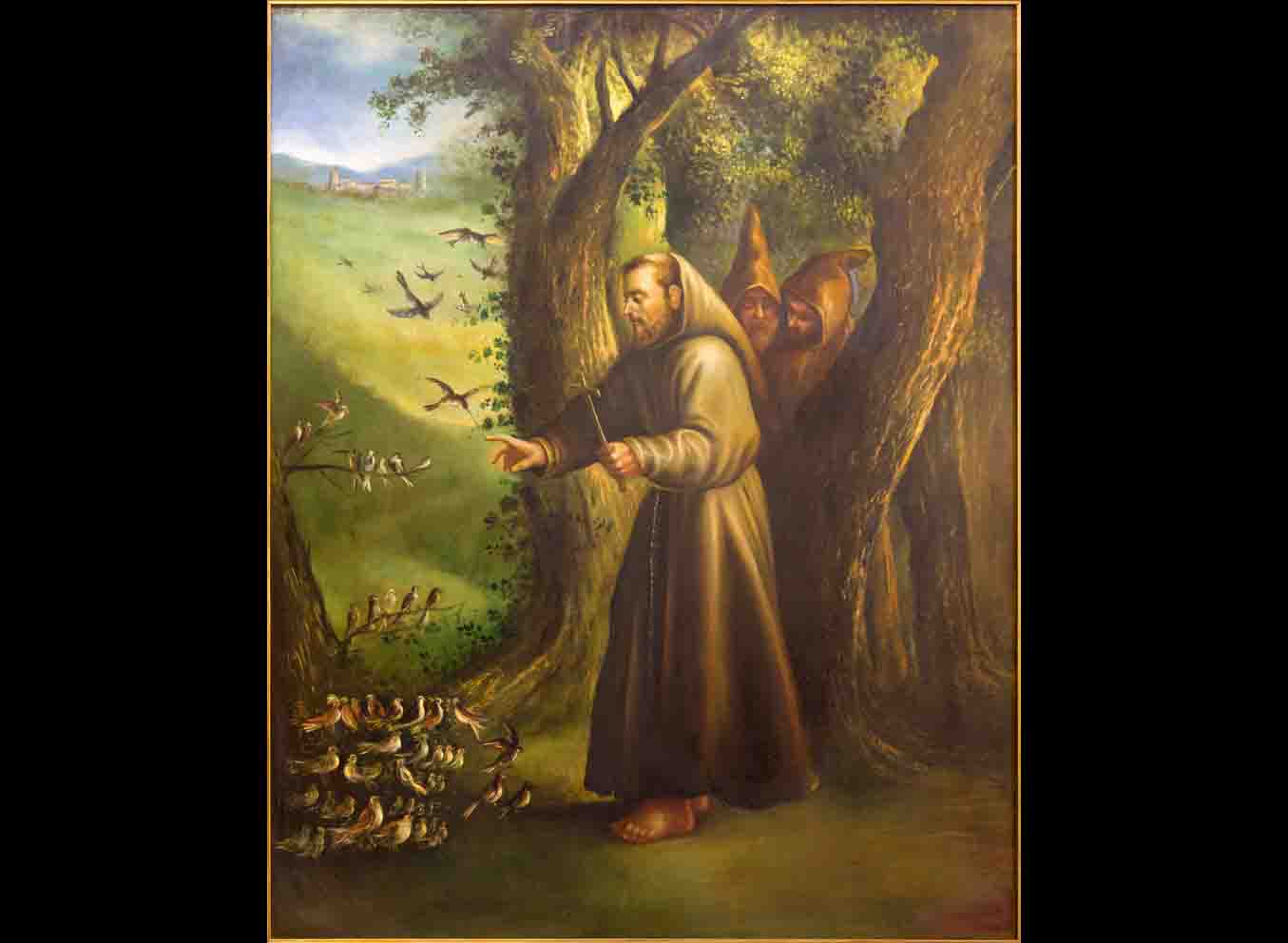
The immense popularity of The Little Flowers accounts for the widespread recognition of certain common stories about the saint, such as his preaching to the birds (Chapter 16), how he brokered peace between the villagers and the wolf of Gubbio (Chapter 21), and how he converted “three murderous robbers” to the faith and then to the Franciscan Order (Chapter 26), among others.
While admittedly a late document, the power of storytelling to convey the substance and meaning of the person and figure of Francis, as well as the spirit of the Franciscan movement, is not to be easily dismissed.
When we think of the figure of St. Francis 800 years after his death, we cannot help but recall the many stories that carry forward his personality, priorities, and legacy. These narratives relate to us who he was and, more importantly, what he stood for—living the Gospel of Jesus Christ as sincerely as possible.
We cannot understand St. Francis without immersing ourselves in the rich narrative tradition of Franciscan storytelling. To seek shortcuts in understanding or explaining St. Francis will inevitably lead to caricature and a misreading of this multidimensional and truly complex Christian figure.
What this teaches us today is that those who want easy, quick, static, and universal short answers to some of life’s most meaningful questions are going about it all wrong. To understand those things that matter most and to answer life’s most profound and impactful questions—Who am I? How should I live? What is God like? What am I meant to do?—requires storytelling.
But we should be careful to avoid the temptation to tell false tales or reframe those things we find uncomfortable. And we should attend carefully not only to the stories we tell about ourselves, but also those we tell about others, including those who have gone before us. The example of St. Francis’ storytelling and the narrative tradition that follows from him can help us to do just that. Published in National Catholic Reporter