
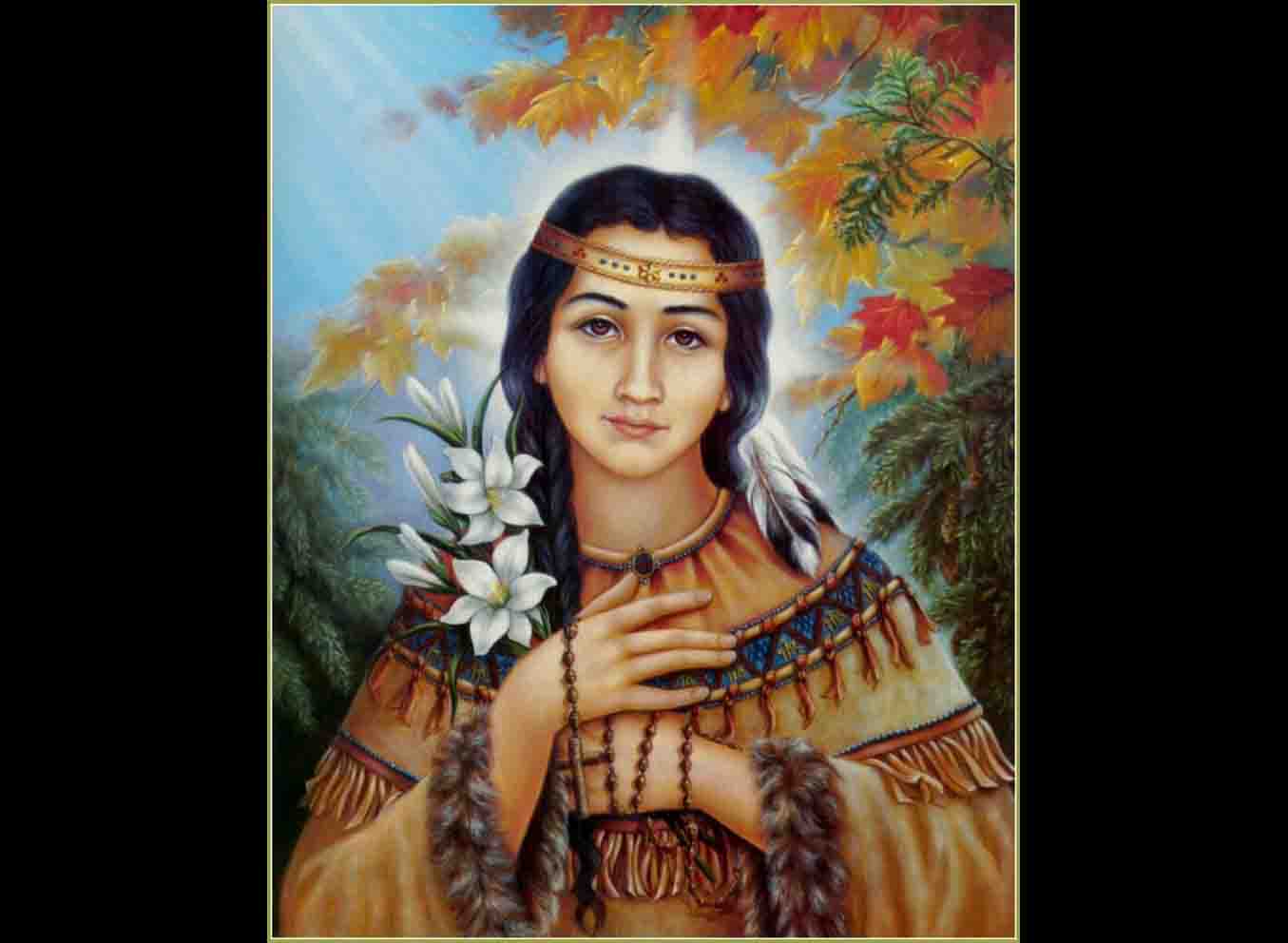
Kateri Tekakwitha, the first American native saint, was canonized by Pope Benedict XVI in 2012. Kateri (Catherine) was born to a Mohawk father and a Christian Algonquin mother. Baptized at twenty years of age, she died four years later.
Katari’s parents both died during a smallpox epidemic in 1660; the disease also greatly disfigured her face. When her uncle insisted that she marry, Kateri fled to the Saint Francis Xavier mission station near Montreal, Canada. She remained full of hope, dedicating her life to prayer, penitential practices, and care for the sick and aged, even in the midst of her own terrible sufferings.
As Pope Benedict XVI noted at the canonization mass on October 21, 2012, “Kateri impresses us by the action of grace in her life in spite of the absence of external help and by the courage of her vocation, so unusual in her culture. In her, faith and culture enrich each other!” The pope encouraged all to pray to the “Lily of the Mohawks.”
We listen to Kateri’s hopeful words: “I am not my own; I have given myself to Jesus. He must be my only love. The state of helpless poverty that may befall me if I do not marry does not frighten me….If I should become sick and unable to work, then I shall be like the Lord on the cross. He will have mercy on me and help me, I am sure.”
DYNAMIC EXAMPLE OF HOPE
Sister Thea Bowman, an African-American Franciscan (1937-1990), is a wonderful contemporary treasure of the Catholic Church in America, although she is not widely known. Born in Mississippi, the granddaughter of slaves, she was baptized a Catholic at age ten. While attending a school run by the Franciscan Sisters of Perpetual Adoration, she decided to become a nun and entered the convent at age sixteen.
Taking the religious name Sister Thea, derived from Theos (God), she strove to be a divine gift to others. Sharing her unique self as a black Catholic, she explained, “I come to my Church fully functioning. I bring myself, my black self, all that I am, all that I have, all that I hope to become … as a gift to the Church.”
Sister Thea expressed her deep-seated hope in multiple ways (words, actions, songs, and service). She drew strength and insight from the wisdom of her elders and, in particular, the resilience expressed in African-American spirituals. Her deep hope sustained her as she battled cancer, dying of bone cancer in 1990 at age fifty-two.
Explaining her preparation for death, Sister Thea simply said: “I try to hope, and I try to love, and I try to trust, and I try to get ready. I want to choose life, I want to keep going, I want to live fully until I die.” Sister Thea’s hope inspires us “to live fully” until we pass away.
SLAVE, SISTER, AND SAINT
Josephine Bakhita (1868-1947), born in Sudan, was kidnapped as a child and sold five times as a slave. Once, when she tried to escape from the ownership of a Turkish general, she was forced to endure an extensive, painful tattooing.
As Bakhita narrates, the process included “cuts on my breasts” and “some 60 cuts on the stomach and another 40 on the right arm. It is impossible to describe how I felt…, especially when salt was mixed into the wounds. For some hours, I lay in a pool of blood, and for a while, I became unconscious.”
Ultimately, Bakhita was sold to an Italian consul in Khartoum, who took her to Italy and entrusted her to the Canossian Sisters in Venice. Here, “the poor, black, ignorant slave” – her own words – received a dignified treatment; she was instructed in the faith and baptized. Bakhita eventually became a Canossian sister. She was canonized by Pope John Paul II on October 1, 2000.
Saint Bakhita is a sterling witness of faith-filled hope, noting: “Even as a slave, I never despaired, because I felt in me a mysterious force which sustained me.” The Church celebrates the International Day of Prayer and Awareness against Human Trafficking annually on February 8, the Feast of Josephine Bakhita.
These three indigenous women have manifested their profound optimism, rooted in their Christian faith. We perceive how their Christian faith and hope transformed their lives into a profound Christian witness. Whatever one’s ethnic or cultural background, faith-based hope marvelously transforms all of life!
James H. Kroeger, MM, served mission in Asia (Philippines and Bangladesh) for over five decades; recently, he authored Walking with Pope Francis (Paulines, Manila) as well as A Joyful Journey with Pope Francis and Living in Joyful Hope (Claretians, Manila).