
To Be Christian Means to Love Your Neighbor

INTRODUCTION

To be a Christian is more than to merely claim such with one’s words. It requires action and the lived experience of loving one’s neighbor. To do so is to live out the greatest commandment and to love God in concrete and practical ways.

WRITTEN BY

SHARE THE WORD

PUBLISHED ON

In May 1965, the renowned German Jesuit theologian Fr. Karl Rahner delivered an address at an event sponsored by the charity organization Katholische Fürsorgeverein für Mädchen, Frauen, und Kinder (“the Catholic Welfare Association for Girls, Women, and Children” known today as the “Social Service of Catholic Women”) in Cologne, Germany. His talk would later be published as “Reflections on the Unity of the Love of Neighbor and Love of God,” which has become one of his most well-known essays.

Despite Rahner’s notoriously dense theological writing and reliance on technical academic jargon, the central point of his argument is quite simple: The love of God and the love of neighbor are essentially united and cannot be properly understood apart from one another.

Rahner’s point is not novel, as he is quick to point out, but is grounded in numerous Scripture passages from both the synoptic Gospels and the Gospel of John, as well as in reflections throughout the New Testament letters. Rahner makes the point explicit early in his text that the truth of the Gospel is, essentially, about the love of neighbor. And this shouldn’t be surprising, given that this is the major focus of Jesus’ preaching, especially in the parables and in His earthly ministry.

I have been thinking a lot about Rahner’s 60-year-old essay since the promulgation of Pope Leo XIV’s apostolic exhortation, Dilexi te, “On Love for the Poor.”  In many ways, Leo’s exhortation and Rahner’s essay make the same simple and radical point.


SIMPLE AND RADICAL POINT

And yet, despite their directness and clarity, the reception of both texts has been mixed. I suppose that should not be surprising, given the fact that Jesus’ directness and clarity have also not often been well received over the centuries, including by self-identified Christians. This is a point that Leo makes directly early in the exhortation:

“Christians too, on a number of occasions, have succumbed to attitudes shaped by secular ideologies or political and economic approaches that lead to gross generalizations and mistaken conclusions. The fact that some dismiss or ridicule charitable works, as if they were an obsession on the part of a few and not the burning heart of the Church’s mission, convinces me of the need to go back and re-read the Gospel, lest we risk replacing it with the wisdom of this world. The poor cannot be neglected if we are to remain within the great current of the Church’s life that has its source in the Gospel and bears fruit in every time and place.”

The pope is crystal clear about this central point of Christianity, what he calls “the burning heart of the Church’s mission,” and that it centers on the love of our neighbor, especially in care for the poor and vulnerable. Those who do not recognize this fact or choose, in their own ways, to mitigate or qualify this Gospel mandate are not living authentic Christianity.

For Rahner, the love of neighbor is not merely a Christian charitable expectation, but part of what it means to be fully human. He writes: “The act of personal love for another human being is therefore the all-embracing basic act of man which gives meaning, direction, and measure to everything else.” This love for others, including and especially those outside our inner circle or chosen communities, is how we make manifest the love of God in this world.

Jesus in John’s Gospel summarizes this succinctly: “I give you a new commandment: love one another. As I have loved you, so you also should love one another.” To make clear the connection between this action in the world and our claim to Christian identity, he adds: “This is how all will know that you are my disciples, if you have love for another” (John, 13:34-35).


PSEUDO-CHRISTIANITY

It is quite troubling to see the ubiquity of a kind of pseudo-Christianity, adopted by private and public figures alike, that claims the identity and title “Christian” but rejects this most fundamental tenet of faith.  Too many people who hold political office today, especially at the federal level, throw around words like “faith” and “Christianity” and “values,” yet support dehumanizing practices that not only fail to love one’s neighbor but also cause great harm and destruction.

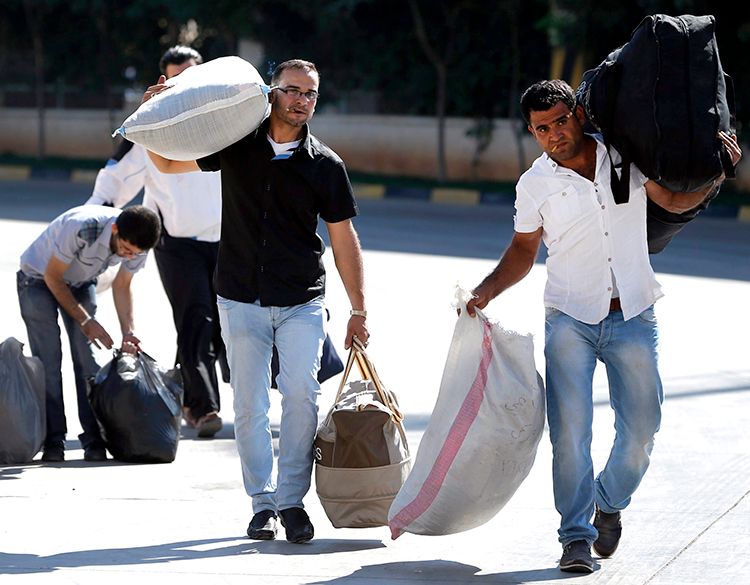
We see this in the Immigration and Customs Enforcement (ICE) raids in major cities across the United States at the behest of the current presidential administration. The brutality displayed at both the individual and collective levels is in direct opposition to what is core to Christianity: love of neighbor. It should be a scandal that the current Trump administration’s “Border Czar” Tom Homan, who speaks disparagingly of immigrants and is the unapologetic architect of the ICE cruelty, identifies as Catholic.

We see this in the persistent attacks on the federal workforce, beginning with the DOGE (Department of Government Efficiency) gutting of offices and services, and continuing through the current government shutdown, which has lasted almost a full month. Many of the departments most devastated by both of these factors are specifically oriented toward helping the poor and caring for our neighbors—one thinks of USAID or the Department of Education, to name just two.

The effects on the poor and vulnerable in our society will become even more dire on when SNAP benefits, also known as food stamps, will cease to be distributed to the hungry due to lack of funding resulting from the shutdown.

As the Catholic Church teaches clearly, the purpose of any government is to protect and promote the common good. As both Pope Francis and Pope Leo have encouraged us, we might think of this aspect of Catholic social teaching as “loving one’s neighbor” at the institutional and societal level, and there are many self-identified Christians who are willfully and actively working against the common good.


REQUIRED ACTION

To be a Christian is more than to merely claim such with one’s words. It requires embodied action and the lived experience of loving one’s neighbor. We also see this in the way LGBTQ+ communities, especially transgender and nonbinary individuals, have been targeted and attacked. The denial of their existence and experience, the refusal to accept their reality and histories, and the active effort to scapegoat and eradicate them are not only sinful but also the exact opposite of Jesus’ teaching about love of neighbor.

Famously, Jesus never placed a condition on what it means to be a neighbor. On the contrary, His most searing parables flip the hearer’s expectations upside down in order to emphasize the radicality of God’s call to love all.

If we call to mind the parable of the Good Samaritan (Luke, 10:25-37), which Francis used to frame his 2020 encyclical letter, Fratelli Tutti, “On Fraternity and Social Friendship,” we might recognize the behavior of the priest and Levite of Jesus’ story in some of today’s religious leaders who contribute to the harm, discrimination and suffering experienced by the LGBTQ+ community. In this case, those we would expect to love their neighbor because of their public religious commitment to Christianity are those first to walk on by without practicing what they profess to believe.

The key takeaway here is that being a Christian is more than merely claiming it with words. It requires embodied action and the lived experience of loving one’s neighbor. To do so is to live out the greatest commandment, to announce the inbreaking of the reign of God with our lives, and to love God in concrete and practical ways.

To ignore this divine mandate, to think that anything else matters more in Christianity than this, is to sidestep or reject the core of Jesus’ clear and simple message. For those who still have doubts about the nonnegotiable obligation to love their neighbors—all their neighbors—they should take up Leo’s advice “to go back and re-read the Gospel, lest we risk replacing it with the wisdom of this world.”  Published in National Catholic Reporter

Share Your Thoughts

All comments are moderated

From The Same Issue

The articles and content about this issue

From The Same Issue

The articles and content about this issue

From This Topic

The articles and content about this topic

From This Topic

The articles and content about this topic

Explore Other Topics

Browse other coverage

Explore Other Topics

Browse other coverage

WM SPECIAL

Presents, discusses and draws readers to reflect on issues of outmost relevance to the world today.


FRONTIERS

Very often, mission is carried out in frontier situations around the world. Those who embrace these situations have much to share.


UNITY IN DIVERSITY

Writer Ilsa Reyes will be exploring the richness of Pope Francis’s latest encyclical Fratelli Tutti with a view of helping our readers to get a grasp of the this beautiful papal document.


FRONTLINE

Puts to the front committed and inspiring people around the world who embrace humanitarian and religious causes with altruism and passion.


IN FOCUS

Focus on a given theme of interest touching upon social, economic and religious issues.


FAITH@50

As the Philippines prepares to celebrate 500 years of the arrival of Christianity. Fr. James Kroeger leads us in this series into a discovery journey of the landmark events in the history of faith in the Philippine archipelago.


INSIGHT

Aims to nurture and inspire our hearts and minds while pondering upon timely themes.


FILIPINO FOCUS

The large archipelago of the Philippines, in its richness of peoples and cultures, offers varied and challenging situations for mission.


FOLLOW ME

Reflections and vocation stories that shape up the lives of young people.


MISSION IS FUN

As humor and goodness of heart are qualities of Christian and missionary life, the new column “Mission is fun” will be publishing some anecdotes and stories that have happened in a missionary context to lighten up the spirits and trigger a smile in our faces.


LIVING COMMUNION

To help readers of World Mission live this year dedicated to Ecumenism, Interreligious Dialogue and Indigenous Peoples, Tita Puangco, writer and lecturer, shares in this section insights on the spirituality of communion.


WINDS OF THE SPIRIT

A historic view of the Catholic movements that emerged from the grassroots as an inspiration by the Holy Spirit.


BRIDGE BUILDERS

On the Year of Ecumenism, Interreligious Dialogue and Indigenous Peoples, radio host and communicator Ilsa Reyes, in her monthly column, encourages Christians and people of good will to be one with their fellow people of other sects, religions and tribes.


INTERVIEW

Questions to a personality of the Church or secular world on matters of interest that touch upon the lives of people.


WORLD TOUCH

News from the Church, the missionary world and environment that inform and form the consciences.


CARE OF THE EARTH

A feature on environmental issues that are affecting the whole world with the view of raising awareness and prompting action.


EDITORIAL

The editor gives his personal take on a given topic related to the life of the Church, the society or the world.


YOUNG HEART

A monthly column on themes touching the lives of young people in the Year of the Youth in the Philippines by radio host and communicator I lsa Reyes.


SCROLL

A missionary living in the Chinese world shares his life-experiences made up of challenges and joyous encounters with common people.


EXTRAORDINARY PEOPLE

Life stories of people who deserve to be known for who they were, what they did and what they stood for in their journey on earth.


ONE BY ONE

Stories of people whom a missionary met in his life and who were touched by Jesus in mysterious ways.


INCREASE OUR FAITH

Critical reflection from a Christian perspective on current issues.


SPECIAL MOMENTS

Comboni missionary Fr. Lorenzo Carraro makes a journey through history pinpointing landmark events that changed the course of humanity.


PROFILE

A biographical sketch of a public person, known for his/her influence in the society and in the Church, showing an exemplary commitment to the service of others.


WM REPORTS

Gives fresh, truthful, and comprehensive information on issues that are of concern to all.


LIFE'S ESSENTIALS

A column aimed at helping the readers live their Christian mission by focusing on what is essential in life and what it entails.


ASIAN FOCUS

Peoples, events, religion, culture and the society of Asia in focus.


THE SEARCHER'S PATH

The human heart always searches for greatness in God’s eyes, treading the path to the fullness of life - no matter what it takes.


INDIAN FOCUS

The subcontinent of India with its richness and variety of cultures and religions is given center stage.


AFRICAN FOCUS

The African continent in focus where Christianity is growing the fastest in the world.


JOURNEY MOMENTS

Well-known writer and public speaker, Fr. Jerry Orbos, accompanies our journey of life and faith with moments of wit and inspiration based on the biblical and human wisdom.


IGNATIUS STEPS

On the year dedicated to St. Ignatius of Loyala, Fr. Lorenzo Carraro walks us through the main themes of the Ignatian spirituality.


THE SEVEN LAST WORDS OF JESUS

Fr. John Taneburgo helps us to meditate every month on each of the Seven Last Words that Jesus uttered from the cross.


INSIDE THE HOLY BOOK

In this section, Fr. Lorenzo delves into the secrets and depths of the Sacred Scriptures opening for us the treasures of the Sacred Book so that the reader may delight in the knowledge of the Word of God.


CONVERSATIONS

Reflections about the synodal journey on a conversational and informal style to trigger reflection and sharing about the synodal path the Church has embarked upon.


VATICAN II

This 'mini-course' series provides a comprehensive exploration of Vatican II, tracing its origins, key moments, and transformative impact on the Catholic Church.


COMBONIS IN ASIA

This series offers an in-depth look at the Comboni Missionaries in Asia, highlighting their communities, apostolates, and the unique priorities guiding their mission. The articles provide insights into the challenges, triumphs, and the enduring values that define the Comboni presence in Asia.


BEYOND THE SYNOD

Following the Synod on Synodality, this series examines how dioceses, parishes, and lay organizations in the Philippines are interpreting and applying the principles of the synod, the challenges encountered, and the diverse voices shaping the synodal journey toward a renewed Church.


A TASTE OF TRADITION

This series introduces the Fathers of the Church, featuring the most prominent figures from the early centuries of Christianity. Each article explores the lives, teachings, and enduring influence of these foundational thinkers, highlighting their contributions the spiritual heritage of the Church.


A YEAR OF PRAYER

In preparation for the 2025 Jubilee Year under the theme “Pilgrims of Hope,” 2024 has been designated a Year of Prayer. World Mission (courtesy of Aleteia) publishes every month a prayer by a saint to help our readers grow in the spirit of prayer in preparation for the Jubilee Year.


OUR WORLD

In Our World, the author explores the main trends shaping contemporary humanity from a critical and ethical perspective. Each article examines pressing issues such as technological advancement, environmental crises, social justice, and shifting cultural values, inviting readers to reflect on the moral implications and challenges of our rapidly changing world.


CATHOLIC SOCIAL DOCTRINE

This series unpacks the principles of Catholic Social Doctrine, offering a deep dive into the Church's teachings on social justice, human dignity, and the common good.


HOPEFUL LIVING

Hopeful Living’ is the new section for 2026, authored by Fr. James Kroeger, who dedicated most of his missionary life to the Philippines. In this monthly contribution, he will explore various aspects of the virtue of hope. His aim is to help readers align their Christian lives more closely with a hopeful outlook.


PHILIPPINE CROSSROADS

Filipino Catholic scholar Jose Bautista writes each month about how the Philippines is at a crossroads, considering the recent flood control issues and other corruption scandals that have engulfed the nation. He incorporates the Church’s response and its moral perspective regarding these social challenges.


BIBLE QUIZ

Test your knowledge and deepen your understanding with our Bible Quiz! Each quiz offers fun and challenging questions that explore key stories, themes, and figures from both the Old and New Testaments.


Shopping Cart