
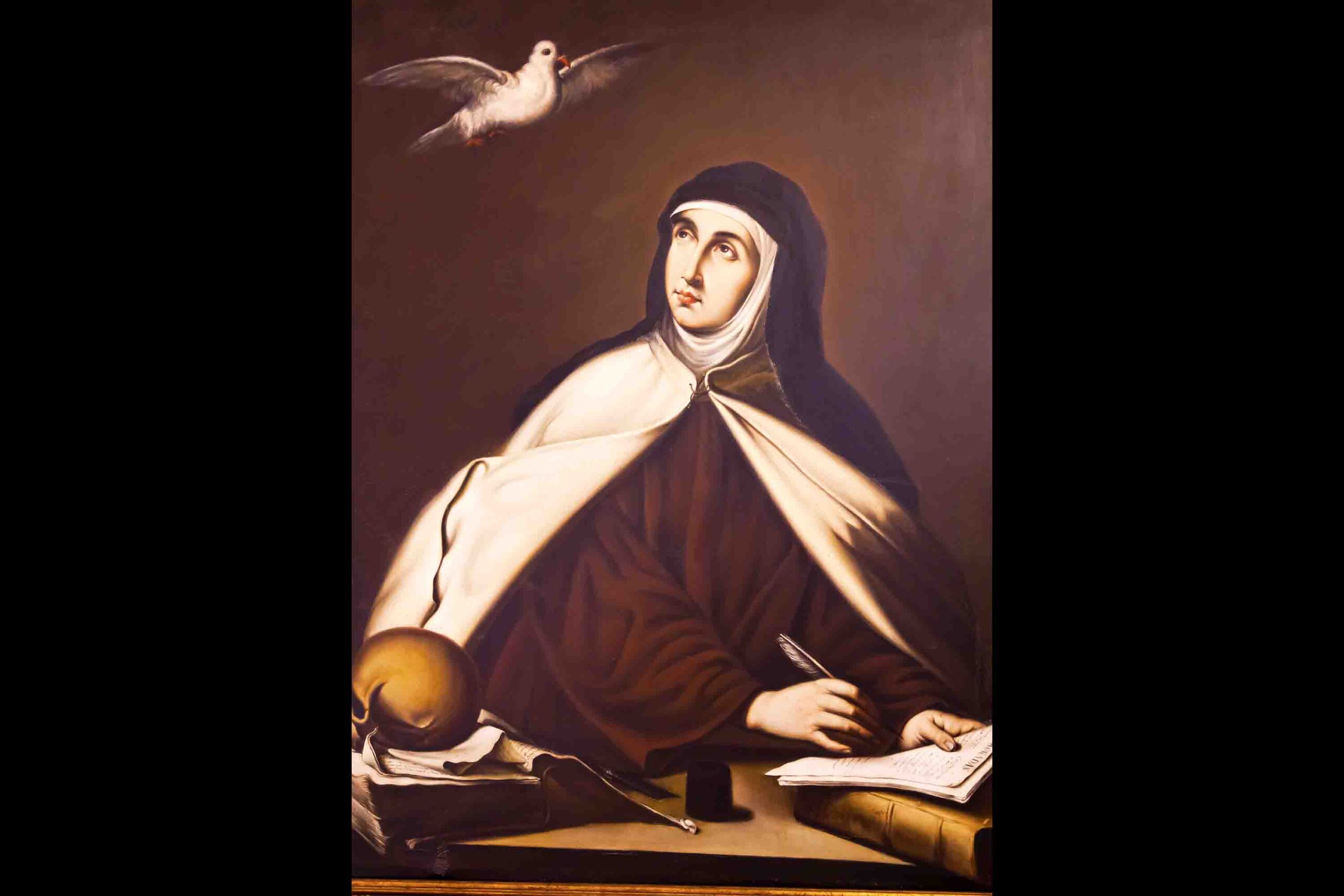
Teresa of Avila (1515-1582). This Spanish mystic and the first female Doctor of the Church authored four books; however, she is best known for her poem, Nada Te Turbe. Though quite short, its insights are profound: “Let nothing disturb you; let nothing frighten you…. One who has God finds he lacks nothing; God alone suffices.” Indeed, Solo Dios Basta!
Teresa’s view of hope emphasizes a deep, unfailing trust in God, even though one certainly must face life’s difficulties and trials. This means letting go of earthly concerns and placing complete trust in God’s divine will and loving plan. She writes: “Oh my soul! Let the will of God be done…. Serve and hope in His mercy.”
God Always Suffices. This witness to hope encountered her own challenges. Her mother died when she was only fourteen. Her father opposed her plan to become a nun, so she ran away to the Carmelite convent in Avila. Within a year, she became so ill that her father came to take her home. For three years, she was virtually paralyzed from the waist down. She reentered the convent and eventually founded seventeen convents; her feast day is October 15.
Along with her confessor-colleague, John of the Cross, she founded the Discalced (shoeless) Carmelite branch. Once, when traveling by oxcart, she was thrown into the mud; she heard an inner voice say, “This is how I treat my friends.” She responded: “Yes, my Lord, and that is why you have so few of them.”
Thérèse de Lisieux (1873-1897). In 2025, the centenary of this saint’s canonization was observed. This means one hundred years of “rose showers” from heaven. Known as the “Little Flower,” she said that she would spend her heaven doing good on earth: “When I die, I will send a shower of roses from the heavens.”
Thérèse (October 1 feast day) is the youngest Doctor of the Church. This Carmelite nun was the last child of Saints Zelie and Louis Martin. Her mother died when she was four, leaving the family of five in the care of their father, a watchmaker and man of genuine piety. Thérèse died of tuberculosis on September 30, 1897, at age twenty-four.
Flowers from Heaven. She called her approach to spirituality the “Little Way,” which is not about striving for great deeds, but rather doing everything, even small things, with great love. Thérèse, though her language in her autobiography, The Story of a Soul, is filled with beautiful metaphors, was not naïve or starry-eyed. She suffered much; yet, she completed her narrative, writing the final chapters in extremis.
Thérèse had several profound insights on hope. “I’m not relying on my own merits, as I have none, but I put my hope in Him who is goodness and holiness Himself.” “We can never have too much confidence in the good God…. As we hope in Him, so shall we receive.” “I never ceased hoping against all hope.”
Edith Stein (1891-1942). The eleventh child of Orthodox Jewish parents, Edith’s life traversed a remarkable journey: pious Jew, professed atheist, scholar-author, Catholic convert, Carmelite nun, refugee from Nazis, Gestapo prisoner, and Auschwitz martyr. She died on August 9, 1942 at the age of fifty; she was beatified (1987) and canonized (1998) by Pope John Paul II; her feast-day is August 9.
Stein’s conversion occurred in 1921 as she read the autobiography of Saint Teresa of Avila, the sixteenth-century Carmelite mystic. However, Stein never forgot her Jewish roots; she continued to accompany her mother to the synagogue. She spent the entire evening in prayer in the synagogue with her mother before entering the Carmelite monastery in 1934. When they were arrested together, Edith reassured her sister, saying: “Come, Rosa. We’re going for our people.”
Our True Hope. Canonized as “Saint Teresa Benedicta of the Cross,” Stein’s quotes on hope focus on embracing the Cross as the unique pathway to union with God. She writes: “I have been convinced of this from the first moment onward and have said with all my heart: ‘Ave, Crux, Spes Unica’ (Hail to you, Cross, our only hope).”
Stein believed that true hope only comes from trust in God’s boundless love and power to bring about peace and fulfillment. She defines hope as a process of emptying oneself of earthly attachments to receive divine fulfillment; God alone is the only source of authentic hope.
Each day at Mass after praying the Our Father we hear the priest invoke the Lord that “we may be always free from sin and safe from all distress, as we await the blessed hope and the coming of our Savior, Jesus Christ.” In faith, we seek daily to follow the saints who persevered and waited in hope for Christ’s promised return.
James H. Kroeger, MM, served mission in Asia (Philippines and Bangladesh) for over five decades; recently he authored Walking with Pope Francis (Paulines, Manila) and A Joyful Journey with Pope Francis (Claretians, Manila).