
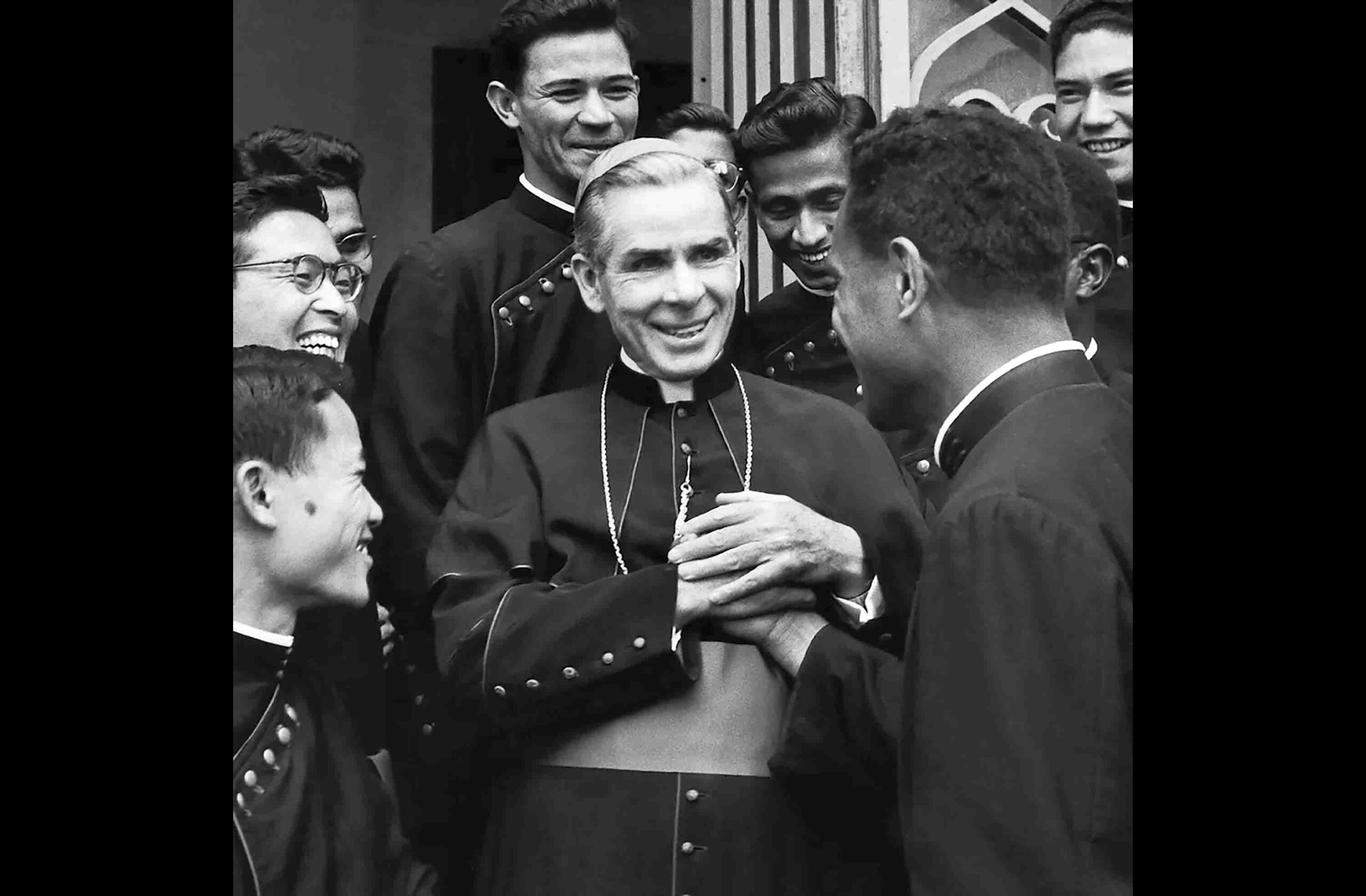
Indeed, to the 21st-century eye and ear, it is sometimes hard to recognise anything more than a great showman in this American priest. Certainly, his work on TV (a wealth of clips is available on YouTube) seems a little alien to today’s way of thinking. And yet, buried beneath the teasing, the belligerence, the extravagant robes, and the jabbing finger, there is often a message to which we can relate today. His many books offer wisdom that resonates in these times, where we see escalating violence worldwide.
This Irish American introduced TV evangelism to the world, and in the process, edged Frank Sinatra off the small screen. But it is, of course, for miracles associated with him that Pope Francis, in 2019, authorized a decree recognizing a miracle through his intercession, clearing the path for his beatification.
He was the eldest of four Sheen boys, born to Newton and Delia Sheen on May 8, 1895. Baptized Peter John, he was known as Fulton, his mother’s maiden name. At the turn of the 20th century, he was lucky to have made it out of childhood reasonably unscathed, having contracted tuberculosis as an infant. However, as the Sheens moved from El Paso, Illinois, to Peoria, we find Fulton as an altar boy in St. Mary of the Immaculate Conception Cathedral, the seat of the Diocese of Peoria.
A smart boy, he completed high school in 1913 with honors and went on to St. Viator College in Bourbonnais, Illinois, but since he had a calling, he completed his studies for the priesthood at Saint Paul Seminary in St. Paul, Minnesota.
He was ordained in his home diocese in September 1919, then commenced his studies at the Catholic University of America in Washington, DC. He subsequently moved to Belgium, where he gained a PhD in Philosophy from Leuven Catholic University in 1923 and was awarded the Cardinal Mercier Prize for the best philosophical treatise–the first American to win this prize.
The following year, he attended the International Pontifical College in Rome. He was head-hunted by both Oxford University in England and Columbia University in New York, but his bishop in Peoria appointed him as curate at a needy parish in the diocese. His stay there was brief, however, and his next step was to teach theology in England. He returned to the Catholic University of America in 1929, where he taught philosophy until 1950.
BROADCASTING WORK
He began broadcasting in 1930 with a slot on a radio show called The Catholic Hour, which boasted an audience of four million listeners at the height of its popularity. Keep in mind that this was the dawn of radio, and to attract such a large audience was a major achievement. With the advent of television, it was no surprise that Sheen made the transition in 1951, hosting a show called Life Is Worth Living. He proved to be a magnificent showman, drawing an amazing 30 million viewers.
There is no doubt that he was regarded as a star by those viewers, but Sheen’s intentions were not to seek fame for himself. In 1929, the year before he began his radio slot, he had addressed the National Catholic Educational Association, encouraging teachers to “educate for a Catholic Renaissance” in America. How better to begin a renaissance than to use the most modern of tools? Radio and then television provided Sheen with the platform to attract more people to the Church–by illustrating how it could be part of their everyday lives rather than an exclusive Sunday affair.
In 1940, he began using television in its earliest days, providing a voice-over for an Easter Mass at the Catholic University of America. During the homily, he commented: “This is the first religious television in the history of the world. Let, therefore, its first message be a tribute of thanks to God for giving the minds of our day the inspiration to unravel the secrets of the universe.” Clearly, from the outset, he understood how to use this medium for maximum effect.
In his radio programs and TV shows, Sheen never shied away from making bold political statements. He referred to World War II as a theological struggle as well as a political one. He called Adolf Hitler an Anti-Christ. One of the most newsworthy shows was broadcast in 1953, when, just days after denouncing the Soviet Union and declaring that Stalin must one day meet his judgment, the Soviet leader died of a stroke.
Millions tuned in to his Irish “Blarney”, for his occasionally (from a 21st-century perspective) outrageous comments about beautiful women, their supposed domestic roles, and for the recycled jokes that irked the comedian Milton Berle, whose own TV show was screened concurrently with Life Is Worth Living.
The comedian’s show bled viewers to the religious broadcast, and amazingly, singing star Frank Sinatra, one of the biggest names of the early 1950s, saw his own weekly show (also screened on another channel simultaneously with Sheen’s program) canceled.
MULTITASKING
Sheen was a multitasker. In 1950, he had been appointed national director of the Society for the Propagation of the Faith, and in his 16 years in the position, he raised millions of dollars for missionary work across the globe–donating some 10 million US dollars generated by his TV shows.
Throughout the 1950s and ‘60s, Sheen reached out to other Christian denominations, including the Eastern Orthodox and Protestant Churches. His comment about ecumenism in his autobiography seems well ahead of its time: “The combination of travel, the study of world religions and personal encounter with different nationalities and peoples made me see that the fullness of truth is like a complete circle of 360 degrees. Every religion in the world has a segment of that truth.”
He was appointed auxiliary bishop to New York in 1951, and in 1966 was ordained Bishop of Rochester in New York State.
One of his first tasks in his diocese was to set up the Sheen Ecumenical Housing Foundation. He honored Ash Wednesday in 1967 by donating Church property to the federal Housing and Urban Development program, to be used for African Americans.
Later that year, Bishop Sheen spoke out against the US’ activities in the Vietnam War. But that would have come as no surprise to the millions who tuned in to his program every week, and there is no denying that beyond his diocese, he was best known for his TV work.
Within months of the program first being broadcast, 15 television stations signed up to screen it. The country’s elite magazines, Time and Life, wrote numerous articles about Sheen and his program. It was almost impossible to secure tickets for the show, which was sponsored by a household appliances company.
MEDIA AWARDS
The Emmy Awards for TV shows and personalities were initiated in 1949. In 1952, Sheen received an Emmy Award for ‘Most Outstanding Personality’. As he collected it, he quipped, “I feel it is time I pay tribute to my four writers–Matthew, Mark, Luke and John.” It was his first of three Emmy Award nominations, the third of which in 1957 ended on a high note with around 30 million viewers.
From 1961 to 1968, the pioneer televangelist appeared in another show, syndicated across the country, called simply The Fulton Sheen Program. This series, like his first, attracted huge audiences, which ironically were mainly non-Catholic. An audience that was very much Catholic attended when Sheen was asked to speak at a retreat for diocesan priests.
With his knowledge of the value of contemporary media, he requested that the talks be recorded and distributed. This was the first production of a worldwide cassette tape ministry and included nine hour-long tapes. The man would have had a field day in today’s multi-media world! Sheen stood his ground on matters of principle, arguing with Cardinal Francis Spellman over public funds–a matter he never spoke of but for which he received papal support.
RESIGNATION
He resigned as Bishop of Rochester in 1969. He had authored 73 books, enjoyed a career in radio and TV and had been highly influential in the Catholic Church. Now he was given the ceremonial title of Archbishop of Newport, Wales. In October 1979, during his visit to New York, Pope John Paul II embraced a frail Sheen, saying, “You have written and spoken well of the Lord Jesus Christ. You are a loyal son of the Church.”
After his death in December 1979, Sheen was interred in the crypt of St. Patrick’s Cathedral near the deceased archbishops of New York. In 2002, the cause for his canonization was opened. In 2019 his remains were transferred to the Cathedral of St. Mary in the Diocese of Peoria. The road to beatification has been a long one, not devoid of some of the controversy Sheen himself stirred up during his lifetime. But that’s show business.