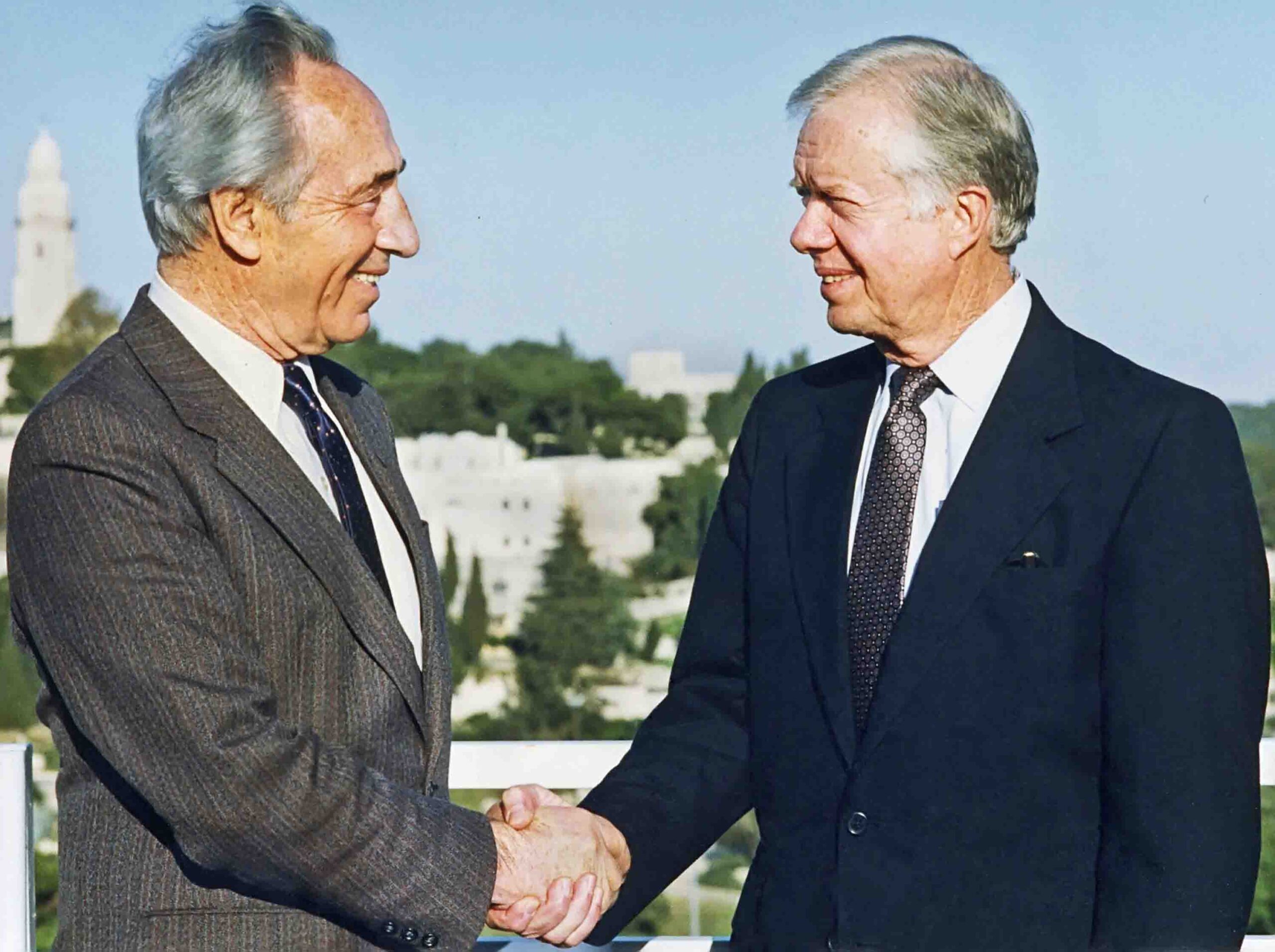
James Earl “Jimmy” Carter, the thirty-ninth president of the United States died on December 29, 2024 at the age of 100; he is remembered for his profound, lifelong message of hope. A man of sterling principle, genuine integrity, and deep religious faith, he dedicated his life to public service. He pursued causes of human rights, peace, and care for the least fortunate.
Along with his wife, Rosalynn, they built hope by founding The Carter Center; its motto and guiding principle is: Waging Peace, Fighting Disease, Building Hope. For over four decades, the center worked to advance human dignity, eradicate diseases like the Guinea worm, and promote genuine democracy around the world.
Man of Faith. Carter was awarded the Nobel Peace Prize in 2002; in his acceptance speech he expressed “hope in a growing consensus that the generally accepted goals of society are peace, freedom, human rights, environmental quality, the alleviation of suffering, and the rule of law” would advance worldwide. Carter asserted that the source of his profound hope was his deep religious faith.
Hope resounds in his “life’s motto”: “I have one life and one chance to make it count for something. I’m free to choose that something. That something–the something that I’ve chosen–is my faith. My faith demands that I do whatever I can, wherever I can, whenever I can, for as long as I can, with whatever I have, to try to make a difference.”
Barack Obama. This American president published a book in 2006 with a title drawn from his 2004 speech at the Democratic National Convention: The Audacity of Hope. The volume is filled with numerous, insightful comments on genuine hope and how to integrate this virtue into daily life. As one reads Obama’s words, it becomes clear they emerge from a lifetime of struggling to remain realistically hopeful.
“Hope is not blind optimism. It’s not ignoring the enormity of the task ahead or the roadblocks that stand in our path. It’s not sitting on the sidelines or shirking from a fight. Hope is that thing inside us that insists, despite all evidence to the contrary, that something better awaits us if we have the courage to reach for it, and to work for it, and to fight for it.”
Faith-centered Vision. “Faith doesn’t mean that you don’t have doubts…. You come to church precisely because you [are] of this world, not apart from it; rich, poor, sinner, saved, you [need] to embrace Christ precisely because you had sins to wash away.” Hopeful religious commitment does “not require me to suspend critical thinking, disengage from the battle for economic and social justice, or otherwise retreat from the world.”
Hope is essential “in the face of difficulty. The audacity of hope! In the end, that is God’s greatest gift to us…. A belief in things not seen. A belief that there are better days ahead.”
Martin Luther King. It is surprising and noteworthy that the longest quote employed by Pope Francis in his The Joy of Love (Amoris Laetitia) [AL] (2016) comes from a unique and unexpected source. Francis employs the insights of Martin Luther King, the African-American Baptist pastor and civil rights leader who was awarded the Nobel Peace Prize in 1964 and was assassinated in 1968.
Pope Francis notes how King’s insights are apropos to understanding genuine hope in all of life’s various circumstances, because he “met every kind of trial and tribulation with fraternal love” (AL, n. 118). Such an attitude gives rise to both human and spiritual hope.
Seeing with God’s Eyes. “When you come to the point that you look in the face of every man and see deep down within him what religion calls ‘the image of God,’ you begin to love him in spite of [everything]. No matter what he does, you see God’s image there” (118).
“Hate for hate only intensifies the existence of hate and evil in the universe…. Somewhere somebody must have a little sense, and that’s the strong person. The strong person is the person who can cut off the chain of hate, the chain of evil…. Somebody must have religion enough and morality enough to cut it off and inject within the very structure of the universe that strong and powerful element of love” (118). Thus, authentic hope is born!
Incarnating Hope. These three public figures have marvelously expressed their profound optimism that emerges from their Christian faith. Their examples show us how Christian faith and hope transform daily service–even in politics–into a profound Christian witness. Whether one is known publicly or is an ordinary person (parent, teacher, laborer) faith-based hope marvelously transforms all of one’s life!
James H. Kroeger, MM, served mission in Asia (Philippines and Bangladesh) for over five decades; recently he authored Walking with Pope Francis (Paulines, Manila) as well as A Joyful Journey with Pope Francis and Living in Joyful Hope (Claretians, Manila).